
BLOG POST
LED vs HPS vs CMH Grow Lights: Which Is Right for Your Grow?
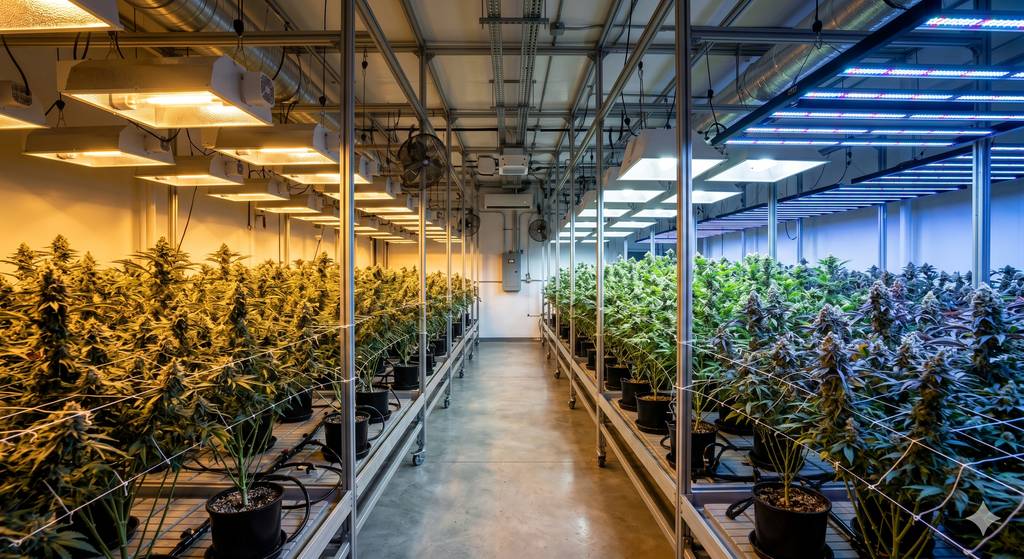
Choosing between LED, HPS, and CMH grow lights is one of the most consequential decisions a grower can make. Each technology has a distinct efficiency profile, heat footprint, spectrum output, and total cost of ownership. This guide breaks down the real-world differences so you can match the right technology to your grow operation — whether you’re running a single tent or a commercial facility.
Efficacy: Getting the Most from Every Watt
Efficacy — measured in micromoles of photosynthetically active radiation per joule (µmol/J) — determines how efficiently your fixture converts electricity into usable plant light.
- HPS: 1.4–2.1 µmol/J. Single-ended fixtures average 1.4–1.7; top double-ended HPS (Gavita, Philips) approach 2.1 µmol/J.
- CMH/LEC: 1.7–2.0 µmol/J
- LED: 2.0–3.5+ µmol/J for top-tier fixtures
Modern LED grow lights in the AGL verified directory regularly post efficacy scores above 2.8 µmol/J, representing a 35–100% improvement over equivalent HPS wattage. At scale, this difference translates directly to electricity cost savings. Browse the full directory to compare verified efficacy data across brands side-by-side.
Heat Output and HVAC Load
Heat management is often the hidden cost of a grow operation. All three technologies generate heat, but the type and location of that heat matters for canopy management and HVAC sizing.
- HPS radiates intense downward radiant heat directly onto the canopy, requiring significant air gaps and often active cooling. In poorly ventilated spaces, a 1,000W HPS can raise ambient temperatures substantially and requires a minimum hanging height to prevent light burn.
- CMH runs cooler than HPS due to better efficacy, but still generates substantial radiant heat. Sealed reflectors with integrated ducting are commonly used to control the heat signature.
- LED converts more input power to light, producing less heat per photon delivered. Heat is dissipated through heatsinks and remote drivers rather than radiated onto plants. Many LED fixtures can safely run closer to the canopy as a result.
For tents and sealed rooms, lower heat loads from LEDs can reduce or eliminate the need for dedicated cooling equipment — a significant capital and operating cost reduction.
Spectrum: What the Plants Actually See
HPS Spectrum
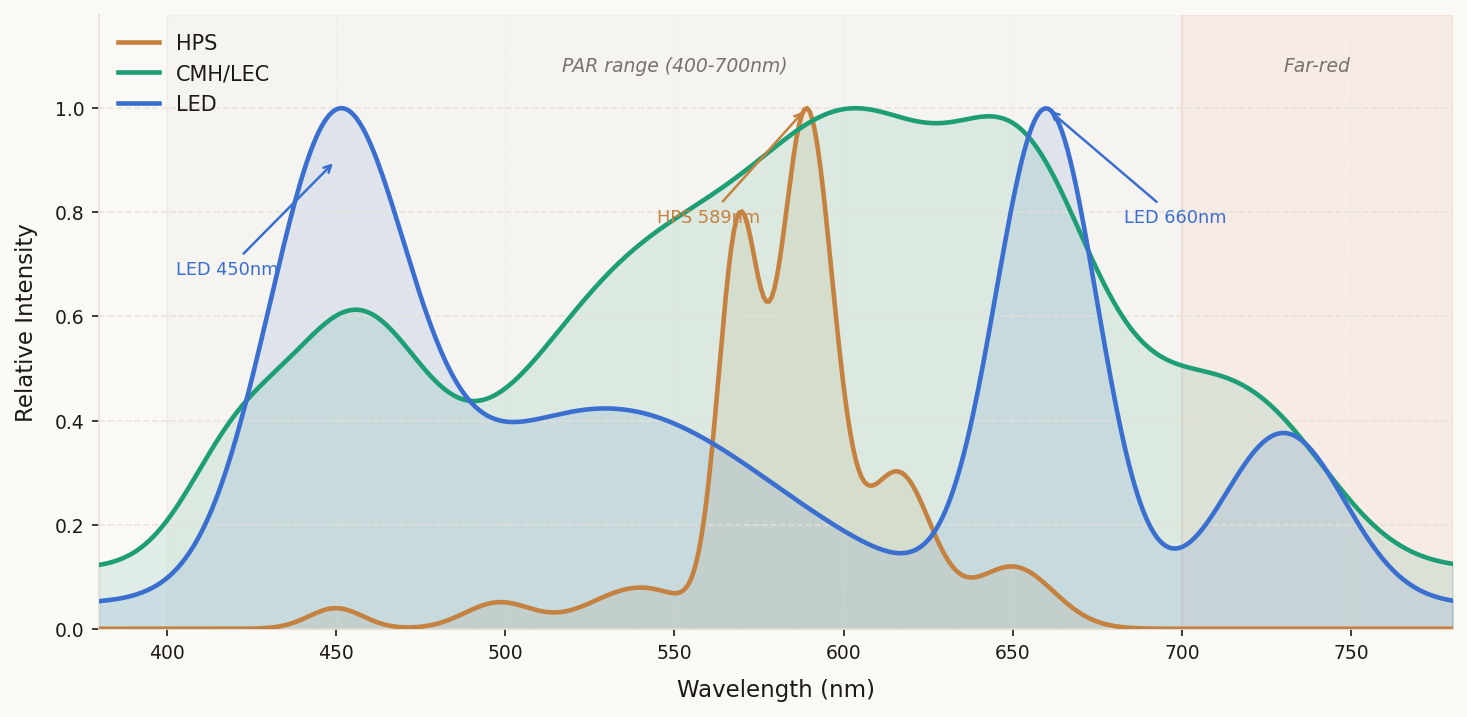
High-pressure sodium produces a narrow, amber-heavy spectrum with primary peaks at 569nm and 589nm and secondary emissions around 616nm. This warm yellow-orange output supports flowering but is severely deficient in blue wavelengths (400–500nm). Growers running HPS-only veg often experience elongated, stretchy internodes as a result. HPS also has negligible far-red output, limiting Emerson Enhancement during flowering.
CMH / LEC Spectrum
Ceramic metal halide (also marketed as Light Emitting Ceramic or LEC) produces a much broader, more balanced spectrum than HPS. A 3100K CMH covers blue, green, red, and some UV, making it a versatile single-technology solution across both veg and flower. The spectrum closely resembles natural sunlight, which is why CMH is popular with photoperiod and living-soil grows. A 4200K CMH shifts further into the blue region and is often preferred for vegetative growth. Like HPS, CMH has limited engineered far-red output above 700nm.
LED Spectrum
Modern LED grow lights use a combination of blue (450nm), red (660nm), and far-red (730nm) diodes — often supplemented with green, white, UV, and IR channels depending on the fixture. This engineered spectrum can be tuned to maximize photosynthetic efficiency across all growth stages. Far-red output (700–780nm) triggers the Emerson Enhancement Effect, increasing the rate of photosynthesis beyond what red alone achieves. See our Technology page for a deeper dive into how spectrum affects plant physiology.
Cost Analysis: Purchase Price vs. Lifetime Cost
Upfront cost comparisons often favor HPS and CMH, but lifetime cost analysis tells a different story.
- HPS 1000W: $150–$400 initial cost. Bulb replacement every 10,000–12,000 hours (~$50–$80/bulb). Growers commonly replace at 50% rated life to maintain consistent output. High electricity cost.
- CMH 315W–630W: $250–$600 initial cost. Lamps rated to 20,000 hours; practical replacement every 2–3 years. Better efficiency than HPS reduces operating cost.
- LED (top-tier): $500–$2,000+ initial cost. No bulb replacement. Rated 50,000–100,000 hours to L90 (90% of original output). Electricity savings of 30–50% vs. HPS over 5 years typically offset the price premium.
Check our Pricing page to see how AGL directory tiers work for brands at every price point. For ROI modeling by fixture type, visit Grow Logic.
Comparison at a Glance
✓ LED wins on most long-term metrics. HPS wins on upfront cost.
Decision Framework: Which Technology Is Right for You?
Use this framework to match technology to your situation. For personalized guidance on which verified fixtures meet your specs, use Grow Logic.
- Budget-constrained, existing HPS infrastructure: Consider CMH as an upgrade that reuses existing ballast infrastructure (with adapters) and improves spectrum quality at moderate cost.
- Commercial operation, energy costs are primary concern: LED is the clear winner at scale. Efficacy above 2.5 µmol/J with 50,000+ hour lifespan minimizes $/gram produced.
- Living soil, photoperiod, connoisseur grows: CMH spectrum is popular with craft growers who prioritize terpene expression. Some growers run CMH in veg and LED in flower.
- Vertical farming or tight spaces: LED only. Heat per photon delivered is lowest, and full-spectrum fixtures work across all growth stages without changes.
- Legacy compliance grows: If your facility is grandfathered on HPS infrastructure and renovation is not budgeted, high-quality double-ended HPS (approaching 2.1 µmol/J) remains a capable option.
Conclusion
HPS dominated horticulture for decades because it was reliable, affordable, and the science was well understood. CMH improved on HPS’s weaknesses — particularly spectrum quality and efficacy — without a dramatic price jump. LED has redefined what’s possible: efficacy above 3.0 µmol/J, engineered spectra, zero bulb replacement, and software-controlled dimming that HPS and CMH cannot match.
For most new installations in 2026, LED is the default choice. But the right fixture depends on your specific canopy size, electricity rate, crop type, and capital budget. The AGL directory provides verified specs — including PPF, efficacy, and spectrum data — so you can make data-driven decisions rather than relying on marketing claims.
Frequently Asked Questions
Is LED always better than HPS for growing?
LED outperforms HPS on efficacy, lifespan, heat output, and spectrum control in most modern applications. However, HPS remains cost-competitive for growers with existing infrastructure or very tight capital budgets. For new installations, LED is almost always the better long-term investment.
Can I replace my HPS with CMH using the same ballast?
Some CMH lamps are available in HPS-compatible form factors, but most CMH fixtures require a dedicated CMH ballast for proper operation and rated lamp life. Running CMH on an HPS ballast is not recommended and may void the lamp warranty. Always check manufacturer specifications before substituting.
What is the best spectrum for cannabis flowering?
Red-heavy spectra (640–680nm) drive photosynthesis during flowering, but far-red wavelengths (700–730nm) trigger the Emerson Enhancement Effect and can meaningfully increase yield and biomass. Modern full-spectrum LEDs that combine red, far-red, and supplemental blue are widely considered optimal for flowering performance. CMH with its broad, balanced output is also popular for cannabis due to its reported effect on terpene profiles.
How does light efficacy affect electricity costs?
A fixture rated at 3.0 µmol/J produces the same amount of PAR as a 2.0 µmol/J fixture using 33% less electricity. At $0.12/kWh running a 1,000 µmol/s target over 4,380 flowering hours per year, the difference between a 2.0 and 3.0 µmol/J fixture is approximately $87/year per fixture. Use our Grow Logic calculator to model your specific electricity cost scenario.