BLOG POST
UV and Far-Red Supplemental Lighting: What the Science Actually Says vs. What Brands Want You to Believe
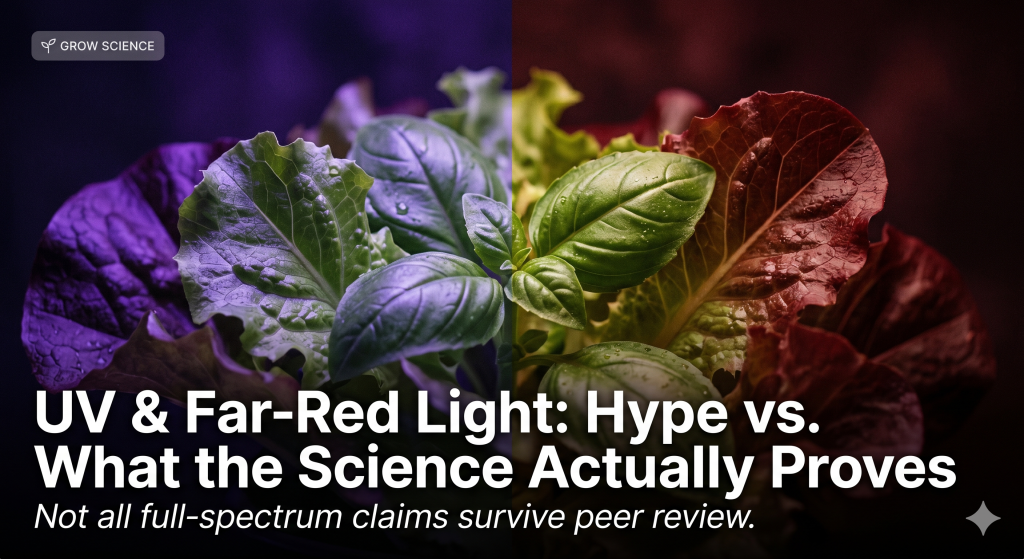
Walk any indoor horticulture trade show floor or scroll through a lighting vendor’s product pages and you will run into the same language: UV wavelengths that “unlock” secondary metabolites, far-red diodes that “supercharge photosynthesis,” and spectrum add-ons that promise double-digit yield gains backed by — somewhere, if you look hard enough — a white paper the company funded themselves.
The add-on lighting category is genuinely useful. The underlying photobiology is real and well-documented. But the gap between what peer-reviewed science supports and what marketing copy claims has grown as wide as the product selection itself. This post works through both wavelength categories honestly: what the mechanisms are, what the studies actually found, where the evidence is thin, and what a technically literate buyer should be demanding from vendors before a purchase order goes out.
UV Lighting: The Science Behind the Stress Response
Ultraviolet radiation spans from 100 nm to 400 nm. In horticulture, the practical range of interest is UV-A (315–400 nm) and UV-B (280–315 nm). UV-C (below 280 nm) is germicidal and damaging to plant tissue at almost any horticulturally relevant dose — a 2024 study in the International Journal of Molecular Sciences found that UV-C supplementation caused measurable leaf bronzing, curling, and immediate reduction in photosystem II efficiency even at relatively low cumulative doses, while UV-B at moderate doses improved antioxidant profiles without negative effects on photosynthetic function. [1]
What UV-A Does
UV-A is the workhorse wavelength of supplemental UV applications. It is perceived by multiple photoreceptors, including cryptochromes and UVR8 (UV RESISTANCE LOCUS 8), and drives both photomorphogenic responses and secondary metabolite accumulation. In practical terms: UV-A tends to increase concentrations of flavonoids, phenolics, and anthocyanins in leafy crops. The response is dose-dependent; more is not automatically better.
For commercial operations — whether growing specialty lettuce for a retail buyer who wants deep color, or basil for a culinary market that prices on aroma and essential oil content — UV-A supplementation has a defensible research base. The key word is supplemental: UV-A works as an adjunct to a well-designed primary spectrum, not as a replacement for adequate photosynthetically active radiation.
What UV-B Does
UV-B is where the science gets more nuanced and the marketing gets more aggressive. UV-B is specifically perceived by the UVR8 receptor, which activates a photomorphogenic signaling cascade regulating phenylpropanoid biosynthesis, hypocotyl elongation, and stress-response gene expression. At low, controlled doses, UV-B measurably increases total phenolic content and can induce flavonoid and anthocyanin accumulation.
Skowron et al. (2024) [1] reported UV-B supplementation increased total phenolic content by approximately 28 percent in green-leaf lettuce cultivars and induced anthocyanin accumulation by 15–71 percent across varieties, at a cumulative dose of 15.622 kJ·m⁻², without negative impact on photosynthetic activity.
The Dose Problem Nobody Advertises
The same biological pathway that produces beneficial secondary metabolite responses under low UV-B becomes a liability at higher doses. Excessive UV-B drives reactive oxygen species (ROS) accumulation, lipid peroxidation in thylakoid membranes, and direct DNA damage. Photosystem II is the most UV-B-sensitive component of the photosynthetic apparatus. Crops that have not been conditioned to UV-B stress — which describes almost every plant produced under conventional grow-light systems — are particularly vulnerable. Duration and intensity thresholds vary significantly by species, cultivar, and growth stage.
The absence of clear, species-specific dose guidance in most vendor literature is a significant omission. End-of-day UV-B pulses, UV-B during a defined window of the photoperiod, and continuous low-level supplementation produce meaningfully different results, and no single protocol has been validated across the crop diversity that commercial CEA operations manage.
Far-Red Lighting: Real Physics, Real Tradeoffs
Far-red light (700–800 nm, with the most studied horticultural range at 700–750 nm) has stronger peer-reviewed support than UV supplementation — but the benefits are crop-dependent and the tradeoffs are routinely understated in product marketing.
The Emerson Enhancement Effect
In 1957, Robert Emerson demonstrated that simultaneous illumination with red (approximately 660–680 nm) and far-red (beyond 680 nm) light produced a photosynthetic rate greater than the sum of the two wavelengths used independently. The mechanism is the cooperative interaction between Photosystem I and Photosystem II: far-red photons drive PSI efficiently but cannot alone sustain the electron transport chain at high rates. When shorter-wavelength photons are simultaneously driving PSII, the two photosystems work in tandem and overall photochemical efficiency increases.
Zhen and van Iersel (2017) [2] quantified this rigorously in lettuce, demonstrating that adding far-red to red-blue or warm-white LED backgrounds increased both photosynthetic rate and PSII quantum yield. Zhen and Bugbee (2020) [3] went further, demonstrating that far-red photons (701–750 nm) produced equivalent canopy photosynthetic efficiency to adding 400–700 nm photons — the scientific basis for the emerging argument that the conventional PAR definition should be extended to 750 nm as “extended PAR” (ePAR). This is real, well-replicated science. The Emerson Effect is not a marketing construct.
Far-Red and Photoperiod Extension
Phytochromes cycle between two interconvertible forms: Pr (absorbs red, ~660 nm) and Pfr (absorbs far-red, ~730 nm). The Pfr:Pr ratio at the end of the photoperiod signals the plant’s shade-detection system. A brief pulse of far-red at lights-off drives phytochrome rapidly toward the Pr form, mimicking the low red:far-red ratio of a forest understory.
Research by Kalaitzoglou et al. (2019) [4] found that tomato plants receiving only end-of-day far-red — with no far-red during the main photoperiod — produced approximately 59 percent less total fruit fresh weight compared to continuous far-red supplementation. The conclusion was pointed: a brief end-of-day far-red pulse cannot compensate for the absence of far-red during the primary photoperiod.
The Stem Elongation Tradeoff
Far-red supplementation — particularly end-of-day or continuous far-red at elevated ratios — induces shade avoidance including internode elongation. In transplant production this can be desirable. In mature fruiting crops or compact ornamental production it represents a morphological problem. Growers adding far-red bars to an existing multi-tier vertical farm system without adjusting tier spacing or crop cycle duration are not simply adding photons — they are altering plant architecture. Marketing materials rarely frame it this way.
Quick Reference: UV vs. Far-Red at a Glance
| Wavelength | Primary Mechanism | Proven Benefits | Tradeoffs / Risks |
|---|---|---|---|
| UV-A / UV-B (280–400 nm) | Photomorphogenesis via UVR8 & cryptochrome receptors; stress-response signaling | Increases secondary metabolites: phenolics, flavonoids, anthocyanins. Defensible for specialty leafy crops and culinary herbs. | Dose-dependent — high UV-B causes DNA damage, ROS accumulation, and suppressed biomass. No species-universal dose protocol exists. |
| Far-Red (700–750 nm) | Emerson Enhancement Effect (PSI/PSII synergy) & phytochrome photostationary state cycling | Increases photosynthetic efficiency when added to a PAR-rich background. Well-replicated in lettuce and fruiting crops. | Induces internode elongation (shade avoidance). EOD pulses alone can reduce fruit yield if far-red was absent during the main photoperiod. |
What Brands Claim vs. What Studies Show
“UV wavelengths boost yield significantly.”
What the research shows: UV supplementation in the reviewed literature primarily increases secondary metabolite concentrations — phenolics, flavonoids, anthocyanins — not fresh or dry mass. In some trials, high UV-B dose actually suppresses biomass accumulation. Yield effects measured as total harvest weight per square meter per cycle are not consistently demonstrated.
“Far-red LEDs increase photosynthesis by [X] percent.”
What the research shows: Adding far-red to a background spectrum that already contains red and blue wavelengths does increase photosynthetic efficiency through the Emerson Effect — this is real. However, the magnitude depends heavily on background spectrum composition. The percentages cited in marketing typically come from studies comparing far-red-supplemented spectra to narrow red-blue spectra with zero far-red, which overstates the gain a grower would see upgrading between two commercial fixtures.
“Our UV bar improves secondary metabolite production by [X] percent.”
What the research shows: Percentage improvements in isolated metabolite fractions are real in controlled studies, but the commercial relevance depends entirely on whether the buyer’s market values those specific metabolites. A phenolic content increase that matters for a nutraceutical lettuce grower may be irrelevant for a commodity operation. Context is absent from the claim.
“End-of-day far-red is all you need to get the Emerson Effect benefits.”
What the research shows: End-of-day far-red primarily manipulates phytochrome photostationary state — not the Emerson Enhancement Effect. These are two distinct mechanisms. The Emerson Effect requires concurrent illumination with shorter wavelengths, not a pulse at lights-off. Conflating the two in marketing copy is a meaningful inaccuracy, and the Kalaitzoglou et al. (2019) [4] data suggest EOD-FR alone may actually reduce yields in full-cycle fruiting production.
Practical Guidance: What to Ask Before You Buy
Demand spectrum data, not adjectives. Any supplemental UV or far-red fixture should come with a full spectral power distribution (SPD) graph showing output in µW·cm⁻²·nm⁻¹ across the relevant wavelength range. “UV-A enriched” tells you nothing about intensity or spectral centroid.
Ask for cumulative dose parameters, not just intensity. For UV in particular, cumulative daily dose expressed in kJ·m⁻² is the variable that matters most for plant response — not instantaneous PPFD. A vendor who cannot tell you the recommended daily UV-B dose for your specific crop in kJ·m⁻² is not applying the science.
Look for third-party fixture validation. The DesignLights Consortium (DLC) Horticultural Qualified Products List (QPL) provides independently tested photosynthetic photon efficacy (PPE) data and spectrum reporting for listed fixtures. DLC listing confirms the fixture outputs what it claims to output — a non-trivial distinction given how common misrepresented PPF specs are in this market segment.
Be skeptical of cross-species extrapolation. A study showing UV-B improves anthocyanin content in red-leaf lettuce has limited predictive power for a basil grower, a strawberry propagator, or a research facility growing Arabidopsis. If a vendor cannot point to trial data specific to your crop category, the performance claims are speculative.
Evaluate supplier-funded research carefully. Manufacturer white papers and application notes are not peer-reviewed literature. They may contain valid data, but independent university or research institution trials published in indexed journals are the benchmark before informing capital equipment decisions.
AGL’s Position
Advanced Grow Lights is a directory, not a product advocate. Our job is to surface verified fixture data and help commercial growers, CEA operations, and research facilities evaluate equipment on the merits of independently validated specifications — not on the strength of marketing claims.
UV and far-red supplemental lighting represent a legitimate and scientifically grounded category. The photobiology is real. The practical applications are documented in peer-reviewed literature. What is not well-supported is the magnitude and universality of the gains that vendor marketing implies, or the idea that any single supplemental spectrum strategy applies cleanly across the crop diversity a commercial CEA facility manages.
Read the SPDs. Ask for the dose data. Find the independent trials. That is how informed procurement decisions get made.
References
[1] Skowron, E., Trojak, M., & Pacak, I. (2024). Effects of UV-B and UV-C Spectrum Supplementation on the Antioxidant Properties and Photosynthetic Activity of Lettuce Cultivars. International Journal of Molecular Sciences, 25(17), 9298. DOI: 10.3390/ijms25179298. PMC: PMC11394776.
[2] Zhen, S., & van Iersel, M.W. (2017). Far-red light is needed for efficient photochemistry and photosynthesis. Journal of Plant Physiology, 209, 115–122. DOI: 10.1016/j.jplph.2016.12.004. PMID: 28039776.
[3] Zhen, S., & Bugbee, B. (2020). Far-red photons have equivalent efficiency to traditional photosynthetic photons: Implications for redefining photosynthetically active radiation. Plant, Cell & Environment, 43(5), 1259–1272. DOI: 10.1111/pce.13730. PMID: 31990071.
[4] Kalaitzoglou, P., van Ieperen, W., Harbinson, J., van der Meer, M., Martinakos, S., Weerheim, K., Nicole, C.C.S., & Marcelis, L.F.M. (2019). Effects of Continuous or End-of-Day Far-Red Light on Tomato Plant Growth, Morphology, Light Absorption, and Fruit Production. Frontiers in Plant Science, 10, 322. DOI: 10.3389/fpls.2019.00322. PMC: PMC6448094.