BLOG POST
Closed-Loop Lighting Control: How Real-Time Plant Feedback Is Outperforming Fixed Light Schedules
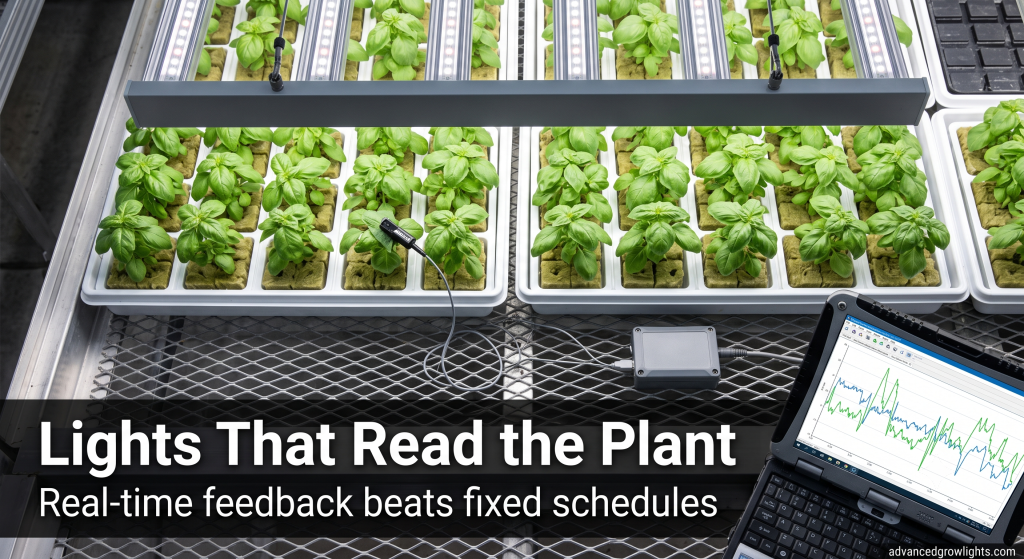
A cherry tomato crop in a 110-day trial pulled 31.7% more harvestable yield out of the same fixtures, the same greenhouse, and less energy than a matched control. The lights didn’t get brighter. They got smarter about when to change, using live plant and environmental data instead of a preset curve. That result, published in Frontiers in Plant Science in June 2026, is one of two independent 2026 studies showing that lighting control tied to real-time plant feedback beats even well-designed fixed schedules. For commercial growers who’ve already adopted stage-based dimming to cut energy costs, this is the next fork in the road.
The Fixed-Schedule Ceiling
Stage-based light scheduling solved a real problem. Growers who once ran fixtures at full output around the clock learned to ramp intensity to match seedling, vegetative, and flowering demand, trimming energy spend without giving up yield. AGL covered that shift in our earlier piece on dynamic light scheduling, and the approach remains sound for most operations today.
But a schedule is still a guess made in advance. It assumes today’s plants behave like yesterday’s model predicted, regardless of a cloudy afternoon, a CO2 dip, or a canopy that filled in faster than expected. Two research teams spent 2026 building systems that remove that assumption entirely, reading the plant’s own physiological signals and adjusting light in response, continuously, instead of on a timer.
What Closed-Loop Lighting Control Means
Closed-loop control treats the plant as a sensor. Instead of programming a light curve and hoping it matches reality, the system measures something the plant is doing right now, feeds that measurement into a model, and changes spectrum or intensity based on the result. Two distinct approaches reached publication this year, and they attack the problem from opposite ends.
Chlorophyll Fluorescence Feedback
Chlorophyll fluorescence is light a plant re-emits when it can’t use all the photons hitting its leaves for photosynthesis. Professor Tracy Lawson, working with the University of Essex and now affiliated with the Carl R. Woese Institute for Genomic Biology at the University of Illinois Urbana-Champaign, led a team that built a system reading that fluorescence signal directly and dimming LEDs whenever the plant showed it had more light than it could process. Their 2026 study in Smart Agricultural Technology, led by Jim Stevens, tested the approach on basil and reported a 13% yield increase alongside a 6% cut in energy costs. The light only runs as hard as the plant can use.
Predictive Spectral-Thermal Optimization
Kabeer Usman Abdulrazaq and Amuthakkannu Rajakannu, researchers at the National Forensic Sciences University in Gandhinagar, India and the National University of Science and Technology in Muscat, Oman, took a modeling route instead of a direct-sensing one. Their system pairs a neural network that predicts photosynthetic rate from live temperature, humidity, and CO2 readings with an optimization algorithm that searches for the light intensity and red-to-blue ratio that maximizes photosynthesis while minimizing the LED energy behind it. Tested on cherry tomato over 110 days, the dual-parameter version of their system delivered a 38.4% reduction in LED-related carbon emissions, a 22.6% increase in net photosynthetic rate, and that 31.7% yield gain over an unlit control. The model’s prediction accuracy held at R² = 0.976 against measured data, a tight fit for a live agricultural system.
Neither team names a specific commercial fixture in their published results. Both built the control logic first and tested it on research-grade LED arrays. The gap between publication and a fixture you can order is where the next section picks up.
Fixed, Scheduled, or Closed-Loop: How the Approaches Compare
| Approach | Input signal | Adjustment frequency | Typical energy/yield result | Hardware demand |
|---|---|---|---|---|
| Fixed intensity | None (static setpoint) | Manual, rarely changed | Baseline | Any dimmable fixture |
| Stage-based scheduling | Growth stage / calendar day | Days to weeks | Energy cut with yield held even, per AGL’s earlier coverage | Programmable driver or controller |
| Closed-loop (fluorescence) | Live chlorophyll fluorescence | Continuous / minutes | +13% yield, -6% energy (basil, 2026 Essex trial) | Fluorescence sensor + control software |
| Closed-loop (predictive model) | Temperature, humidity, CO2 | Continuous | +31.7% yield, -38.4% carbon (cherry tomato, 2026 trial) | Environmental sensors + edge/cloud compute |
Hardware Is Catching Up: The Sollum SF-INFINITE Example
Sollum Technologies launched its SF-INFINITE fixture in February 2026, and it shows where commercial hardware is heading even ahead of full closed-loop deployment. The fixture runs up to four independently controlled channels per zone, connected to Sollum’s cloud platform for real-time adjustment of spectrum, intensity, timing, and daily light integral targets. Edge computing at the fixture level keeps lighting running through a connectivity outage, and the platform includes tariff-aware dimming, cutting output automatically during peak electricity pricing windows. The fixture debuted at the Leamington Greenhouse Grower Expo aimed at cucumber, tomato, pepper, and propagation operations.
SF-INFINITE isn’t running the fluorescence or predictive-model algorithms from the two studies above. It’s infrastructure built for that future: multi-channel control, cloud connectivity, and per-zone customization are exactly the prerequisites a fluorescence sensor or a photosynthesis-prediction model would need to drive a fixture in a commercial greenhouse. Gavita’s RS series and DimLux’s Xtreme line offer similar multi-channel dimming control today, though neither currently ships with sensor-driven closed-loop logic built in.
A Worked Example: What the Numbers Mean on a Real Bill
Take a 10,000 sq ft greenhouse zone running 40 fixtures at 650W each, 16 hours a day, at a commercial electricity rate of $0.14/kWh. Full-output operation draws 416 kWh per day, or roughly $58 in daily lighting cost, $21,200 a year.
Apply the Essex team’s basil result (a 6% energy cut) and the same zone saves about $1,270 a year on electricity alone, before counting the 13% yield increase on the crop side. Apply the tomato study’s 38.4% carbon-linked energy reduction and the same zone saves closer to $8,100 a year, with a 31.7% yield lift layered on top. Neither number is a guarantee. Both studies ran single-crop trials in controlled conditions, and commercial greenhouses carry variables a research plot doesn’t. But the gap between “dim on a schedule” and “dim in response to what the plant is doing” is large enough that growers evaluating new fixtures or retrofits should ask what it would take to close that loop on their own site.
What to Ask Before Investing in Closed-Loop Control
- Does the fixture or controller expose an open API or sensor input, or is spectrum/intensity control locked to the manufacturer’s own scheduling app?
- What sensor hardware does closed-loop control require, and what’s the added cost per zone beyond the fixtures themselves?
- Has the vendor published results for your crop, or only for a different one? A model tuned on cherry tomato photosynthesis curves won’t transfer cleanly to leafy greens or cannabis without revalidation.
- Does the system fail safe if the sensor or connection drops? Sollum’s edge-computing approach is one answer; ask any vendor what happens to your lighting during an outage.
- Is the DLC Horticultural QPL listing tied to a fixed spectrum profile, or does it cover the full range the fixture can dynamically produce?
Starting Smaller: Partial Closed-Loop Retrofits
Full closed-loop control, reading fluorescence or running a trained photosynthesis model, isn’t available as a packaged commercial product yet. A partial version already is. Many greenhouse operations run PAR sensors tied to VPD (vapor pressure deficit) controllers today, dimming or boosting lights when humidity and temperature drift outside a target band. That’s a coarser feedback loop than the 2026 research describes, reacting to environmental proxies rather than a direct plant signal, but it uses the same core idea: let a live measurement drive the light output instead of a fixed clock.
Growers who already run VPD-linked dimming have a shorter path to full closed-loop control than those still on fixed schedules. The controller infrastructure, sensor network, and staff familiarity with reading live data are already in place. Adding a fluorescence sensor or a photosynthesis-prediction layer on top becomes a software and calibration project rather than a full retrofit. For operations still running static intensity curves, VPD-linked dimming is the more practical near-term upgrade, and one with a track record longer than a single research trial.
Where This Still Falls Short
Both 2026 studies ran single-crop trials over one growth cycle, in academic-scale setups far smaller than a commercial greenhouse block. Neither team has published a multi-site or multi-season validation yet, and neither system is available as an off-the-shelf commercial product today. Sensor cost and integration complexity remain real barriers. A fluorescence sensor accurate enough for control decisions, not monitoring alone, adds hardware and calibration work most operations haven’t budgeted for. Growers running cannabis, leafy greens, or ornamentals should treat these results as a strong signal of where the technology is headed, not a spec sheet they can order against this quarter.
Frequently Asked Questions
Is closed-loop lighting control the same as dynamic light scheduling?
No. Dynamic scheduling adjusts intensity based on growth stage or time, set in advance. Closed-loop control reads a live signal (plant fluorescence or environmental data feeding a prediction model) and adjusts continuously in response to current conditions.
Can I retrofit closed-loop control onto existing LED fixtures?
It depends on whether your driver accepts an external control signal. Fixtures with 0-10V or DALI dimming and an open control interface are retrofit candidates; fixtures locked to a manufacturer’s own fixed-profile app generally aren’t, without replacing the driver.
What does a chlorophyll fluorescence sensor cost?
Neither the Essex study nor Sollum’s product materials publish a per-unit sensor price for commercial deployment. Growers evaluating this should request a quote directly, since research-grade and commercial-grade sensor costs differ substantially.
Does this work for cannabis cultivation specifically?
Not yet demonstrated in published research. Both 2026 studies tested basil and cherry tomato. The underlying principle, that photosynthetic capacity varies in real time and fixed schedules can’t track it, applies broadly, but cannabis-specific validation hasn’t been published.
Will DLC certification cover dynamically adjusted spectrum output?
DLC Horticultural QPL listings are tied to tested spectrum and efficacy profiles. A fixture that shifts its red-to-blue ratio in real time needs its full operating range evaluated, not one setpoint alone. Confirm with the manufacturer which configurations carry the listing.
Is a 6% or 38% energy reduction realistic for my facility?
Both figures come from single-crop academic trials. Commercial results will vary with crop, canopy density, baseline scheduling practices already in place, and local electricity rate structure. Treat published percentages as an upper bound demonstrated under controlled conditions, not a guaranteed outcome.
What’s the difference between the two 2026 studies’ approaches?
The Essex/Illinois team measures the plant directly through fluorescence and dims lights in response. The India/Oman research team predicts photosynthetic rate from environmental data using a trained model and optimizes light intensity and spectrum against that prediction. One reads the plant; the other models it.
Commercial fixtures with the multi-channel control and cloud connectivity closed-loop systems will need are already shipping. Browse verified spectrum and efficacy data across dimmable, multi-channel fixtures in the AGL directory to see which current products are positioned for what comes next.
Is closed-loop lighting control the same as dynamic light scheduling?
No. Dynamic scheduling adjusts intensity based on growth stage or time, set in advance. Closed-loop control reads a live signal (plant fluorescence or environmental data feeding a prediction model) and adjusts continuously in response to current conditions.
Can I retrofit closed-loop control onto existing LED fixtures?
It depends on whether your driver accepts an external control signal. Fixtures with 0-10V or DALI dimming and an open control interface are retrofit candidates; fixtures locked to a manufacturer’s own fixed-profile app generally aren’t, without replacing the driver.
What does a chlorophyll fluorescence sensor cost?
Neither the Essex study nor Sollum’s product materials publish a per-unit sensor price for commercial deployment. Growers evaluating this should request a quote directly, since research-grade and commercial-grade sensor costs differ substantially.
Does this work for cannabis cultivation specifically?
Not yet demonstrated in published research. Both 2026 studies tested basil and cherry tomato. The underlying principle, that photosynthetic capacity varies in real time and fixed schedules can’t track it, applies broadly, but cannabis-specific validation hasn’t been published.
Will DLC certification cover dynamically adjusted spectrum output?
DLC Horticultural QPL listings are tied to tested spectrum and efficacy profiles. A fixture that shifts its red-to-blue ratio in real time needs its full operating range evaluated, not one setpoint alone. Confirm with the manufacturer which configurations carry the listing.
Is a 6% or 38% energy reduction realistic for my facility?
Both figures come from single-crop academic trials. Commercial results will vary with crop, canopy density, baseline scheduling practices already in place, and local electricity rate structure. Treat published percentages as an upper bound demonstrated under controlled conditions, not a guaranteed outcome.
What’s the difference between the two 2026 studies’ approaches?
The Essex/Illinois team measures the plant directly through fluorescence and dims lights in response. The India/Oman research team predicts photosynthetic rate from environmental data using a trained model and optimizes light intensity and spectrum against that prediction. One reads the plant; the other models it.