
BLOG POST
Dynamic Light Scheduling: How Commercial Growers Are Cutting Energy Costs Without Sacrificing Yield
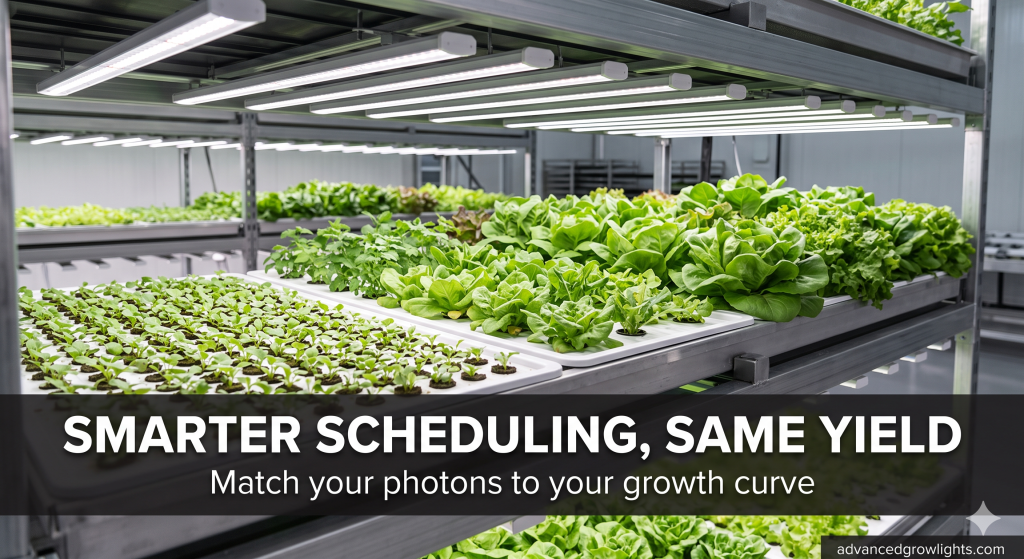
Commercial growers face a familiar tension: push lights to maximum output and energy bills climb, or cut intensity and watch yields drop. Dynamic light scheduling breaks that trade-off. By matching LED intensity to each growth stage rather than running full power around the clock, growers capture most of the yield at a fraction of the energy cost.
A June 2026 study from the University of Delaware, published in Frontiers in Plant Science, measured a 23–31% improvement in light use efficiency when growers applied dynamic scheduling protocols to lettuce production — and final yields matched those from maximum-output controls. That result aligns with work from Cornell’s CEA program and decades of commercial observation: the relationship between light and yield is real, but the timing and intensity profile matter as much as the total photon budget.
What Dynamic Light Scheduling Actually Means
Dynamic light scheduling is stage-based intensity control. Instead of setting LEDs at a fixed output for the full photoperiod, growers program intensity ramps that follow crop physiology:
- Germination and early seedling: Low intensity (30–50% of rated output). Young plants have limited root mass and leaf area — saturating them wastes photons and risks tip burn.
- Vegetative growth: Ramping intensity as canopy develops. Photosynthetic capacity scales with leaf area, so weekly intensity increases track the plant’s actual light-harvesting ability.
- Pre-harvest: Sustained high intensity in the final days maximizes carbohydrate accumulation and drives the last increment of fresh weight gain.
The goal is to deliver the right daily light integral (DLI) at each stage without the energy overhead of running peak output when the crop cannot use it.
The Research Behind the Numbers
University of Delaware (Frontiers in Plant Science, June 2026)
Researchers at Delaware grew butterhead lettuce under three protocols: constant maximum output, a simple two-stage ramp, and a multi-stage dynamic schedule aligned to growth-stage DLI targets. The multi-stage protocol achieved 23–31% better light use efficiency — measured as grams of fresh weight per mol of photons delivered — while hitting the same final yield benchmarks as constant-maximum plants. The finding confirms that late-stage photon delivery is disproportionately productive, and early-stage over-lighting is largely waste.
Farhangi et al. (Scientific Reports, 2025)
This study examined LED spectral optimization alongside intensity scheduling in leafy greens. It found that blue-heavy spectra during early vegetative growth combined with red-dominant light in the pre-harvest window produced both better morphology and higher yield than fixed-spectrum approaches. Dynamic scheduling and spectral tuning are not competing strategies — they compound.
P.L. Light Systems: The 1% Rule
P.L. Light Systems — one of the dominant greenhouse lighting suppliers in northern Europe — has long cited an empirical relationship: a 1% change in light level produces approximately a 1% change in yield. The rule holds at the crop level when the rest of the environment is not limiting. Dynamic scheduling exploits this linearity: growers trade photons in low-productivity growth windows for photons in high-productivity windows, capturing the same yield from a smaller energy spend.
Cornell CEA: 26% Electricity Reduction
Cornell’s Controlled Environment Agriculture program has documented electricity reductions averaging 26% in commercial operations that switched from fixed-output LED protocols to DLI-based control systems. The reductions came from shorter high-intensity windows, overnight dimming during off-peak plant activity, and better alignment between lighting schedules and HVAC loads.
Fixture Specs That Enable Dynamic Scheduling
Not every LED fixture supports the dimming range and control resolution that dynamic scheduling requires. Full 0–100% dimming with smooth ramping — controllable from a grow controller or building management system — is the baseline requirement. Here are three commercial-grade options that meet it:
| Fixture | Efficacy | Wattage | Dimming Range | Key Advantage |
|---|---|---|---|---|
| Gavita RS 2400e | 3.2 µmol/J | 750W | 0–100% | Industry-leading efficacy; native EL controller integration |
| Fluence SPYDR 3 | 3.0 µmol/J | 800W | 0–100% | Wide canopy coverage; Fluence Link control compatibility |
| Lumatek ZEUS 600W PRO | 2.85 µmol/J | 600W | 0–100% | Lower entry cost; built-in scheduling timer |
Efficacy matters more at scale than it does in a small trial. At 3.2 µmol/J, the Gavita RS 2400e delivers roughly 12% more photons per watt than the Lumatek. Across a 10,000 sq ft facility running 16-hour photoperiods, that gap compounds into significant annual savings even before dynamic scheduling is applied. Add scheduling on top and the combined effect on operating cost is substantial.
Implementing Dynamic Scheduling: A Practical Framework
Step 1: Set Stage DLI Targets
Start with crop-specific DLI targets for each growth stage. Lettuce germination runs well at 8–12 mol/m2/day. Vegetative growth in weeks two and three scales to 14–18 mol/m2/day. Pre-harvest can push to 20–22 mol/m2/day. These numbers shift by variety and environment — monitor tip burn and internode length as feedback signals and adjust accordingly.
Step 2: Map Intensity to Photoperiod
Once you have DLI targets, calculate the PPFD required to hit each target within your photoperiod. A 16-hour day at a germination target of 10 mol/m2/day requires about 174 µmol/m2/s average PPFD. At 50% output, the Gavita RS 2400e produces approximately 600–700 µmol/m2/s at canopy — well above what seedlings need, which means even a 25% setting covers germination targets with headroom to spare. That headroom is energy that does not need to be purchased.
Step 3: Automate with a Grow Controller
Manual dimming schedules fail in production environments. A grow controller that accepts 0–10V or PWM signals from fixtures and triggers intensity changes based on crop age — not just time of day — is the operational backbone of any dynamic scheduling program. Controllers from Argus, Priva, and Link4 all support growth-stage programming. The Gavita EL controller integrates with Gavita fixtures and supports zone-level dimming across a bench or rack.
Step 4: Log and Iterate
Dynamic scheduling is a continuous improvement process. Log energy consumption and yield data by batch, segment by light protocol, and test incremental changes to your intensity ramp. A 5% shift in the vegetative-to-pre-harvest transition point can move both yield and energy metrics. The data from your own facility, under your specific conditions, is more actionable than any published study.
Common Mistakes That Kill the Efficiency Gains
- Ignoring DLI accumulation: Cutting intensity early in the day without compensating later in the photoperiod undershoots total DLI and reduces yield. Dynamic scheduling requires tracking cumulative photons, not just instantaneous PPFD.
- Dimming below fixture spec: Some LED drivers behave poorly below 10–15% output — flicker, spectral shift, and reduced driver lifespan are real risks at the bottom of the dimming range. Check manufacturer specs before programming sub-20% settings.
- Failing to account for fixture degradation: LED output drops over time. A schedule calibrated at installation will under-deliver DLI by year three unless intensity settings are adjusted to compensate. Annual PPFD mapping with a quantum sensor keeps schedules accurate.
- Treating all cultivars identically: A romaine variety optimized for 20 mol/m2/day pre-harvest may share a house with a butterhead that tip-burns above 17 mol/m2/day. Zone-level control — either separate fixture circuits or fixtures with individual dimming — allows cultivar-specific scheduling in a shared space.
Dynamic Scheduling and the Broader Energy Picture
Lighting is the largest single electricity load in most controlled environment agriculture facilities — typically 40–60% of total site consumption. A 26% reduction in lighting energy translates to roughly a 10–15% reduction in total facility energy cost, depending on HVAC configuration. In markets with time-of-use electricity pricing, shifting high-intensity windows to off-peak rate periods adds another layer of cost reduction without touching yield.
Carbon reporting requirements are tightening across food retail supply chains. Buyers for major grocery chains now ask suppliers for scope 2 emissions data. A facility running optimized LED scheduling with documented energy logs has a measurable, auditable advantage over one running fixed-output protocols.
Choosing the Right Fixtures for Your Operation
Dynamic scheduling is only as good as the hardware running it. A fixture without full 0–100% dimming capability forces growers into binary choices — on or off — that eliminate most of the efficiency gains described above. Before investing in a scheduling control system, verify that every fixture in the facility supports the full dimming range and communicates with the controller protocol you plan to use.
The AGL commercial grow light directory lists verified specs for fixtures across the major commercial categories, including dimming range, control protocol compatibility, and third-party efficacy test data. Use it to cross-check manufacturer claims before specifying fixtures for a new build or retrofit.
Dynamic light scheduling is not a set-and-forget optimization. It requires crop data, fixture specs, control hardware, and iteration. But the fundamental trade-off — trading early-stage photons for energy savings without losing late-stage yield — is well-supported by research and confirmed in commercial practice. The 23–31% efficiency gain from Delaware’s 2026 study is achievable. The 26% electricity reduction from Cornell’s CEA data is reproducible. The 1% light-to-yield relationship gives growers a reliable model for predicting the impact of protocol changes before implementing them.
What is dynamic light scheduling for LED grow lights?
Dynamic light scheduling adjusts LED intensity across the day or growth stage, ramping up during peak photosynthesis periods and reducing output when demand is low. The goal is to hit your daily DLI target without running fixtures at full power for an 18-hour stretch. The body of this article walks through the full implementation approach.
How much energy can dynamic scheduling save in a commercial grow?
Cornell CEA data shows an average 26% electricity reduction when commercial operations shift from fixed-output LED protocols to DLI-based scheduling. University of Delaware research found 23–31% improvement in light use efficiency with multi-stage scheduling in lettuce. The savings depend on current protocol, fixture efficacy, and crop type.
Does dimming LEDs reduce yield?
Not if you maintain your daily DLI target. The 1% rule applies to total daily photon dose, not instantaneous intensity — so stage-based scheduling preserves yield while cutting energy cost. A University of Delaware study confirmed matched yields at 23–31% better light use efficiency.
What fixtures support dynamic scheduling?
Any LED fixture with 0–10V or PWM dimming supports dynamic scheduling. The Gavita RS 2400e, Fluence SPYDR 3, and Lumatek ZEUS PRO all support 0–100% dimming — see the comparison table in the article for specs.
What is the 1% light = 1% yield rule?
For most crops, a 1% reduction in cumulative daily light integral produces roughly a 1% reduction in yield. Dynamic scheduling works within this constraint by maintaining total DLI while shifting when photons are delivered across the day.
What DLI targets should I use for lettuce?
Lettuce germination runs well at 8–12 mol/m²/day. Vegetative growth in weeks two and three scales to 14–18 mol/m²/day. The pre-harvest window can push to 20–22 mol/m²/day for maximum fresh weight accumulation. These targets shift by variety — monitor tip burn and internode length as real-time feedback and adjust your schedule accordingly.
Do I need a grow controller for dynamic scheduling?
Yes — manual dimming schedules are not practical in production environments. A grow controller that accepts 0–10V or PWM signals and triggers intensity changes based on crop age is required. Argus, Priva, and Link4 all support growth-stage programming. The Gavita EL controller integrates with Gavita fixtures and supports zone-level dimming across a bench or rack.
Can dynamic scheduling work with other crops besides lettuce?
Yes. The stage-based intensity principle applies to any crop with distinct growth phases and documented DLI requirements. Tomatoes, cucumbers, herbs, and cannabis all benefit from protocols that match intensity to development stage. The specific DLI targets and ramp timing differ by crop — start with published research for your species and calibrate based on your facility data.