BLOG POST
Interlighting: Why Commercial Greenhouses Are Putting LED Light Inside the Canopy
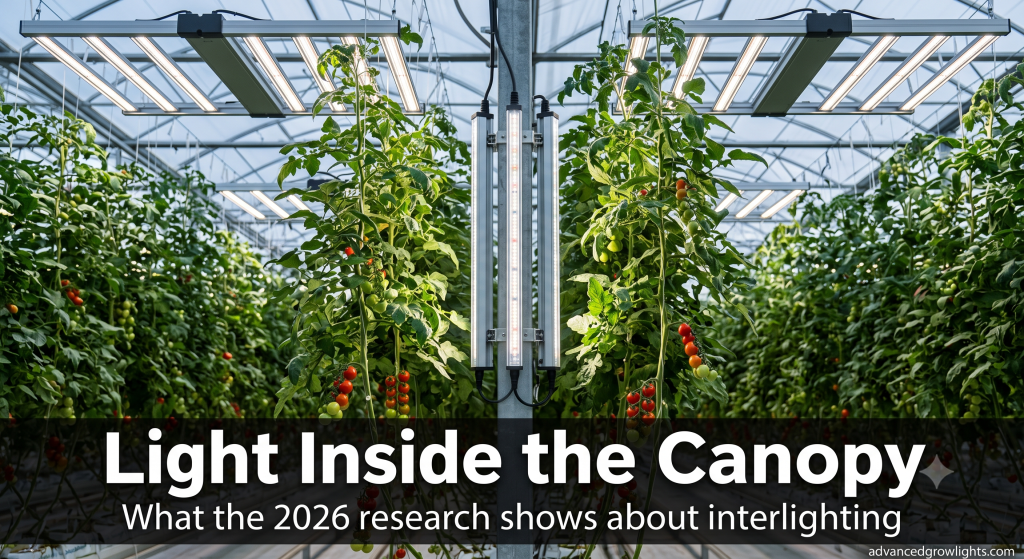
Tomato and cucumber growers running high-wire greenhouses hit the same wall every winter. Push overhead LED output higher and the canopy grows denser right along with it, so the lower third of the plant sits in shade doing almost nothing. Toplighting alone runs into diminishing returns before it solves that problem, and heat piles up faster than yield does.
Interlighting takes a different approach. Instead of adding more light from above, growers hang LED bars inside the canopy itself, at the height where fruit sets. Gavita, Fluence, and Signify all build fixtures for this now, and a 2026 study out of a Beijing greenhouse added fresh numbers to a decade of prior trials. The technique isn’t new. The documentation behind it is new, along with how much cheaper the fixtures have gotten relative to the yield they unlock.
Energy cost is part of why this technique is getting a second look in 2026. Commercial growers have spent the past two seasons chasing spectrum tuning and dimming schedules that cut heat load without cutting yield, and interlighting fits that same goal: it adds photons where they raise fruit weight, instead of blasting the whole canopy from six feet up and hoping enough of it reaches the bottom trusses.
Toplighting vs. Interlighting: The Basic Difference
Toplighting sits above the canopy and shines down, the way growers have lit greenhouses since LED fixtures started replacing HPS. Light intensity falls off fast as it passes through leaf layers. The top of a tomato plant might see full PPFD while a truss three feet down gets a fraction of it, blocked by every leaf above.
Interlighting fixtures hang between plant rows at mid-canopy height and fire sideways into the leaves and fruit clusters toplighting can’t reach. Gavita’s Under Canopy 150W runs a 155-degree dual-sided beam for this reason. Wedged into a narrow gap between rows, it has to spray photons in two directions at once instead of one.
The result isn’t more total light landing on the greenhouse floor. It’s light moved to tissue that was starved of it before, which is why the studies below measure fruit weight and quality instead of raw photon totals.
The Research Behind the Yield Numbers
A 2020 Frontiers in Plant Science study from the Norwegian Institute of Bioeconomy Research (NIBIO) put the theory to a real greenhouse test. Researchers grew Flavance F1 tomatoes under HPS toplighting alone and compared them to plants that also received LED inter-lighting. The supplemented plants produced 21% more fruit by weight.
The mechanism behind that number turned out to matter more than the number itself. NIBIO measured photosynthetic light use efficiency (PLUE) in the lower-canopy leaves and found it about double under LED inter-lighting compared to the control. The LED treatment also shifted the far-red to red ratio in a way that helped those shaded leaves use whatever light reached them. Root activity changed too. Xylem sap exudation rose near 44%, jasmonic acid levels more than tripled, and root pressure rose enough to keep fruit growing through the night, about 29% faster in the dark than in the control plants. Water supply, not photosynthesis, drove that part of the gain.
A March 2026 study in the MDPI journal Plants ran a similar trial in a multi-span greenhouse in Beijing over a full year, from August 2024 through July 2025. Instead of testing on-or-off, researchers tried six spectral combinations split between upper and lower canopy: full red, full blue, a red-blue mixture, and three cross-combinations. During the early overwintering stage, the red-blue mixture produced a 22.6% to 24.0% fruit weight increase over the unlit control, with no increase in total daily light integral. The gain came from matching spectral quality to canopy position, not from adding photons.
Cucumber has its own track record, and an older one. A 2012 Acta Horticulturae trial on year-round mini-cucumber production tested red, blue, and white LED inter-lighting at 10% of top-lighting output and found fruit yield gains beyond what the added PAR alone explained, over 10% in the early production period. Fruit visual quality improved across all three spectra, though the yield advantage faded as the season went on, a detail growers planning a full-season budget should weigh against the tomato numbers above.
Three studies, three crops or crop varieties, three different decades, and the same pattern holds: light placed where the canopy needs it beats the same photon count added to the top of the plant. That distinction, quality over quantity, is the same skepticism AGL applies to marketing claims around UV and far-red supplementation. More of a wavelength delivered to the wrong part of the plant doesn’t help much.
Toplighting Alone vs. Toplighting Plus Interlighting
| Metric | Toplighting Only | Toplighting + Interlighting | Source |
|---|---|---|---|
| Fruit yield, tomato | Baseline | +21% | NIBIO, Frontiers in Plant Science, 2020 |
| Fruit weight, tomato (red-blue spectrum) | Baseline | +22.6% to +24.0% | MDPI Plants, 2026, Beijing trial |
| Lower-canopy photosynthetic light use efficiency | Baseline | About 2x | NIBIO, Frontiers in Plant Science, 2020 |
| Night fruit growth rate, tomato | Baseline | +29% | NIBIO, Frontiers in Plant Science, 2020 |
| Fruit yield, mini-cucumber | Baseline | Over +10% | Acta Horticulturae, 2012 |
| A-grade harvest share, cannabis (company trials) | 46% | 55% | Fluence internal trials, 5 facilities |
That last row deserves a caveat: it’s Fluence’s own trial data, not an independent peer-reviewed study, so treat it as a manufacturer’s reported result rather than a controlled academic finding.
Fixtures Available Today
Three manufacturers build purpose-made interlighting fixtures today, and their spec sheets tell a consistent story.
| Fixture | Manufacturer | Output | Efficacy | Notes |
|---|---|---|---|---|
| Under Canopy 150W | Gavita | 450 µmol/s | 3.0 µmol/J | 155° dual-sided beam, dims to 10%, IP66, daisy-chains up to 17 units at 277V |
| GreenPower LED interlighting module | Signify / Philips | 300 µmol/s (92W) | 3.3 µmol/J | IP66, Q90 rated at 36,000 hours, up to 64 modules per power run |
| VYNE | Fluence | 120 µmol/s per meter | 3.0 µmol/J (R6) to 3.3 µmol/J (R9B) | 2m and 2.5m modules, choice of broad-white or high red/blue spectrum |
Efficacy across all three lands in the 3.0 to 3.3 µmol/J range, and every fixture carries an IP66 rating built for the humid mid-canopy environment. Beyond that, the differences come down to beam geometry and spectrum choice more than raw output. Fewer manufacturers compete here than in toplighting. Several brands with strong toplighting lineups, including HLG, DimLux, and PHOTOBIO, don’t list a dedicated interlighting SKU today, which narrows the field for a grower comparing options. For a broader look at how these three companies compare across their full product lines, see AGL’s manufacturer overview.
A Worked Example: What One Fixture Adds
Take the Gavita Under Canopy 150W at its published 450 µmol/s output. Run it for a 12-hour photoperiod: 450 × 43,200 seconds equals 19.44 million µmol, or 19.4 mol of photons per fixture, per day.
That number is not the same as added DLI at the leaf surface. Canopy geometry, fixture spacing, and how much of that light lands on leaf tissue instead of stems and gaps all change the real figure, and none of the three manufacturers publish a standard “effective DLI contribution” metric. The 19.4 mol figure gives a grower the photon budget on offer, a number worth checking against a facility’s existing target using AGL’s guide to PPFD, DLI, and efficacy before adding fixtures, not after.
Compare that fixture-day figure against the ISHS cucumber trial above, which ran inter-lighting at 10% of top-light output and still measured a real yield gain. The lesson for a grower on a budget: placement beats raw quantity.
Crops That Benefit, and Crops That Don’t
Interlighting works best on tall, dense, high-wire crops. Tomato and cucumber carry the deepest published research base, and both grow tall enough to create the shading problem interlighting solves.
Lettuce, herbs, and microgreens don’t share that problem. A short canopy stays close enough to a single toplighting layer that a second light source inside it adds cost and complexity without much return. A grower running leafy greens on multi-tier racks gets more value from tuning the toplighting spectrum than from installing bars most plants will grow past within two weeks.
Cannabis cultivation sits in between the two. A dense indoor canopy can shade lower bud sites the same way a tomato plant shades its lower trusses, which is the reasoning behind Fluence’s VYNE trial data on harvest grade. But indoor rooms already run tight power budgets, and interlighting adds circuits, mounting hardware, and heat in a space with less thermal headroom than an open greenhouse.
Installation Realities: Heat, IP Rating, and Dimming
Mid-canopy placement puts a fixture in the most humid, most cramped part of the greenhouse. That’s why every fixture in the table above carries an IP66 rating; anything less risks condensation failure inside a season.
Dimming matters more here than it does for toplighting. A fixture mounted inches from leaf tissue can scorch a plant at full output in a way an overhead fixture six feet up never would, so growers run interlighting at a fraction of rated output during early growth and raise it as the canopy fills in. Gavita’s Under Canopy line dims to 10% for this reason. A grower retrofitting an existing greenhouse should treat dimming range as a harder requirement than raw PPF on the spec sheet.
Fixture spacing down the row matters just as much as dimming range. Manufacturer guidance for all three fixtures above centers on one unit every meter to meter and a half of row length, close enough to avoid gaps in the light curtain but wide enough to keep airflow moving between fixtures and foliage.
Retrofitting an existing greenhouse costs more in labor than in fixture price. An operation with rail or gutter irrigation already running through the mid-canopy zone has to route power and mounting hardware around lines that were never designed to share space with a light fixture. Growers planning a build from scratch have it easier: mid-canopy conduit and mounting rail can go in during construction, before crop rows and irrigation are locked in place.
AGL’s directory lists verified specs for interlighting-capable fixtures alongside toplighting options, sorted by efficacy and IP rating rather than marketing copy. Compare them in the directory.
What’s the difference between interlighting and intracanopy lighting?
Growers and manufacturers use the two terms for the same thing: LED fixtures mounted inside or between canopy rows instead of above them, in contrast to toplighting.
Does interlighting replace toplighting?
No. Every study and product in this article assumes interlighting adds to an existing toplighting system. Running interlighting alone, with no overhead fixtures, isn’t something the research here tested.
How much yield increase can I expect from adding interlighting?
Published trials show a range, not one number. NIBIO measured 21% more fruit weight in tomato; the 2026 Beijing trial measured 22.6% to 24.0% under a tuned red-blue interlighting spectrum; the older ISHS cucumber trial measured a gain beyond 10% in early production. Results depend on crop, canopy density, and existing toplighting levels, so treat these figures as a range to plan around, not a guarantee.
What efficacy should I look for in an interlighting fixture?
The three fixtures compared in this article all fall between 3.0 and 3.3 µmol/J. That range is a fair current benchmark for purpose-built interlighting hardware.
Is interlighting worth it for short crops like lettuce or microgreens?
In most cases, no. Short, single-layer canopies do not create the shading problem interlighting fixes, and the added fixture cost and irrigation clutter seldom pay back on a two-to-four-week crop cycle.
Does interlighting add much to energy costs?
It adds load, since it’s an extra fixture layer rather than a swap. Gavita and Signify units in the 90 to 150-watt range are modest next to an overhead fixture over the same footprint, but a grower should size the addition against the facility’s DLI target and electrical capacity before installing a full row of them.
Can interlighting damage plants if mounted too close?
Yes, at full output before the canopy fills in. That risk is why every fixture in this article’s comparison table ships with a wide dimming range. Growers raise output in steps as the plant grows into the light rather than running full power on day one.
Which crops have the strongest research base for interlighting?
Tomato has the deepest published record, with cucumber close behind. Both are tall, high-wire greenhouse crops grown at commercial scale, which is also why manufacturer fixtures target that use case first.