BLOG POST
DLC Listed Isn’t Electrical Code Compliant: UL 8800 and NEC 410 for Grow Lights
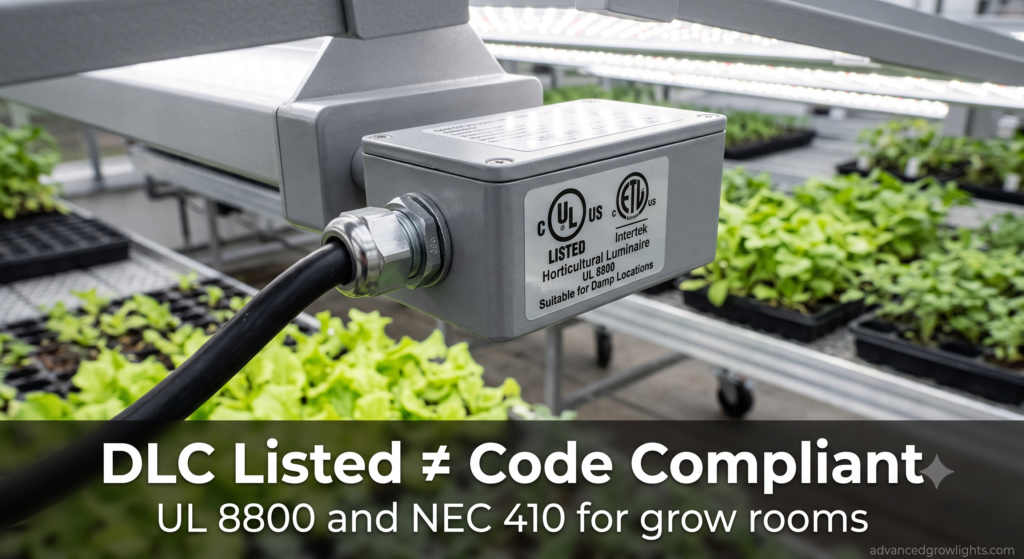
A fixture can carry a DLC Horticultural QPL listing and still fail an electrical inspection on day one. Those are two separate certifications doing two separate jobs, and the confusion between them costs commercial growers real money when a retrofit stalls at final inspection or an insurance claim gets denied after a fire. UL 8800 and the National Electrical Code, not the DLC database, decide whether your lighting is legal to install.
Two Certifications, Two Jobs
DesignLights Consortium tests photon efficacy. A fixture earns a spot on the Horticultural QPL by clearing a minimum µmol/J threshold, and utilities use that listing to decide who qualifies for a rebate check. Nothing about that process touches electrical safety. Underwriters Laboratories built UL 8800 for that half of the equation: wiring methods, moisture resistance, ground-fault protection, the things an electrical inspector or an insurance adjuster actually cares about.
You need both. A grower who treats DLC listing as proof of code compliance finds out otherwise when the inspector pulls a fixture off the wall and asks for its safety listing mark. AGL covered how the DLC V4.0 delisting affects rebate eligibility separately. This piece covers the other certification, the one that determines whether you can legally energize the circuit at all.
What UL 8800 Actually Tests
UL published the Standard for Safety of Horticultural Lighting Equipment in August 2019, covering both the United States and Canada under the joint ANSI/CAN/UL 8800 designation. It targets equipment built for plant growth environments specifically, not general illumination fixtures repurposed for a grow room.
Environmental Ratings and Wiring
Horticultural luminaires under UL 8800 need a damp or wet environmental rating, plus testing at elevated ambient temperatures that reflect real grow room conditions rather than office lighting assumptions. The standard also addresses wiring and connection methods built for repositioning. Growers raise and lower fixtures constantly as plants develop, and UL 8800 requires connectors and flexible cord provisions rated for that kind of repeated handling instead of a fixed-position residential fixture.
Ingress Protection and Photobiological Safety
IP testing rates how well a fixture resists dust and water intrusion, a real concern in high-humidity cultivation spaces and anywhere near irrigation lines. UL 8800 also folds in photobiological safety requirements aligned with IEC 62471, the same photobiological standard AGL covered in detail for LED risk groups. Polymeric housing materials get tested for UV resistance too, since constant exposure to a fixture’s own output can make plastics brittle over a multi-year service life.
The 2023 Scope Expansion
UL expanded UL 8800’s scope on March 14, 2023, adding indoor wet environment ratings, provisions for horticultural systems with integrated refrigeration, updated photobiological safety markings, and support for remotely located low-voltage or Class 2 power supplies. The expansion also opened the door for attachment plugs and connectors certified under UL 2238 or CSA C22.2 No. 182.3, which matters for anyone running multi-tier vertical racks where fixtures daisy-chain through plug-and-play connectors rather than hardwired junction boxes.
Part 2 Covers Whole Systems, Not Just Fixtures
UL 8800 splits into two parts. Part 1 covers individual luminaires. Part 2 covers horticultural systems, meaning prefabricated grow chambers that bundle lighting with controls, plumbing, heating, and cooling into one certified unit. The 2023 scope expansion specifically added integrated refrigeration coverage to Part 2, which matters if you’re buying a turnkey vertical farming pod or container system rather than assembling fixtures, HVAC, and controls separately. Ask the vendor whether the whole system carries a Part 2 listing or whether only the light engine inside it does. Those are different claims, and only one of them covers the plumbing and refrigeration components an inspector will also want to see certified.
NEC Article 410, Part XVI: What the Code Actually Requires
The 2020 National Electrical Code added Part XVI to Article 410 specifically for horticultural lighting, coordinating installation rules with the UL 8800 testing standard. Two sections inside that part decide whether your retrofit passes inspection.
410.172: The Listing Requirement
Section 410.172 states plainly that lighting equipment identified for horticultural use shall be listed. It does not name UL specifically. ETL/Intertek and CSA listings against the same UL 8800 standard satisfy the requirement equally, since the code cares about third-party testing to a recognized standard, not the brand on the label. Check for a safety listing mark on the fixture itself, not a spec sheet claim alone.
410.184: The GFCI Rule Retrofits Keep Missing
This is the section that trips up commercial installs. Horticultural lighting equipment using flexible cords with separable connectors or attachment plugs requires ground-fault protection, and the 2023 NEC splits that requirement by voltage to ground. Branch circuits rated 150 volts or less to ground need a listed Class A GFCI, the standard residential-grade device most electricians reach for by default. Circuits exceeding 150 volts to ground need a listed SPGFCI, a special-purpose ground-fault circuit interrupter, with a ground-fault trip current not exceeding 20 milliamps.
The 2026 NEC restructures this section into two clearly labeled parts, 410.184(A) and (B), and removes the old exception-based language in favor of direct, positive requirements. The underlying voltage-based split stays the same. The rewrite exists to stop exactly the kind of misreading that gets flexible-cord installations rejected at final inspection.
Where This Actually Bites: A Worked Example
Picture a vertical farm retrofitting a 40-fixture rack system, each fixture connected through flexible cords with attachment plugs so racks can be reconfigured between crop cycles. The facility runs on a 480Y/277V three-phase service, standard for larger commercial buildings, which puts each fixture circuit at 277 volts to ground.
277 volts clears the 150-volt threshold in 410.184. A standard Class A GFCI breaker, the kind rated for a 120-volt residential circuit, is the wrong device here and won’t pass inspection even if it happens to trip. The circuit needs a listed SPGFCI rated for a 20 mA trip current instead. Electricians who default to whatever GFCI breaker is on the truck, without checking voltage to ground first, are the most common reason these retrofits get flagged and sent back.
Run this check before you order equipment: confirm your service voltage to ground, confirm whether your fixtures use flexible cords with separable connectors, and confirm your electrical contractor is speccing SPGFCI protection rather than standard GFCI wherever that voltage exceeds 150 volts. It costs nothing to check in advance and considerably more to fail final inspection with 40 fixtures already hung.
Retrofits Trigger Code Upgrades That New Builds Don’t See
A facility wired before the 2020 NEC adopted Part XVI never had to meet these requirements at the time of original construction. That grandfather status doesn’t survive a retrofit. Pull a permit to swap HPS fixtures for LED, add rack tiers, or expand a flowering room, and the inspector evaluates the new work against whichever NEC edition your jurisdiction has adopted now, not the edition in effect when the building was wired. Older facilities planning an LED conversion should budget for the electrical upgrade alongside the fixture cost, not treat it as a fixture swap that happens to also need a permit.
Check which NEC edition your state or municipality has adopted before you finalize a retrofit budget. Adoption lags the national code cycle by anywhere from a few months to several years depending on the jurisdiction, so confirm the actual enforced edition with your local electrical inspector rather than assuming the newest NEC applies everywhere.
DLC vs. UL/ETL: What Each One Actually Covers
| Certification | What It Tests | Who Requires It | What Happens Without It |
|---|---|---|---|
| DLC Horticultural QPL | Photosynthetic photon efficacy (µmol/J) | Utility rebate programs | Rebate application denied; fixture still legal to install |
| UL 8800 (via UL, ETL/Intertek, or CSA) | Electrical safety: wiring, IP rating, GFCI compatibility, photobiological safety | NEC 410.172, local electrical inspectors, most commercial insurance underwriters | Fails electrical inspection; possible insurance coverage dispute after a loss |
Insurance and the Paper Trail
Commercial property and equipment policies commonly reference code-compliant, listed electrical equipment as a condition of coverage. That means the paperwork matters as much as the physical fixture. Keep the listing documentation, the electrical permit, and the final inspection sign-off together in one file per project. If a claim ever comes up, the first question an adjuster asks is whether the installed equipment was listed and installed to code, not whether it was efficient.
A Checklist Before You Sign Off on a Retrofit
- Confirm the fixture carries a UL, ETL/Intertek, or CSA safety listing mark against UL 8800, separate from its DLC efficacy listing
- Verify the environmental rating (damp or wet) matches your actual grow room humidity conditions
- Calculate voltage to ground for every horticultural lighting circuit before specifying GFCI vs. SPGFCI protection
- Confirm flexible cords, connectors, and attachment plugs are part of the listed system, not aftermarket substitutions
- Keep listing documentation and inspection sign-off on file alongside your insurance policy
FAQ
Is DLC listing the same as a safety certification?
No. DLC tests photon efficacy for utility rebate eligibility. It says nothing about wiring safety, moisture resistance, or ground-fault protection. A fixture needs a separate UL, ETL/Intertek, or CSA listing against UL 8800 to satisfy electrical code.
What does UL 8800 actually cover?
Environmental ratings for damp or wet locations, elevated ambient temperature testing, wiring and connector methods built for repositioning, ingress protection against dust and water, photobiological safety aligned with IEC 62471, and UV resistance testing for polymeric housing materials.
Does my fixture need to be UL brand specifically?
No. NEC 410.172 requires a listing, not a specific certifying body. ETL/Intertek and CSA listings against the UL 8800 standard satisfy the code requirement the same as a UL mark.
When does a horticultural lighting circuit need an SPGFCI instead of a standard GFCI?
Under the 2023 NEC, circuits at 150 volts or less to ground need a listed Class A GFCI. Circuits exceeding 150 volts to ground, including 277-volt circuits common on 480Y/277V commercial services, need a listed SPGFCI with a ground-fault trip current not exceeding 20 mA.
Does this GFCI requirement apply to every fixture?
It applies specifically to horticultural lighting equipment using flexible cords with separable connectors or attachment plugs. Hardwired fixtures without plug-and-play connections fall under different code sections.
What changed in the 2026 NEC?
The 2026 NEC restructures 410.184 into two labeled subsections, (A) and (B), and rewrites the old exception language into direct requirements. The voltage-based split between Class A GFCI and SPGFCI protection stays the same; the update targets clarity, not a substantive change to the threshold.
Can a non-listed fixture void my insurance?
Commercial policies commonly condition coverage on code-compliant, listed equipment. Confirm your specific policy language with your broker, but keep listing documentation and inspection records on file regardless, since that paperwork is what an adjuster asks for first after a loss.
Where do I check a fixture’s UL 8800 listing status?
Look for the safety listing mark on the fixture nameplate itself, or search the certifying body’s online listing directory (UL Product iQ, Intertek’s directory, or CSA’s) by manufacturer and model number before you order.
Browse verified fixture specs across manufacturers in the AGL directory before your next retrofit.
Is DLC listing the same as a safety certification?
No. DLC tests photon efficacy for utility rebate eligibility. It says nothing about wiring safety, moisture resistance, or ground-fault protection. A fixture needs a separate UL, ETL/Intertek, or CSA listing against UL 8800 to satisfy electrical code.
What does UL 8800 actually cover?
Environmental ratings for damp or wet locations, elevated ambient temperature testing, wiring and connector methods built for repositioning, ingress protection against dust and water, photobiological safety aligned with IEC 62471, and UV resistance testing for polymeric housing materials.
Does my fixture need to be UL brand specifically?
No. NEC 410.172 requires a listing, not a specific certifying body. ETL/Intertek and CSA listings against the UL 8800 standard satisfy the code requirement the same as a UL mark.
When does a horticultural lighting circuit need an SPGFCI instead of a standard GFCI?
Under the 2023 NEC, circuits at 150 volts or less to ground need a listed Class A GFCI. Circuits exceeding 150 volts to ground, including 277-volt circuits common on 480Y/277V commercial services, need a listed SPGFCI with a ground-fault trip current not exceeding 20 mA.
Does this GFCI requirement apply to every fixture?
It applies specifically to horticultural lighting equipment using flexible cords with separable connectors or attachment plugs. Hardwired fixtures without plug-and-play connections fall under different code sections.
What changed in the 2026 NEC?
The 2026 NEC restructures 410.184 into two labeled subsections, (A) and (B), and rewrites the old exception language into direct requirements. The voltage-based split between Class A GFCI and SPGFCI protection stays the same; the update targets clarity, not a substantive change to the threshold.
Can a non-listed fixture void my insurance?
Commercial policies commonly condition coverage on code-compliant, listed equipment. Confirm your specific policy language with your broker, but keep listing documentation and inspection records on file regardless, since that paperwork is what an adjuster asks for first after a loss.
Where do I check a fixture’s UL 8800 listing status?
Look for the safety listing mark on the fixture nameplate itself, or search the certifying body’s online listing directory (UL Product iQ, Intertek’s directory, or CSA’s) by manufacturer and model number before you order.