BLOG POST
Grow Light Photobiological Safety: What IEC 62471 Risk Groups Mean for Your Crew
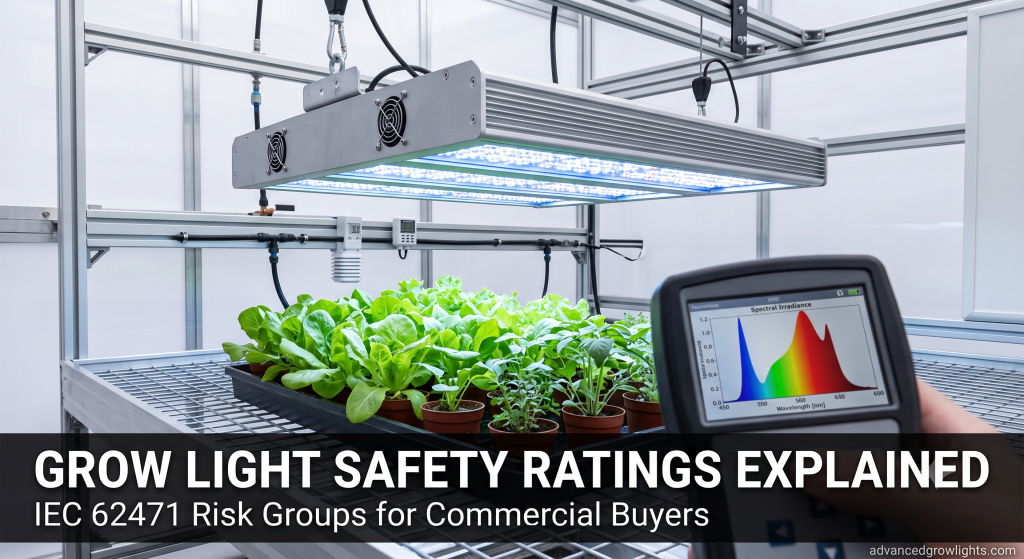
Every DLC-listed grow light on the market passed a test almost no buyer ever asks to see. It has nothing to do with PPFD, efficacy, or spectrum. It measures whether the fixture can injure the people standing under it. That test is IEC 62471, and since 2023 it has been a hard requirement inside ANSI/CAN/UL 8800, the safety standard the DesignLights Consortium now requires for horticultural QPL listing. If your facility buys rebate-eligible fixtures, you already own equipment that carries a Risk Group rating. Most buyers don’t know what number they got.
That gap matters more in 2026 than it did five years ago. Fixtures have gotten more powerful per square foot, interlighting has put diodes inside the canopy at arm’s length from workers, and researchers at the University of Washington’s Northwest Center for Occupational Health and Safety have flagged UV overexposure in cannabis cultivation facilities as a real, documented hazard, not a theoretical one. Photobiological safety used to be a line item for compliance departments. Commercial operators now need to understand it well enough to ask their supplier the right question.
The Standard Behind the Sticker
UL published the first edition of UL 8800, the Standard for Horticultural Lighting Equipment and Systems, in August 2019. UL expanded its scope in March 2023 to cover indoor wet-environment ratings and updated photobiological markings, then revised it again in March 2025. The standard folds in photobiological safety requirements that mirror IEC 62471, the international standard for photobiological safety of lamps and lamp systems. A fixture cannot pass UL 8800 without a completed IEC 62471 assessment attached to it.
The DesignLights Consortium doesn’t run its own safety lab. It leans on UL 8800 as a technical requirement for any fixture seeking a spot on the Horticultural Lighting QPL. Chase a rebate through your utility, and you’ve chased your way into a fixture that already carries a photobiological Risk Group classification, whether the spec sheet mentions it or not.
What IEC 62471 Actually Tests
IEC 62471 assesses optical radiation hazards to human eyes and skin across the 200nm to 3,000nm range, a far wider window than the visible spectrum a PAR meter reads. The standard breaks that range into distinct hazard bands: actinic and near-UV hazard for skin and eyes (200-400nm), retinal blue light hazard (300-700nm), retinal thermal hazard (380-1,400nm), and infrared radiation hazard to the cornea and lens (780-3,000nm).
A grow light spectrum tuned for photosynthesis sits right in the middle of several of these bands. Blue peaks that boost compact growth and red peaks that drive flowering both fall inside ranges IEC 62471 was built to measure. The test doesn’t care what the light does to a plant. It measures what the same photons do to a cornea, a retina, or exposed skin over a defined exposure time.
Risk Groups, From Exempt to Banned
IEC 62471 sorts light sources into four risk groups. UL 8800 only allows three of them on a horticultural fixture. Risk Group 3, the classification that can injure eyes with momentary exposure, is not permitted on any product certified under the standard. That alone rules out the most extreme high-intensity sources from commercial grow light design.
| Risk Group | What It Means | Marking Requirement |
|---|---|---|
| RG0 (Exempt) | No photobiological hazard under normal use conditions | None required |
| RG1 (Low Risk) | No hazard under normal behavioral limitations, including the blink and aversion response to bright light | Warning label and instructions for use |
| RG2 (Moderate Risk) | Not hazardous because of aversion response to brightness or thermal discomfort, not because the light itself is weak | Warning label and instructions for use |
| RG3 (High Risk) | Can injure eyes or skin even with momentary exposure | Not permitted under UL 8800 for horticultural fixtures |
RG2 is where the nuance lives. RG1 fixtures are rated safe under normal behavioral conditions without leaning on any protective reflex. RG2 fixtures only clear the standard because testing assumes a person’s aversion response, the reflex to blink or look away from something too bright, the same mechanism that keeps most people from staring at the sun. Translate that into a grow room: an RG2 fixture is not dangerous to glance at. It becomes a real risk when someone works close to it, repeatedly, without eye protection, for reasons that have nothing to do with a rare accident and everything to do with a normal shift.
RG0 and RG1 cover the large majority of general horticultural fixtures on the market. RG2 shows up more often on high-intensity supplemental and UV-heavy products, the same category this site’s UV and far-red coverage already treats with caution for plant response reasons. The photobiological rating is a separate question from spectral effectiveness, and a fixture can be excellent at both PPFD and RG1 at once. Buyers need to check both.
The Occupational Health Case, Not Just the Compliance One
Researchers at the University of Washington’s Northwest Center for Occupational Health and Safety have identified UV overexposure in cannabis cultivation facilities as a documented workplace hazard, tied to skin damage, premature aging, immune effects, and eye injury from cumulative exposure. That research targets a specific, growing workforce: people who spend full shifts inside rooms lit for plant growth, not human comfort, often working directly beneath or beside fixtures during defoliation, trellising, and harvest.
OSHA’s general eye and face protection standard already requires employers to provide appropriate protection wherever workers face a hazard capable of causing eye injury, and the agency’s guidance explicitly names UV-protective eyewear for workers exposed to UV-emitting light sources. A cultivation facility running RG1 or RG2 fixtures with a UV supplemental component has an obligation that predates any grow-light-specific rule. The photobiological Risk Group tells a safety manager how seriously to take it.
Where This Shows Up on the Floor
Consider a mid-size flower room running interlighting, the technique this site covered in detail in its piece on putting LED fixtures inside the canopy. Interlighting puts diodes at arm’s length from a worker’s face during every trellising and defoliation pass, a different exposure pattern than a fixture mounted eight feet overhead. Two fixtures with identical PPFD output and identical spectrum can carry different Risk Group ratings depending on driver current, optic design, and how tightly the light is focused. The spec sheet won’t tell you which one your crew is safer working next to. The IEC 62471 test report will.
A practical worked example: a facility manager evaluating two competing interlighting bars for a retrofit asks both manufacturers for their UL 8800 photobiological test summary. Fixture A comes back RG1, with a manufacturer-specified minimum viewing distance and no additional PPE requirement beyond standard eye protection already in use on the floor. Fixture B comes back RG2, with a warning label calling for eye protection during any close-range maintenance work and a documented safe exposure duration. Both fixtures might hit the same efficacy target. Only one of them changes the facility’s PPE program and training requirements. That’s a real cost difference that never shows up in a µmol/J comparison, and it’s the kind of detail a rebate program checks for even when a buyer doesn’t.
What to Ask Your Manufacturer
Before the next fixture order goes out, ask for three documents that most manufacturers already have on file because DLC listing requires them:
- The IEC 62471 photobiological safety test report, with the assigned Risk Group stated explicitly, not implied.
- The UL 8800 certification listing, confirming the fixture passed as a complete system, not as a component alone.
- Manufacturer-specified safe viewing distance and any required PPE, especially for interlighting, top-lighting retrofits, or any install that puts workers within a few feet of the diodes.
A manufacturer that can’t produce these on request is either selling a fixture that never went through DLC-eligible certification, or one that isn’t being fully transparent about what it submitted. Neither is a reason to walk away automatically, since plenty of legitimate fixtures sell outside the DLC program entirely. It is a reason to ask harder questions before installing it in a room your people work in eight hours a day.
FAQ
Is RG2 dangerous for normal grow light use?
Not for casual exposure. RG2 fixtures rely on a person’s natural aversion response, the reflex to look away from something too bright, to keep exposure below the hazard threshold. Risk rises with close, sustained, repeated exposure during tasks like trellising or maintenance, which is exactly why UL 8800 requires warning labels and instructions on RG2 products.
Can a grow light legally be Risk Group 3?
Not under ANSI/CAN/UL 8800. Fixtures classified RG3, the highest hazard tier under IEC 62471, are not permitted for horticultural lighting equipment certified to the standard. That effectively removes RG3-class sources from the commercial DLC-eligible market.
Does DLC rebate eligibility require UL 8800 certification?
Yes. UL 8800 is a technical requirement for a fixture to qualify for the DesignLights Consortium’s Horticultural Lighting QPL, and the photobiological safety testing inside UL 8800 is based on IEC 62471. A fixture on the QPL has already been through this assessment.
Do UV supplemental fixtures carry different risk than full-spectrum white light bars?
UV wavelengths fall inside the actinic UV hazard band (200-400nm) that IEC 62471 evaluates on its own, in addition to the broader retinal blue light hazard band (300-700nm) that every visible-spectrum LED fixture gets tested against. UW occupational health researchers specifically flagged UV overexposure as a documented risk in cannabis cultivation settings, so UV-supplementing fixtures warrant closer attention to their Risk Group and any manufacturer-specified exposure limits.
What PPE should cultivation staff wear around high-intensity LED fixtures?
OSHA’s eye and face protection standard requires employers to provide protection appropriate to the specific hazard, which for grow light exposure typically means eyewear rated for the wavelengths the fixture emits, not generic sunglasses. The manufacturer’s IEC 62471 documentation should specify what protection level applies to that particular fixture.
Does a higher Risk Group mean a fixture is more effective at growing plants?
No. Risk Group is a human-safety classification, not a performance metric. A fixture’s photosynthetic efficacy, covered in this site’s PPFD and DLI explainer, is measured and reported entirely separately from its photobiological Risk Group. The two ratings answer different questions and neither predicts the other.
How often does UL 8800 get updated?
UL published the original standard in August 2019, expanded its scope in March 2023 to address wet-environment ratings and photobiological markings, and issued a further revision in March 2025. Buyers evaluating older fixture certifications should confirm which edition of the standard a product was tested against.
Where can I find manufacturers with verified specs and compliance data?
The Advanced Grow Lights directory tracks verified specifications across dozens of commercial grow light brands, and is a good starting point before you request photobiological documentation directly from a manufacturer.
Photobiological safety won’t show up on a spec sheet next to efficacy and PPFD, and most sales reps won’t bring it up unless asked. It’s already baked into every DLC-listed fixture on the market. The only question is whether your facility knows which Risk Group it bought, and whether your PPE program matches it. Ask for the IEC 62471 report before the next order, not after an incident report.
Is RG2 dangerous for normal grow light use?
Not for casual exposure. RG2 fixtures rely on a person’s natural aversion response, the reflex to look away from something too bright, to keep exposure below the hazard threshold. Risk rises with close, sustained, repeated exposure during tasks like trellising or maintenance, which is exactly why UL 8800 requires warning labels and instructions on RG2 products.
Can a grow light legally be Risk Group 3?
Not under ANSI/CAN/UL 8800. Fixtures classified RG3, the highest hazard tier under IEC 62471, are not permitted for horticultural lighting equipment certified to the standard. That effectively removes RG3-class sources from the commercial DLC-eligible market.
Does DLC rebate eligibility require UL 8800 certification?
Yes. UL 8800 is a technical requirement for a fixture to qualify for the DesignLights Consortium’s Horticultural Lighting QPL, and the photobiological safety testing inside UL 8800 is based on IEC 62471. A fixture on the QPL has already been through this assessment.
Do UV supplemental fixtures carry different risk than full-spectrum white light bars?
UV wavelengths fall inside the actinic UV hazard band (200-400nm) that IEC 62471 evaluates on its own, in addition to the broader retinal blue light hazard band (300-700nm) that every visible-spectrum LED fixture gets tested against. UW occupational health researchers specifically flagged UV overexposure as a documented risk in cannabis cultivation settings, so UV-supplementing fixtures warrant closer attention to their Risk Group and any manufacturer-specified exposure limits.
What PPE should cultivation staff wear around high-intensity LED fixtures?
OSHA’s eye and face protection standard requires employers to provide protection appropriate to the specific hazard, which for grow light exposure typically means eyewear rated for the wavelengths the fixture emits, not generic sunglasses. The manufacturer’s IEC 62471 documentation should specify what protection level applies to that particular fixture.
Does a higher Risk Group mean a fixture is more effective at growing plants?
No. Risk Group is a human-safety classification, not a performance metric. A fixture’s photosynthetic efficacy is measured and reported entirely separately from its photobiological Risk Group. The two ratings answer different questions and neither predicts the other.
How often does UL 8800 get updated?
UL published the original standard in August 2019, expanded its scope in March 2023 to address wet-environment ratings and photobiological markings, and issued a further revision in March 2025. Buyers evaluating older fixture certifications should confirm which edition of the standard a product was tested against.
Where can I find manufacturers with verified specs and compliance data?
The Advanced Grow Lights directory tracks verified specifications across dozens of commercial grow light brands, and is a good starting point before you request photobiological documentation directly from a manufacturer.