BLOG POST
Grow Light Lifespan: What LM-80 Testing Proves, and Why Drivers Fail First
DesignLights Consortium’s Horticultural V4.0 requirements became mandatory for utility rebates on July 1, 2026, and every commercial buyer now knows the efficacy number to check: 2.5 µmol/J minimum, an 8.7% jump over the old V3.0 floor. Manufacturers advertise it on every spec sheet. DLC tests it, verifies it, and lists it in a public database.
Nobody regulates how long the fixture survives. A grower can compare two 750-watt bars with identical PPE ratings and identical spectra, and still end up with two different outcomes at month 18: one fixture running clean, the other flickering, dimming, or dead. The diodes are almost never the cause. More often, the cause is a $4 capacitor most buyers never think to ask about.
LM-80 and TM-21 testing prove something specific about LED lifespan, and it isn’t what most spec sheets imply. Drivers, not diodes, are the component that decides whether a fixture makes it to year five.
What LM-80 and TM-21 Test, and What They Don’t
IES LM-80 measures one thing: how much light output an LED package loses over time. Chip manufacturers, not fixture brands, run this test. They hold the diode at three fixed case temperatures, a standard pair of 55°C and 85°C plus a third temperature the manufacturer selects, and log lumen output at intervals out to a minimum of 6,000 hours. Ten thousand hours produces a tighter dataset, and reputable chip suppliers publish it.
LM-80 never touches a finished fixture. It tests the bare diode in a lab, isolated from the driver, the housing, the fan, and the greenhouse roof the fixture will sit under in the field. That distinction matters more than most spec sheets let on.
TM-21 is the second half of the equation. It takes LM-80’s raw lumen-decay data and runs an exponential extrapolation to project when the diode will cross a defined threshold. Three thresholds show up in horticultural spec sheets: L70 (70% of initial output remaining, the point most buyers treat as end-of-life), and the tighter L80 and L90 standards some manufacturers apply to premium fixtures. A related figure, B50, states what fraction of a diode population is expected to have crossed that threshold by a given hour count, since not every chip degrades at the same rate.
The Six-Times Rule That Exposes Inflated Lifetime Claims
TM-21 doesn’t let a manufacturer extrapolate forever. IES caps the projection at six times the tested duration. Test for 6,000 hours, and the maximum L70 claim allowed under the standard is 36,000 hours. Test longer, and the ceiling rises with it.
| LM-80 Test Duration | Maximum Valid L70 Claim (6x Rule) |
|---|---|
| 6,000 hours | 36,000 hours |
| 10,000 hours | 60,000 hours |
| 17,000 hours | 102,000 hours |
Apply that table to a real spec sheet claim. Say a manufacturer lists “L70 > 50,000 hours” and, in the fine print, cites 6,000 hours of LM-80 test data behind it. Divide 50,000 by 6,000: the claim extrapolates 8.3 times past the tested window. IES caps that ratio at 6x. The number on the page is not a measurement. It’s a guess dressed up as a certification, and it fails the standard it claims to follow.
Ask for the underlying LM-80 report before you trust an L70 figure on any fixture. If a sales rep can’t produce test hours and case temperature, treat the lifespan number as marketing copy, not data. Efficacy claims get inflated the same way, and the pattern is worth knowing before you read any spec sheet: PPFD, DLI, and efficacy.
Diodes Are Not the First Thing to Fail
Even a well-documented L70 rating only describes the diode. It says nothing about the driver, and in most field failures, the driver is where the fixture dies.
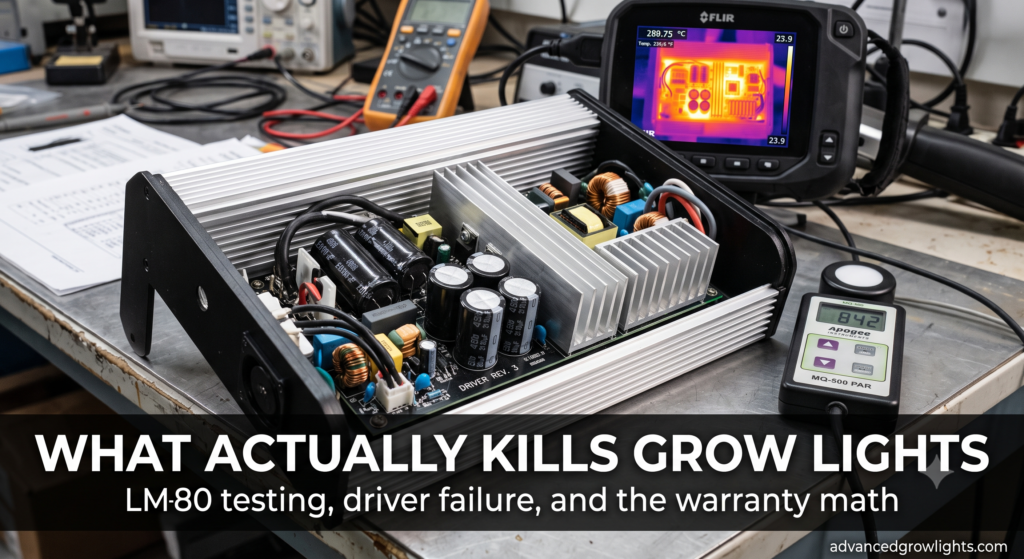
Every switch-mode LED driver depends on electrolytic capacitors to store and smooth power, and those capacitors are the weak link in the circuit. Their lifespan follows a well-documented thermal rule: a 10°C rise in operating temperature cuts the capacitor’s rated life by about half. Manufacturers test driver lifetime at a comfortable 25°C in the lab. A driver mounted inside a sealed fixture on a greenhouse roof can see ambient air near 110°F, with the capacitor itself running hotter once you account for heat trapped inside the housing. The gap between the lab number and the roof number is where warranty claims come from.
Manufacturers also report driver lifetime on a different scale than diode lifetime, and the two figures aren’t interchangeable. MTBF is the worst-misread number on the sheet. It’s the reciprocal of a driver’s constant failure rate, not a median life span. Under the exponential model manufacturers use to calculate it, a population of drivers run to their rated MTBF hour count has already lost close to 63% of its units, not half. The true 50%-failure point has its own name: B50, or median life. L90 on a diode marks a 10% dip in light output, not a failure at all. Three numbers, three different meanings, and spec sheets that stack them without labeling which is which mislead buyers into comparing figures that don’t measure the same thing. Drivers make the problem worse on their own: MTBF assumes a constant, random failure rate, but electrolytic capacitors don’t fail at random. They wear out on a thermal timeline, the same 10°C rule described above, and MTBF can’t capture it.
Power surges compound the problem. Greenhouses running on generators or shared circuits see voltage transients that stress capacitors well beyond steady-state operation, and this shortens real-world life beyond what any lab test predicts. Heat and thermal cycling matter here too, and fixture thermal design has its own effect on component life: passive vs. active cooling.
Four Things to Check Before You Sign a Purchase Order
A DLC listing confirms efficacy and photometric performance. It doesn’t confirm the fixture will survive your environment. Four checks close that gap.
- Request the raw LM-80 report, not the TM-21 summary alone. Test hours and case temperature tell you whether the L70 claim on the spec sheet holds up under the 6x rule.
- Ask for an In-Situ Temperature Measurement Test (ISTMT). This verifies the diode’s real operating temperature inside the finished fixture, not the lab bench. A fixture running hotter than its LM-80 test temperature will underperform its stated lifespan no matter what the marketing says.
- Match the IP rating on the connectors, not the housing alone. IP67-rated enclosures are close to standard for 2026 commercial fixtures, but a sealed housing paired with a lower-rated connector is still a low-IP system at the point where water gets in. Confirm the cable entry points and mated connectors carry the same rating as the housing.
- Check power factor and total harmonic distortion. DLC listing requires horticultural fixtures to hit a power factor above 0.90 and THDi below 20%, and higher-quality drivers beat both figures with room to spare. Weak numbers here mean you’re paying your utility for reactive power you can’t use to grow anything.
Warranty Length Is a Signal, Not a Guarantee
Warranty terms are the closest thing the market has to a manufacturer betting on its own driver. A company covering a fixture for five years is making a different claim about component quality than one covering it for two, even when both fixtures post identical PPE numbers.
| Manufacturer | Warranty Terms |
|---|---|
| Fluence | 3-year standard, optional 5-year extended |
| Build My LED | 5-year full coverage |
| Advanced LED Lights | 3-year full, or limited lifetime coverage on parts (labor excluded) |
| Apollo Horticulture | 2-year full; parts-only after year two, labor at buyer’s cost |
A longer warranty isn’t proof a fixture will outlast a shorter one, and it doesn’t replace the LM-80 and ISTMT documentation above. But it puts real money behind the manufacturer’s confidence in its own driver sourcing. A “limited lifetime” warranty that excludes labor after year three costs a grower more in practice than a straightforward five-year full warranty, even though the first sounds more generous on the box. Read the labor clause before you compare years.
DLC V4.0 Regulates Efficacy. Nobody Regulates Lifespan.
Hort V4.0’s efficacy floor is a real, third-party-tested number, and it did its job: close to 11% of the V3.0-listed products already on the Qualified Products List fell off it for failing to hit 2.5 µmol/J. That’s accountability on one axis of fixture performance.
Lifespan gets none of that scrutiny. No qualification pathway requires a manufacturer to submit driver MTBF data, ISTMT results, or field failure rates to earn a DLC listing. A fixture can clear 2.5 µmol/J on day one and still fail its driver at month 14, and nothing in the certification process would have flagged the risk. The burden sits on the buyer: pull the raw test data, verify it against the fixture you’re buying, and treat any lifespan claim that skips those steps as unverified. DLC’s requirements shape purchasing decisions well beyond this one axis: manufacturer overview.
Frequently Asked Questions
Is there a real difference between LM-80 and TM-21?
Yes. LM-80 is the test: it measures lumen decay in an LED package over a minimum of 6,000 hours at fixed temperatures. TM-21 is the projection: it takes that raw data and extrapolates a lifetime claim, capped at six times the tested duration.
L70 on a grow light spec sheet: what does that number cover?
L70 marks the point where a diode’s light output has dropped to 70% of its original value. It describes the diode alone, not the driver, housing, or fixture as a whole.
Diodes carry 50,000-hour-plus ratings, so why do grow lights still fail early?
In most field failures, the driver fails before the diode shows any real decline. Electrolytic capacitors inside the driver are heat-sensitive, and a fixture running hot inside a sealed housing or greenhouse roof can see driver failure years before the diode approaches L70.
Does a DLC listing guarantee a fixture will last as long as advertised?
No. DLC’s Horticultural Qualified Products List verifies efficacy, photometric output, and testing methodology under LM-79, LM-80, LM-84, and ISTMT protocols. It doesn’t require driver MTBF data or field reliability reporting, so listing status says nothing about how long the fixture will survive in your grow room.
Before buying on a lifespan claim, which documents should a grower request?
Request the raw LM-80 report with test hours and case temperature, an ISTMT report showing in-fixture operating temperature, the driver’s MTBF rating and operating temperature range, and confirmation that the connector IP rating matches the housing rating.
Is a longer warranty always a sign of a more reliable fixture?
Not on its own. A longer warranty reflects manufacturer confidence, but check whether it covers labor as well as parts, and whether coverage steps down after an initial period. A five-year full warranty is a stronger signal than a “limited lifetime” warranty that excludes labor after year three.
Temperature and grow light driver lifespan: how tight is the connection?
Tight. Electrolytic capacitors, the component most likely to fail first inside an LED driver, follow a rule of thumb where every 10°C rise in operating temperature cuts rated capacitor life by about half. Fixtures mounted in hot greenhouse roofs or sealed housings run drivers hotter than their lab-tested rating, and real-world lifespan drops as a result.
Explore verified specs across dozens of commercial fixtures in the AGL grow light directory.
Is there a real difference between LM-80 and TM-21?
Yes. LM-80 is the test: it measures lumen decay in an LED package over a minimum of 6,000 hours at fixed temperatures. TM-21 is the projection: it takes that raw data and extrapolates a lifetime claim, capped at six times the tested duration.
L70 on a grow light spec sheet: what does that number cover?
L70 marks the point where a diode’s light output has dropped to 70% of its original value. It describes the diode alone, not the driver, housing, or fixture as a whole.
Diodes carry 50,000-hour-plus ratings, so why do grow lights still fail early?
In most field failures, the driver fails before the diode shows any real decline. Electrolytic capacitors inside the driver are heat-sensitive, and a fixture running hot inside a sealed housing or greenhouse roof can see driver failure years before the diode approaches L70.
Does a DLC listing guarantee a fixture will last as long as advertised?
No. DLC’s Horticultural Qualified Products List verifies efficacy, photometric output, and testing methodology under LM-79, LM-80, LM-84, and ISTMT protocols. It doesn’t require driver MTBF data or field reliability reporting, so listing status says nothing about how long the fixture will survive in your grow room.
Before buying on a lifespan claim, which documents should a grower request?
Request the raw LM-80 report with test hours and case temperature, an ISTMT report showing in-fixture operating temperature, the driver’s MTBF rating and operating temperature range, and confirmation that the connector IP rating matches the housing rating.
Is a longer warranty always a sign of a more reliable fixture?
Not on its own. A longer warranty reflects manufacturer confidence, but check whether it covers labor as well as parts, and whether coverage steps down after an initial period. A five-year full warranty is a stronger signal than a “limited lifetime” warranty that excludes labor after year three.
Temperature and grow light driver lifespan: how tight is the connection?
Tight. Electrolytic capacitors, the component most likely to fail first inside an LED driver, follow a rule of thumb where every 10°C rise in operating temperature cuts rated capacitor life by about half. Fixtures mounted in hot greenhouse roofs or sealed housings run drivers hotter than their lab-tested rating, and real-world lifespan drops as a result.