
BLOG POST
Light Leaks and Potency: Two Cannabis Grow-Room Rules, Tested Against the Research
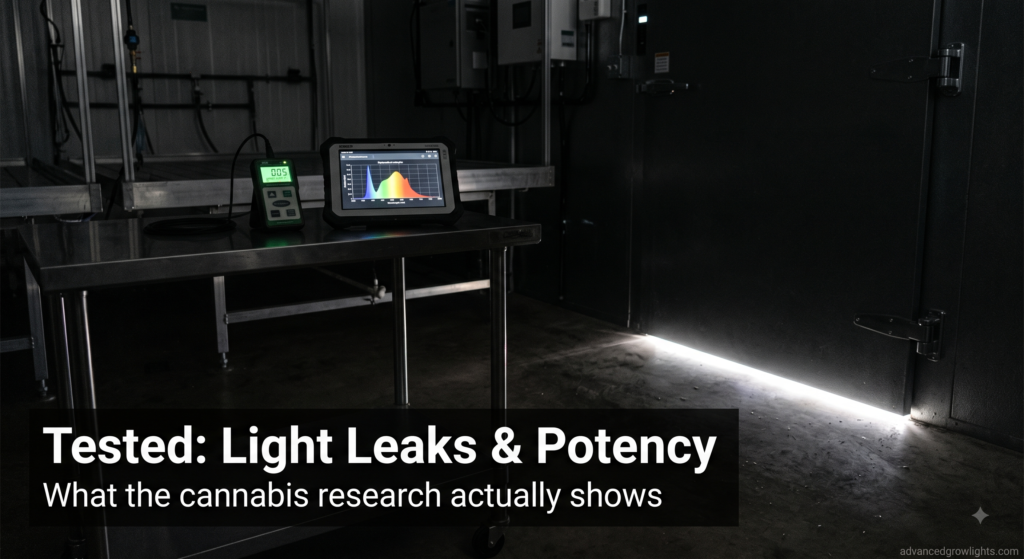
Every commercial cannabis grower inherits a set of rules nobody put in writing. A light leak will turn your girls into hermaphrodites. Push the PPFD higher and you’ll grow stronger flower. Both claims get repeated in forums, at trade shows, and in training manuals for new cultivation techs. One has real science behind it, tested head-on and found wanting. The other has real science behind it too, and it says the opposite of what most growers assume.
The research on both claims tells a sharper story than the forum consensus does.
Myth One: A Light Leak Will Turn Your Plants Hermaphrodite
Where the Rule Comes From
The underlying physiology is real. Cannabis is a short-day plant, and its flowering and sex expression respond to the ratio of light to dark, not just total light received. Photoperiod research on cannabis goes back further than most growers realize: Borthwick and Scully’s 1954 study found that 25 to 45 percent of female plants produced male flowers under 8- and 11-hour photoperiods, while male flower formation dropped off under a 14-hour photoperiod. That’s a real, measured link between light timing and sex expression, and it’s the foundation the light-leak rule got built on.
But Borthwick and Scully tested total photoperiod length, full days of 8, 11, or 14 hours of light. That’s a different question from whether a brief crack of light during an otherwise normal dark period pushes a plant toward hermaphroditism. Growers extrapolated from one to the other, and the extrapolation has intuitive appeal: other short-day plants respond to even brief light pulses during darkness because of how phytochrome resets on exposure to red light. Whether cannabis reacts the same way to a leak under a door, rather than a shortened night, is a separate empirical claim, and until 2024 nobody had tested it in cannabis at all.
The One Study That Tried
A 2024 University of Guelph study set out to test that question head-on. Researcher William Oliver examined 403 indoor plants, using each plant’s distance from the nearest grow room door as a proxy for dark-period light exposure, on the assumption that plants closer to the door caught more stray light. The result: proximity to the door showed no significant relationship to male flower formation, with an average of 0.136 male flowers per plant regardless of position.
That sounds like a clean answer. It isn’t. The study’s own author names the limitation outright: the actual light intensities reaching plants during the dark period in this facility were likely too low to trigger what photobiologists call a low-fluence response, the mechanism that would make a brief light pulse matter in the first place. In plain terms, the leaks in this particular facility may not have been bright enough to test the claim at all. The researchers advised the site’s management not to spend resources chasing door leaks, but they stop short of calling the broader light-leak theory disproven, because their own data couldn’t rule it in or out at meaningful intensities.
Where That Leaves a Commercial Grower
No published study has established a validated light-intensity threshold, in lux or any other unit, above which a dark-period leak reliably triggers hermaphroditism in cannabis. Industry guidance on greenhouse blackout curtains treats “even brief, low-level light exposure” as a risk worth eliminating, but that guidance rests on general short-day-plant photoperiodism and precaution, not a cannabis-specific dose-response curve.
In practice, that argues for sealing light leaks as cheap insurance rather than a confirmed necessity backed by cannabis-specific data. Curtain seams, door gaps, and equipment status lights cost little to fix and carry no downside. Treat the rule as unproven rather than either confirmed or busted, and keep doing what light-tight construction already recommends for reasons beyond sex expression: consistent dark periods also matter for CO2 scheduling and reducing plant stress from irregular light cues.
The asymmetry explains why the rule survives without proof. A hermaphroditic plant in a commercial flower room can pollinate an entire canopy, turning a harvest of sinsemilla flower into a room full of seeded product worth a fraction as much. Sealing a door gap costs a roll of weather stripping. Losing a room to self-pollination costs a harvest. Growers don’t need a peer-reviewed threshold to make that trade, and the absence of one doesn’t mean the caution is misplaced, only that nobody has measured exactly where the risk starts.
Myth Two: Pushing PPFD Higher Increases Potency
What the Guelph Team Found
A separate, better-controlled Guelph study, led by Victoria Rodriguez-Morrison with David Llewellyn and Youbin Zheng, ran cannabis ‘Stillwater’ through a full 12-week flowering cycle under eight target PPFD levels, from 200 to 1,600 µmol/m²/s, with measured canopy-level values ranging from 120 to 1,800 µmol/m²/s across the trial. Daily light integral ranged from 5.2 to 78 mol/m²/day across those treatments, published in Frontiers in Plant Science in 2021.
Inflorescence dry yield rose from 116 to 519 grams per square meter across that range, a linear relationship with no sign of leveling off even at the highest intensity tested. Cannabinoid potency told a different story. The paper says it in plain terms: there were no PPFD treatment effects on the potency of any measured cannabinoid. Total terpene concentration climbed some, about 40 percent across the same range, but the compounds growers and consumers associate most closely with strength, THC and CBD content, stayed flat regardless of how much light the canopy received.
A related 2022 study from the same research group tested supplemental UV radiation on its own and found the same pattern: yield scaled with light intensity, and neither yield nor cannabinoid content moved with added UV. Two independent trials from the same lab point at the same conclusion. Light intensity buys you more flower. It doesn’t buy you stronger flower.
| Metric | Low-Light Treatment (~120 µmol/m²/s) | High-Light Treatment (~1,800 µmol/m²/s) |
|---|---|---|
| Daily light integral | 5.2 mol/m²/day | 78 mol/m²/day |
| Inflorescence yield | 116 g/m² | 519 g/m² |
| Cannabinoid potency | Baseline | No treatment effect |
| Total terpene concentration | Baseline | About 40% higher |
Where This Sits Against Real Commercial Targets
The Guelph trial’s range runs well past what most flower rooms run day to day. Commercial cannabis flower rooms typically target 700 to 900 µmol/m²/s under ambient CO2, or 900 to 1,500 µmol/m²/s with CO2 enrichment, aiming for a daily light integral in the 35 to 50 mol/m²/day range across a 12-hour flowering photoperiod. That places most commercial operations in the middle of the Guelph study’s tested range, not at its upper edge, which means the flat potency line the study found applies squarely to the intensities growers are already running, not just an extreme case.
The Math Commercial Buyers Should Run
The yield relationship is linear, but linear isn’t the same as proportional, and the difference matters for anyone pricing out a lighting upgrade. Working from the study’s own reported endpoints, the regression works out to close to 0.24 grams per square meter for every additional µmol/m²/s of PPFD, applied on top of a 116 g/m² baseline. Run that math at 900 µmol/m²/s, a common mid-range commercial target, and the model predicts about 303 g/m². Double the PPFD to 1,800, and yield reaches 519 g/m², a 71 percent increase for a 100 percent increase in light intensity and the electrical draw that comes with it.
That’s a real return, but it’s a shrinking one in percentage terms, and it says nothing about potency at all. A facility chasing maximum PPFD on the theory that it’s buying stronger flower is chasing the wrong variable. Potency in this dataset tracks genetics, not photon flux. For background on how PPFD and DLI targets get set in the first place, see our PPFD and DLI explainer, and for a look at where UV supplementation claims hold up against the marketing, see our UV and far-red breakdown.
What This Means for Facility Decisions
Neither finding argues for a single obvious policy change, and that’s the honest takeaway. On light leaks, seal them anyway, since the fix is cheap and the theoretical risk, even if unconfirmed at cannabis-specific intensities, costs nothing to eliminate. On PPFD and potency, stop treating peak light intensity as a potency lever in a purchasing decision. If a fixture rep pitches higher PPFD as a route to stronger flower, ask for the cannabinoid data behind that claim, not a yield chart. The Guelph data says yield and potency respond to different inputs, and conflating them in a capital equipment decision means paying for photons that won’t do what the sales conversation implied.
Commercial genetics selection, curing, and post-harvest handling all move potency more than incremental PPFD does once a facility clears the intensity levels most modern LED fixtures already deliver. Where PPFD does keep paying off is yield, and that’s a legitimate return on investment, just not the one the light-leak-and-potency folklore usually promises.
Does a light leak during the dark period cause cannabis plants to hermaphrodite?
Direct research on this exact question is limited to one 2024 University of Guelph study, and that study’s own authors say their light intensities were probably too low to test the claim in any meaningful way. The underlying photoperiod science that inspired the rule is real, but the specific claim about brief light leaks remains unproven rather than confirmed or disproven.
What did the 1954 Borthwick and Scully study show?
It found that 25 to 45 percent of female cannabis plants produced male flowers under short 8- and 11-hour photoperiods, while male flower formation dropped under a 14-hour photoperiod. That study tested full photoperiod length, not brief interruptions to an otherwise normal dark period, which is a related but distinct question from the light-leak claim.
Is there a known safe light intensity for grow room door leaks or curtain gaps?
No published, cannabis-specific threshold exists in lux or any comparable unit. Industry blackout curtain guidance treats any low-level light exposure during the dark period as a precaution worth eliminating, based on general short-day-plant physiology rather than a confirmed cannabis dose-response curve.
Does higher PPFD increase THC or CBD potency?
No, according to the best-controlled study on this question. A 2021 University of Guelph trial testing PPFD from 120 to 1,800 µmol/m²/s found no treatment effect on the potency of any measured cannabinoid, even as inflorescence yield increased more than fourfold across the same range.
Does higher PPFD do anything to cannabinoid or terpene content?
Terpene concentration rose modestly, about 40 percent, across the tested light range in the Guelph study. Cannabinoid potency showed no measurable response to light intensity in that same trial.
If PPFD doesn’t drive potency, what does?
Genetics is the primary driver of cannabinoid potency in this research. Curing and post-harvest handling also affect measured potency and terpene retention. Light intensity in these studies drove yield, not the concentration of cannabinoids in the flower produced.
Should commercial growers stop investing in higher-PPFD fixtures?
Not necessarily. Higher PPFD delivered a real, linear yield increase in the Guelph data, which is a legitimate return if the added yield covers the added electrical and equipment cost. The mistake is treating that same investment as a potency upgrade, which the data doesn’t support.
Should growers still bother sealing light leaks if the research is inconclusive?
Yes. The fix costs little, and consistent dark periods matter for reasons beyond sex expression, including CO2 scheduling and reducing irregular light stress on the plant. Treat leak-sealing as low-cost insurance against an unresolved risk, not a confirmed one.