BLOG POST
Blue Light Fraction: The Grow Light Spec That Decides Yield and Quality
Every grow light spec sheet lists photon efficacy, PPF, and a spectrum chart. Most buyers read the efficacy number and skip the chart. The chart holds the number that changes your crop more than any other spectral choice: the blue photon fraction.
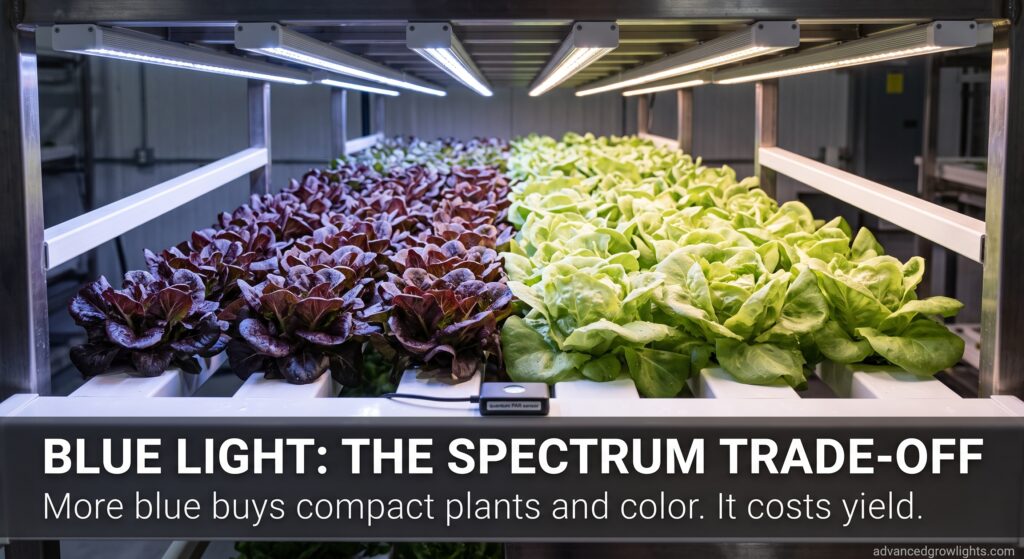
Blue photons sit between about 400 and 500 nanometers. In lettuce and most leafy crops, raise their share and plants get shorter, leaves get smaller, red cultivars deepen in color, and yield drops; lower it and you gain biomass but lose that shape control and pigment. Cannabis runs a narrower version of the same trade: blue fraction moved yield in a clean, measured way without reliably changing plant height or structure. Research groups working on both crops have now put hard numbers on their respective trade-offs, and the numbers point to a spectrum strategy that splits the crop cycle in two.
Blue light drives plant shape, not just photosynthesis
Plants detect blue light mainly through cryptochrome and phototropin photoreceptors, with a supporting role from the blue-absorbing band of phytochromes A and B and from the Zeitlupe family’s part in circadian timing. All of that sits apart from the chlorophyll that runs photosynthesis. Those receptors govern stem extension, leaf expansion, stomatal opening, and the synthesis of protective pigments. A seedling under blue-poor light stretches and pushes out thin, wide leaves. The same seedling under blue-rich light stays compact with thicker, darker leaves.
For a vertical farm running 12-inch tier spacing, that compactness is the whole game. For a greenhouse tomato crop that has to reach a high wire, some stretch is useful. The right blue fraction depends on the architecture you want, and that target moves by crop and by production system.
The yield cost of blue light, measured
Utah State University’s Crop Physiology Laboratory ran the cleanest test on cannabis. Westmoreland, Kusuma, and Bugbee grew flower under five light sources spanning 4% to 20% blue photons, from an HPS reference up to a 5000K LED. Across three trials, flower yield fell 12.3% as blue rose from 4% to 20%. That comes out to about 0.77% of yield for each percentage point of blue added. Cannabinoid concentration did not track spectrum at all, though the crop tested makes that finding narrower than it sounds. The trial used ‘Trump’, an industrial hemp cultivar bred and regulated to keep THC at trace legal levels, so THC is not the meaningful number from this study. The cannabinoid that mattered was CBD-equivalent (CBDeq), which ranged from about 7.6% to 11.8% and showed no consistent pattern across the blue treatments. Spectrum did not move cannabinoid concentration in this hemp trial. Whether the same holds for THC-type cultivars has not been tested here.
The same paper made a second point that carries more weight for a buying decision. Swapping the double-ended HPS fixture (1.72 micromoles per joule) for an LED (2.40 to 2.51 micromoles per joule across the LED treatments) drove a 27% gain in yield per electricity dollar, a bigger swing than any spectral difference among the LED models themselves. The authors concluded that efficacy beats spectral tuning for cost-effective production. Blue fraction is a control for crop quality and canopy structure, not a route to more grams per watt.
Lettuce shows the leaf-area side of the same effect. Researchers at the University of Delaware raised the blue fraction in a broad white spectrum on red-leaf lettuce and watched shoot fresh mass, dry mass, leaf number, leaf size, and plant diameter decline together while red coloration deepened. A 2026 study from Cornell University and the University of Tokyo, published in Frontiers in Plant Science, compared a 20% blue band against a 20% green band layered on 80% red at 255 micromoles per square meter per second. The 454-nanometer blue treatment produced the strongest reduction in leaf area and canopy expansion of any waveband tested.
Blue and far-red pull in opposite directions
Far-red light drives leaf expansion and stem elongation through the phytochrome system. Blue light restrains both. Growers who add far-red to grow bigger leaves and capture more light often find their plants turning leggy and pale, and the fix is more blue, not less far-red. A 2025 study in Frontiers in Plant Science on arugula and lettuce tested that interaction head-on. Under a low blue fraction, adding far-red plus a positive day-night temperature difference cut yield. A high blue fraction canceled that loss. The two spectral regions work as a pair. If you raise far-red, check that blue is high enough to hold plant form.
This is the practical case for a tunable fixture over a fixed spectrum, in the crops where this interaction has been tested: leafy greens and herbs. A basil or lettuce grower running a far-red bar late in the cycle to push leaf size wants that far-red without the stretch, and a higher blue channel during that window holds canopy form. Cannabis is a different case. The Utah State trial found blue fraction had no statistically significant effect on cannabis plant height (p = 0.13) or harvest index (p = 0.91), so blue alone is not a proven lever against stretch in that crop the way it is in leafy greens.
Blue light buys compactness and color
Everything blue light costs in biomass, it returns somewhere else.
Compact plants
A high blue fraction shortens internodes and tightens canopy structure. On a multi-tier rack, shorter plants mean more tiers in the same room and less risk of the canopy growing into the fixture above it. The Delaware and Cornell results both show plant diameter and leaf area shrinking as blue climbs, which is the response a plant-factory operator wants.
Pigment and phytochemicals
Blue photons activate the pathway that builds anthocyanins, the red and purple pigments that make premium salad cultivars look premium. The Cornell and Tokyo group found that 454-nanometer blue produced the highest chlorophyll content of any waveband, and that a short blue treatment lifted anthocyanin in the red ‘Red Oak’ cultivar. Blue-driven pigment also tracks with higher phenolic content, a trait that leafy-greens buyers now ask about.
Stomatal control and resilience
Blue light opens stomata and tends to produce sturdier plants that move from propagation to production with less transplant shock.
Green light is the fraction most growers ignore
The Cornell and Tokyo study carried a result that cuts against a common assumption. Their 523-nanometer green treatment produced greater fresh weight and leaf area than the 454-nanometer blue treatment at the same 20% substitution. Green is not wasted light. Leaves absorb about 75% to 85% of green photons against more than 95% of blue. Inside a single leaf, that lower absorption lets more green light survive the first pass through the upper cell layers and scatter far enough to reach chloroplasts deeper in the mesophyll. Across a canopy, the same weak absorption means upper leaves transmit a larger share of green light through to the leaves below them, so shaded lower leaves see more usable photons under a green-supplemented spectrum than they would under blue or red alone.
That penetration has a measured payoff in fruiting crops. A greenhouse study on sweet pepper found that adding green light raised fruit weight and dry matter content, and the authors traced the gain to more light reaching the lower canopy and driving photosynthesis there. For a dense crop, a spectrum with 10% to 20% green can distribute photons through the canopy better than a blue-heavy spectrum at the same intensity.
A short blue finish before harvest
The most useful finding for a working grower is a timing result. The Cornell and Tokyo team grew ‘Rex’ (green butterhead) and ‘Red Oak’ (red leaf) lettuce under 80% red plus 20% green for the full cycle, then swapped the green for 454-nanometer blue for the last 2, 4, or 8 days. Two days of blue at the end held biomass steady and deepened leaf color in both cultivars. Past that point the response split by cultivar: ‘Red Oak’ lost fresh weight at 4 and 8 days of blue, while ‘Rex’ showed no significant drop in fresh or dry weight at either duration. A longer blue finish is a real option for green cultivars. For red ones, it is a yield risk.
That splits the cycle into two spectra. Run a low-blue, green-supported spectrum through the bulk of production to bank biomass, then raise blue for the final 48 hours to bring up color and phenolics without a yield penalty. Any fixture with a controllable blue channel or a separate blue bar can run this. Operations growing red-pigmented lettuce, basil, or microgreens have the most to gain, since color at the point of sale sets the price. This end-of-production tactic pairs with pre-harvest UV dosing, which AGL covers in UV and Far-Red Supplemental Lighting: Science vs. Marketing.
An HPS-to-LED switch will change your crop
An HPS lamp runs about 4% to 6% blue. A white LED runs anywhere from about 9% (3000K) to over 20% (5000K and up), and manufacturers who add supplemental red diodes to a white LED base can push the blue fraction lower still, sometimes into single digits, without changing the CCT label on the spec sheet. A grower who swaps HPS for LED at the same PPFD roughly doubles to quintuples the blue fraction the canopy sees, depending on which LED they pick, and the crop responds. In leafy and ornamental crops, expect shorter internodes, smaller and thicker leaves, and deeper green or red color. Cannabis does not reliably follow that pattern: the Utah State trial found no significant height or harvest-index effect from blue fraction alone, so don’t assume an HPS-to-LED swap will tighten cannabis structure on its own. None of this is a defect. It catches growers off guard because they attribute the change to the fixture brand rather than to the spectrum shift behind it.
Two adjustments smooth the transition. Drop target PPFD by 10% to 15% for the first cycle while the crop adapts to the harder spectrum, then bring it back up. A standard 3000K white LED already sits close to HPS-like blue levels, around 9% to 12%, so check the spectral report before assuming you need an exotic low-blue blend. Fixtures running noticeably below that usually add supplemental red diodes to dilute the blue fraction further. Growers moving from HPS also report needing to adjust vapor-pressure-deficit management, and spectrum is not the main reason why. HPS puts out far more radiant heat than LED, roughly 55% of its energy as infrared versus about 15% for LED, so an HPS canopy runs warmer than the surrounding air while an LED canopy tracks closer to ambient, often a degree or more cooler at the leaf surface for the same room temperature. That lower leaf temperature cuts leaf-to-air VPD and slows transpiration unless the grower raises room temperature or lowers humidity to compensate. Blue light does open stomata to a degree, but the heat-load difference between the two fixture types is the bigger lever here.
Reading blue fraction off a spec sheet
Manufacturers seldom print a single “blue %” figure. You calculate it from the spectral distribution chart or the photon flux table, dividing photon output in the 400 to 500 nanometer band by total PPF across 400 to 700. Some brands publish the photon ratios that make this quick. Others give a chart you read by eye.
| Fixture type | Approx. blue fraction (400-500 nm) | Canopy effect |
|---|---|---|
| HPS / DE-HPS | 4-6% | Tall, stretched growth; weak pigment |
| 3000K white LED | 9-12% | Moderate stretch; balanced for fruiting crops |
| 4000K white LED | 13-17% | Compact growth; a solid general CEA choice |
| 5000K+ white LED | 18-24% | Strong compactness and color; yield trade-off |
| White LED + supplemental red diodes | 8-16% | Added red dilutes the blue fraction below the base diode’s CCT-typical level |
| Blue-red “blurple” | 10-25% (varies) | Depends on channel mix; read the chart |
| Tunable multi-channel | User set | Low blue for the bulk of the cycle, high blue to finish |
Blue fraction targets by crop
| Crop / goal | Suggested blue fraction | Reasoning |
|---|---|---|
| Leafy greens, biomass priority | 8-12% | Protects leaf area and yield |
| Red-pigmented lettuce, retail color | 12-18%, plus a 2-day high-blue finish | Color without a full-cycle yield loss |
| Vertical farm, tight tier spacing | 15-20% | Compactness outranks peak yield |
| Cannabis flower | 10-15% | Above 15% costs about 0.77% yield per point |
| Greenhouse tomato or cucumber to a high wire | 6-10% | Some stretch helps the crop reach the wire |
| Propagation and cuttings | 15-25% | Sturdy, compact transplants |
A worked example
A plant-factory operator runs 2,000 square feet of red butterhead on five tiers. Two fixtures are on the table. Fixture A delivers 3.4 micromoles per joule at 12% blue. Fixture B delivers 3.0 micromoles per joule at 20% blue, with a deeper pigment response in the marketing photos.
Fixture A wins on the meter. At the same target DLI it draws about 12% less power than Fixture B, and across five tiers and a year of runtime that gap is the larger line on the P&L. Fixture B’s color advantage is real but small. The operator can close most of it by running Fixture A with a two-day blue boost from a supplemental bar, or by ordering Fixture A in a cooler-white build near 18% to 20% blue and accepting a small efficacy give-back. The spectrum chart informs the decision. The efficacy number still leads it. For the efficacy side of this math, see PPFD, DLI, and Efficacy Explained. For a broader spectrum framing, see Full-Spectrum vs Narrow-Band Grow Lights.
The practical summary
Blue fraction is a crop-steering control, not a yield booster. Set it low enough to protect biomass, high enough to get the plant shape and color your market pays for, and use a tunable channel to lift it for the last two days if you grow pigmented crops. Then choose the fixture on efficacy. AGL lists verified photon efficacy and spectral data for commercial fixtures from Gavita, Fluence, Lumatek, and dozens of other manufacturers in the directory.
Does more blue light increase THC or CBD?
No, based on the available research. The Utah State trial used ‘Trump’, an industrial hemp cultivar, so THC stayed at trace legal levels throughout and CBD-equivalent (CBDeq) was the metric that mattered; it showed no consistent change across 4% to 20% blue. Because higher blue lowers total flower yield, grams of cannabinoid per plant fall as blue rises regardless of concentration.
How much blue light does lettuce need?
For biomass, 8% to 12% protects leaf area and yield. For red cultivars sold on color, 12% to 18% works, and a two-day high-blue finish at the end of the cycle adds pigment without the full-cycle yield cost.
Is green light wasted in a grow light spectrum?
No. Green penetrates deeper into leaves and canopies than blue or red. A 2026 Cornell and University of Tokyo lettuce study found green outperformed blue for fresh weight and leaf area at the same 20% fraction.
Does blue light make plants shorter?
For most leafy and ornamental crops, yes. Blue activates photoreceptors that suppress stem extension. The effect on cannabis height in the Utah State work did not reach significance, so the size of the response varies by crop.
Can I change the blue fraction on a fixture I already own?
Only if it has a separate blue channel or you add a blue supplemental bar. Fixed-spectrum white LED fixtures run one blue fraction for the life of the fixture.
What blue fraction does an HPS lamp produce?
About 4% to 6%. That low blue share is why HPS crops stretch and why red lettuce grown under HPS stays pale.
Should propagation lights carry more blue than flowering lights?
Yes. A blue fraction of 15% to 25% during propagation produces compact, sturdy transplants that handle the move to production with less shock.
Blue fraction or photon efficacy: which matters more when buying?
Efficacy. In the Utah State trial, switching from double-ended HPS to LED, roughly 1.7 to 2.5 micromoles per joule, drove a 27% gain in yield per electricity dollar, more than any spectral difference among the LED models tested. Set blue fraction for the crop response you want, then choose among fixtures that hit it on efficacy.