BLOG POST
Why Commercial Grow Lights Are Losing Their Onboard Drivers
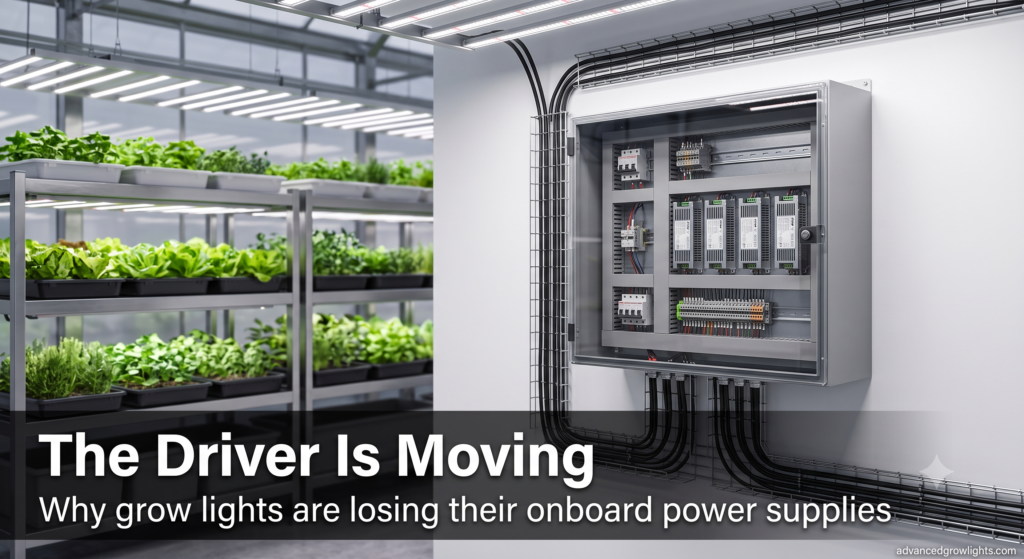
LED power supplies are the single most common point of failure in commercial grow lights, ahead of the diodes themselves. That fact is reshaping how CEA facilities wire their canopies. Instead of building the failure point into every fixture, some growers are moving it off the canopy altogether, into a centralized cabinet down the hall.
The Weak Link Inside Every Grow Light
Every LED grow light contains two very different components bolted together. The diode array does the photochemistry: converting electricity into photons in the 400-700nm band your crop uses. The driver does something far less glamorous: it converts incoming AC power into the regulated DC current the diodes need, and it does that job in the worst possible environment for electronics: high humidity, heat radiating off the fixture itself, and vibration from HVAC and irrigation equipment running nearby.
TSRgrow, a horticultural lighting and controls company, doesn’t mince words: drivers are “the first component of a grow light to fail,” and replacing one means climbing into an active grow room, disrupting the photoperiod, and doing electrical work above wet benches. Trade coverage from Buildings.com confirms the pattern industry-wide: LED power supplies rank as “the single most common point of failure” across commercial installations, ahead of the diodes, ahead of the optics, ahead of everything else in the fixture.
That’s the diagnosis multiple vendors reached on their own. The prescription varies by company, but the shared idea is the same: pull the driver off the fixture and out of the grow room.
Distributed vs. Centralized: The Core Difference
Distributed power, the default in almost every fixture sold today, puts a driver inside or bolted to each individual light. Buy forty fixtures, install forty drivers, and accept forty separate points where humidity, heat, or a bad capacitor can take out a section of canopy.
Centralized (or “remote”) architecture separates the two jobs. AC-to-DC conversion happens in a cabinet outside the grow space, in a dry, temperature-controlled electrical room. DC power then runs to the fixtures themselves, which become passive light-emitting devices with nothing left inside them to fail except the diodes.
Heat and Maintenance, Not Just Failure Rates
The heat argument is separate from the failure-rate argument, and it might matter more to your HVAC budget. TSRgrow argues that pulling drivers out of the grow room lets HVAC systems focus on “conditioning heat directly related to the photons” instead of also absorbing driver waste heat multiplied across hundreds of fixtures. Every driver that stays on a fixture adds a small, constant heat load to a room you’re already paying to cool. Multiply that by a commercial canopy’s fixture count and the number stops being small.
Maintenance economics follow the same logic. A technician swapping a failed centralized power module works in a dry electrical closet, on a schedule, without touching the crop. A technician replacing a failed on-fixture driver works above wet benches, mid-cycle, often under time pressure because the plants below are losing light.
Three Vendors, Three Versions of the Same Idea
No single standard defines centralized driver architecture yet, and the approaches on the market differ enough that they’re worth separating.
VoltServer’s Digital Electricity
VoltServer sells a high-voltage DC distribution system it calls Digital Electricity, which pulses power about 500 times a second and cuts power the instant it detects a fault, before the circuit can pose a shock or fire risk. Ontario’s Greenseal Cannabis installed the system and reports close to 70% fewer electrical components than a traditional AC build. Chris Murray, the facility’s manager, says the design lets the team “do a semi-permanent installation with VoltServer that can change at a moment’s notice” as the grow layout evolves.
Hardee Fresh, a certified organic vertical farm in Wauchula, Florida, made the same call. General manager Clint Hunnicutt frames the appeal in blunt operational terms: “Keeping AC out of the grow space gives us good peace of mind.” EFI Engineering’s Jamie Schurmans, who worked on the installation, describes Digital Electricity as “a low-cost and reliable solution that is washdown compliant and reduces localized heat,” a detail that matters in a facility built around sanitation.
Advanced Energy’s LumaDrive
Advanced Energy takes a more conventional low-voltage DC approach with its LumaDrive system: prewired cabinets combining up to thirty-six 4kW power modules into configurations of 24kW, 36kW, 72kW, or 144kW. The 24kW option ships in a NEMA 3R-rated enclosure built for the humidity swings inside a commercial greenhouse. Modules hot-swap for repair, and the system supports up to six separately dimmable zones per cabinet, working with fixtures from any manufacturer through programmable output settings rather than locking a grower into one brand’s luminaires.
TSRgrow’s Remote Power Servers
TSRgrow builds its case around removing “step-down controls” and the fixture-to-fixture dimming wiring that distributed 0-10V systems require. Its Remote Power Servers centralize maintenance into hot-swappable modules serviced outside the grow rooms, and the company points to commercial relay contactors, long one of the costliest components in a distributed build, as a cost the architecture removes.
| Approach | Technology | Power Configuration | Fixture Compatibility | Key Reported Benefit |
|---|---|---|---|---|
| VoltServer Digital Electricity | Pulsed high-voltage DC with fault detection | Custom per installation | VoltServer-integrated systems | ~70% fewer electrical components (Greenseal Cannabis) |
| Advanced Energy LumaDrive | Low-voltage DC, prewired cabinets | 24kW / 36kW / 72kW / 144kW built from 4kW modules | Any manufacturer’s fixture | Hot-swappable modules, up to 6 zones per cabinet |
| TSRgrow Remote Power Servers | Centralized remote drivers | Not publicly specified | TSRgrow ecosystem | Removes on-fixture driver and associated dimming wiring |
The CapEx Case, According to Trade Press
Trade press has reported centralized DC architecture cutting greenhouse lighting CapEx by up to 20% compared to conventional distributed-driver installations. The savings come from a smaller AC-side build: fewer panels, less conduit, and a smaller footprint of protection and isolation equipment concentrated in one room instead of scattered across the canopy. Treat that figure as an estimate reported by trade press, not a number this article verified against a specific project. Ask any vendor proposing a centralized system for a project-specific cost comparison against your current distributed design before you budget against it.
A Worked Example: Failure Exposure Across a Canopy
Here’s a simplified way to think about the tradeoff, using round numbers instead of a specific vendor’s data. A commercial flower room running 40 fixtures with on-board drivers has 40 independent AC/DC conversion points, each exposed to grow-room heat and humidity. If even 5% of drivers fail within a three-year cycle, a conservative estimate for electronics that run around the clock in that environment, that’s two fixtures going dark mid-cycle, each one requiring an in-room service call.
The same 40 fixtures on a centralized system might run off two or three power cabinets in a dry electrical room. The failure exposure shifts from 40 independent points to two or three, each one serviceable without entering the grow space. The fixture count that can fail didn’t change, the diodes are still there, but the number of places electronics have to survive a hostile environment dropped by an order of magnitude.
This is illustrative math, not a guarantee. Your actual failure rate depends on the driver quality in your current fixtures, your room’s humidity control, and how many hours a day the lights run. Ask a centralized-system vendor for a facility-specific reliability comparison before treating any number here as a planning figure.
Five Things to Verify Before You Commit
- Retrofit cost. Centralized architecture is straightforward to specify in new construction and tends to cost more to retrofit into a facility already wired for distributed power. Get a retrofit-specific quote, not a new-build price.
- Code compliance. Moving high-voltage AC out of the grow room and running DC to the canopy changes your electrical inspection requirements. Loop in your electrician and your local authority having jurisdiction early, and check UL 8800 and NEC 410 for grow lights for the code basics that apply regardless of architecture.
- Vendor lock-in. VoltServer and TSRgrow sell integrated systems built around their own power distribution technology. Advanced Energy’s LumaDrive works with third-party fixtures by design. Know which category you’re buying into before you sign.
- Cabinet space and cooling. Centralized cabinets need a dedicated, climate-controlled room of their own. Confirm you have the square footage and HVAC capacity before you commit to the layout. See passive vs. active cooling in LED grow lights for how fixture-level heat management compares.
- Zone flexibility. If you expect to reconfigure canopy layout often, ask how each system handles rezoning. VoltServer’s marketing leans on this point; confirm the others can match it for your use case.
The Bottom Line for Buyers
Centralized driver architecture doesn’t change the photon output of your fixtures, and it won’t move the needle on the PPFD and DLI numbers that determine yield. It changes where failure happens, how often you send a technician into an active grow room, and how much of your HVAC budget goes toward cooling components that have nothing to do with your crop. For a new build, it’s worth pricing against a conventional distributed design before you finalize your electrical plan. For an existing facility, the retrofit math needs to clear a higher bar, but growers who’ve made the switch describe the same result: fewer people going into the grow room to fix things, and fewer things going wrong when they don’t have to.
Compare the fixtures these architectures pair with in the AGL directory.
What is a “driver” in a commercial LED grow light?
A driver is the power supply inside or attached to a grow light fixture. It converts incoming AC electricity into the regulated DC current the LED diodes need to run. It’s a separate component from the diodes themselves, and trade reporting identifies it as the single most common point of failure in commercial LED lighting.
What does “centralized driver architecture” mean?
It means moving the AC-to-DC power conversion out of individual fixtures and into a shared cabinet, often in a dedicated electrical room outside the grow space. DC power then runs to fixtures that no longer contain their own driver.
Does centralized architecture change how bright my fixtures are?
No. Centralized and distributed architectures both deliver the same DC current to the same diodes. The photon output and spectrum of a given fixture don’t change; what changes is where the power conversion happens and how failures are distributed across the installation.
Is centralized driver architecture only for new construction?
It’s easiest to specify in new construction, where the electrical plan can be built around a central cabinet from the start. Retrofitting an existing facility is possible but tends to cost more, since it means re-running power distribution to fixtures already wired for on-board drivers.
Does moving drivers off the fixture actually reduce cooling costs?
Vendors argue it does, since driver waste heat no longer accumulates inside the grow room and HVAC systems can focus on conditioning the heat that comes from the lighting the crop needs. AGL hasn’t found an audited HVAC savings figure for this specific claim; ask a vendor for facility-specific modeling before budgeting against it.
Are VoltServer, Advanced Energy, and TSRgrow the only companies doing this?
No. These three represent different technical approaches: VoltServer’s pulsed Digital Electricity, Advanced Energy’s low-voltage DC modules, and TSRgrow’s remote power servers. Other lighting and electrical infrastructure companies are entering the space; ask any vendor how their architecture compares to these three before you commit.
Does a centralized system lock me into one manufacturer’s fixtures?
It depends on the vendor. VoltServer and TSRgrow sell integrated systems built around their own power distribution technology. Advanced Energy’s LumaDrive works with fixtures from any manufacturer through programmable output settings. Confirm compatibility before you buy.
What should I ask a vendor before switching to centralized power?
Ask for a facility-specific CapEx comparison against your current distributed design, a retrofit-versus-new-build cost breakdown, confirmation of code compliance with your local authority having jurisdiction, and whether the system locks you into their fixtures or works with your existing lighting brand.