
BLOG POST
Grow Light Efficacy Just Got More Expensive to Ignore: The 2026 Electricity Math
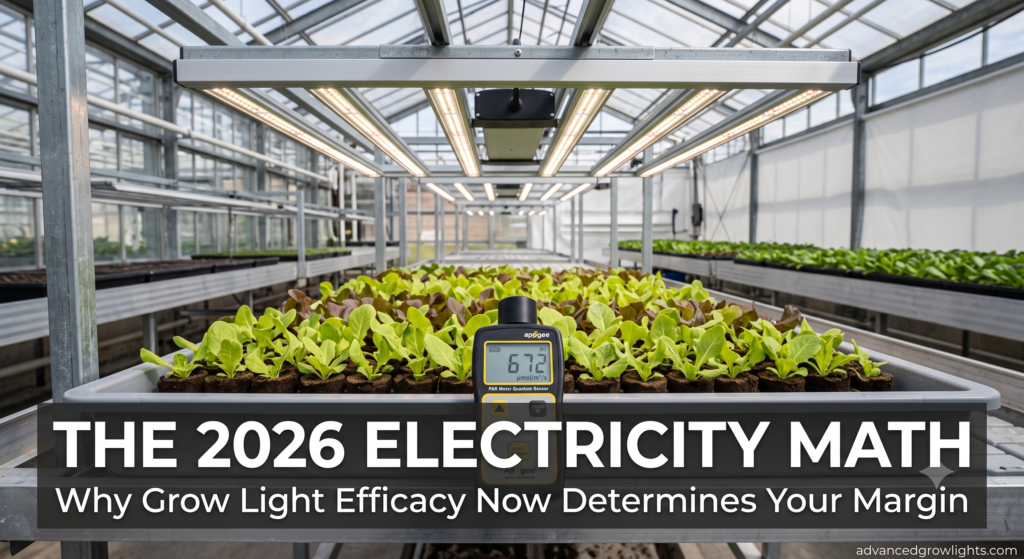
Commercial electricity rates climbed 9 to 11 percent year over year through early 2026, and the U.S. Energy Information Administration expects wholesale power prices to keep rising through the year. A large piece of that increase traces back to a source that has nothing to do with cultivation: AI data centers. Grid operators are absorbing a wave of new, always-on industrial load, and the cost is landing on every commercial electricity account, including yours.
For a commercial grow operation, that changes the math on fixture selection. Photosynthetic photon efficacy, the µmol/J number buried near the bottom of a spec sheet, used to be a tiebreaker. In 2026, it is closer to a direct line item on your utility bill. This piece walks through why rates are moving, what the numbers say, and what the gap between a merely DLC-qualified fixture and a top-tier one costs a real grow room over a year.
Why Electricity Rates Are Rising in 2026
The EIA’s Short-Term Energy Outlook puts the load-weighted average of the 11 regional wholesale prices it tracks at $47 per megawatt-hour in 2025, a 23 percent jump from 2024, and projects $51 per megawatt-hour in 2026. Retail commercial rates have followed. National commercial electricity averaged 13.51 cents per kWh in April 2026, up 4.8 percent from a year earlier, and February 2026 came in at 14.37 cents per kWh, up 10.7 percent year over year.
The EIA attributes the acceleration to demand growth, not fuel costs alone. It projects commercial electricity demand will rise 2 percent in both 2025 and 2026, and industrial demand will rise 2 percent in 2025 and 3 percent in 2026, as new data center, semiconductor, and battery manufacturing load comes online. In Texas and the surrounding West South Central region, where data center construction is concentrated, the EIA projects commercial electricity sales to jump 17 percent in 2026 alone. That figure measures consumption growth, not price, but it signals how much new load is competing for the same grid capacity your facility draws from.
The Data Center Connection
PJM Interconnection, the grid operator serving 13 mid-Atlantic and Midwest states, has an independent market monitor whose analysis, reported by Spotlight PA in April 2026, found that data center power demand is driving higher generation costs, and utilities pass those costs straight to ratepayers. The Federal Reserve Bank of Dallas goes further: with data center electricity demand expected to double within five years, the bank estimates wholesale power prices could rise by as much as 50 percent. NVIDIA CEO Jensen Huang put it in blunt terms at a 2026 industry event: every future data center will be power-limited, and AI is “a power-limited industry” now.
None of this is about horticulture. Data centers and grow rooms share a grid, and a grid absorbing that much new steady-state demand raises the marginal cost of every kilowatt-hour on it. Utilities invest around $35 billion a year in transmission infrastructure today, a figure regulators and grid operators describe as short of what the buildout requires. Microsoft, Meta, OpenAI, and Amazon signed a “Ratepayer Protection Pledge” in March 2026 promising not to shift data center costs onto other customers, but consumer advocates have called it unenforceable. Commercial growers on standard industrial or commercial tariffs have no separate lane from this pressure.
Efficacy Is the Lever You Control
You can’t change a regional wholesale market. You can change how many photons you get per watt. Photosynthetic photon efficacy, expressed in µmol/J, measures how much photosynthetically active radiation a fixture delivers for every joule of electricity it consumes. Two fixtures rated at the same PPF output can draw very different wattage depending on this single number, and wattage is what the utility meter reads. For the underlying math on PPFD, DLI, and why efficacy is one of the only numbers that matters on a spec sheet, see our PPFD, DLI, and efficacy breakdown.
The DesignLights Consortium raised the bar on this in 2026. Hort V4.0, the current version of the DLC’s horticultural technical requirements, set the minimum qualifying photosynthetic photon efficacy at 2.5 µmol/J, an 8.7 percent increase over the V3.0 threshold. Manufacturers had until October 31, 2025 to requalify existing products, and delisting for fixtures that didn’t meet the new bar took effect January 5, 2026, removing about 11 percent of the previous Qualified Products List. The V4.0 update also dropped the qualification pathway for lamp-style products, pushing the category further toward integrated fixtures.
That 2.5 µmol/J number matters because it is now the floor, not a target. A fixture that barely clears it still qualifies for utility rebate programs, but “qualifies” and “efficient” are not the same claim. Gavita’s RS 2400e rates at 3.2 µmol/J, Fluence’s SPYDR 3 at 3.0 µmol/J, and Lumatek’s ZEUS 600W PRO at 2.85 µmol/J. All three sit above the DLC floor. The spread between them and a fixture sitting right at 2.5 µmol/J is where the real electricity bill lives.
The Actual Dollar Gap: A Worked Example
Take a 2,000-square-foot flower room running 40 fixtures on a 12-hour photoperiod, 365 days a year, billed at the April 2026 national commercial average of 13.51 cents per kWh. Gavita’s RS 2400e is rated to deliver 2,400 µmol/s of PPF at 750W, which is where its model name comes from. Forty fixtures draw 30 kW total. At 12 hours a day, that’s 360 kWh daily and 131,400 kWh a year, or $17,756 in electricity.
Now hold PPF output constant and swap in a fixture sitting exactly at the DLC V4.0 minimum of 2.5 µmol/J. To deliver the same 2,400 µmol/s, that fixture needs to draw 960W, not 750W. Forty fixtures at 960W draw 38.4 kW, consuming 460.8 kWh a day and 168,192 kWh a year. At the same rate, that’s $22,731.
The gap: $4,975 a year, for one room, at flat 2026 commercial rates that the EIA expects to keep climbing. Scale that across a multi-room commercial facility and the efficacy line on a spec sheet stops being a footnote.
| Fixture | Manufacturer | PPE (µmol/J) | Rated Power | Rated PPF | Watts to Hit 2,400 µmol/s |
|---|---|---|---|---|---|
| RS 2400e | Gavita | 3.2 | 750W | 2,400 µmol/s | 750W |
| SPYDR 3 | Fluence | 3.0 | 800W | 2,400 µmol/s | 800W |
| ZEUS 600W PRO | Lumatek | 2.85 | 600W | 1,710 µmol/s | 842W (calculated) |
| DLC Hort V4.0 floor | Any qualifying fixture | 2.5 | N/A | N/A | 960W (calculated) |
If You’re Still Running HPS, the Gap Is Worse
Double-ended HPS fixtures top out around 1.7 to 1.9 µmol/J, well under half the efficacy of a top-tier LED. Growers who made the LED switch years ago for spectrum or heat reasons are now sitting on a widening electricity cost advantage they didn’t shop for in the first place. Our LED vs. HPS vs. CMH comparison covers the full technology tradeoff, but the 2026 rate environment adds a new column to that spreadsheet: every year HPS stays installed, the efficacy gap costs more in absolute dollars than it did the year before.
Rebates Still Matter, But Read the Fine Print
Utility rebate programs key off DLC listing status, and several, including Xcel Energy’s indoor agricultural grow lighting program, pay a full rebate tier for DLC-listed fixtures and a reduced tier, around 75 percent, for comparable non-DLC products. Fixtures delisted in the January 2026 V4.0 transition may no longer qualify for full rebate amounts even if they were eligible a year ago, so confirm current listing status before budgeting a rebate into a purchase decision. Our UV and far-red supplemental lighting breakdown and the manufacturer overview are useful starting points if you’re evaluating fixtures against current DLC status rather than assuming last year’s listing still holds.
Dimmable Fixtures Have a Second Job Now
As utilities lean harder on demand response to manage the same data center load that’s pushing up rates, dimmable, networked fixtures gain a second function beyond spectrum control. A facility that can shed or shift lighting load during grid events becomes eligible for capacity payments and event credits in some markets, on top of the energy savings from efficacy alone. That’s a separate revenue conversation from the one in this piece. The controller infrastructure covered in our lighting control coverage is what makes that participation possible.
What to Do With This
Three things are worth doing before your next fixture purchase. First, check current DLC Hort V4.0 listing status on the QPL rather than trusting a spec sheet printed before January 2026. Second, run the wattage-to-PPF math shown above using your actual room layout and your utility’s current commercial rate, not a rate from a prior budget cycle. Third, if you’re evaluating a rebate-eligible upgrade, confirm the rebate tier your specific fixture qualifies for now, since delisted or non-DLC products often drop to a reduced tier.
Efficacy has always affected your electricity bill. In 2026, with data center demand reshaping wholesale markets and commercial rates rising faster than they have in years, it affects it by a bigger number. Browse verified specs across manufacturers in the AGL grow light directory before your next purchase.
Frequently Asked Questions
Will grow light electricity costs keep rising in 2026?
The EIA projects continued wholesale price growth through 2026, driven in part by data center and industrial demand. Regional exposure varies, with Texas and the West South Central region seeing the fastest commercial demand growth.
What does µmol/J measure?
Photosynthetic photon efficacy measures how many micromoles of photosynthetically active photons a fixture delivers per joule of electricity consumed. Higher µmol/J means more usable light per watt drawn from the meter.
Does meeting the DLC Hort V4.0 minimum guarantee a good deal?
No. The 2.5 µmol/J threshold is a qualification floor for rebate eligibility, not a performance benchmark. Fixtures well above the floor, like the examples in the table above, can cut thousands of dollars a year off operating costs at equivalent PPF output.
How much can a grower save by choosing a higher-efficacy fixture?
In the worked example above, a 2,000-square-foot, 40-fixture room saved about $4,975 a year in electricity by choosing a 3.2 µmol/J fixture over one sitting at the DLC minimum, holding PPF output constant. Savings scale with room size and photoperiod hours.
Are commercial growers eligible for utility rebates tied to efficacy?
Many utilities, including Xcel Energy, offer prescriptive rebates for DLC-listed horticultural fixtures, often at a reduced rate for non-DLC comparable products. Confirm current listing status, since the January 2026 V4.0 transition delisted some fixtures that qualified under the old standard.
Can dimmable grow lights participate in demand response programs?
Networked, dimmable fixtures can qualify for demand response and capacity payment programs in some utility territories, providing revenue beyond baseline energy savings. Eligibility and payment structures vary by grid operator and region.
Is HPS still worth considering given rising electricity rates?
Double-ended HPS tops out around 1.7 to 1.9 µmol/J, under half the efficacy of top-tier LED fixtures. Rising 2026 rates widen the operating cost gap every year HPS stays installed.
Where are electricity prices rising fastest for commercial growers?
The EIA projects the fastest commercial demand growth in the West South Central region, including Texas, where data center construction is concentrated. Regional rates depend on local grid conditions and generation mix, so check your utility’s current tariff for exact numbers.
Will grow light electricity costs keep rising in 2026?
The EIA projects continued wholesale price growth through 2026, driven in part by data center and industrial demand. Regional exposure varies, with Texas and the West South Central region seeing the fastest commercial demand growth.
What does µmol/J measure?
Photosynthetic photon efficacy measures how many micromoles of photosynthetically active photons a fixture delivers per joule of electricity consumed. Higher µmol/J means more usable light per watt drawn from the meter.
Does meeting the DLC Hort V4.0 minimum guarantee a good deal?
No. The 2.5 µmol/J threshold is a qualification floor for rebate eligibility, not a performance benchmark. Fixtures well above the floor can cut thousands of dollars a year off operating costs at equivalent PPF output.
How much can a grower save by choosing a higher-efficacy fixture?
In the worked example in this post, a 2,000-square-foot, 40-fixture room saved about $4,975 a year in electricity by choosing a 3.2 µmol/J fixture over one sitting at the DLC minimum, holding PPF output constant. Savings scale with room size and photoperiod hours.
Are commercial growers eligible for utility rebates tied to efficacy?
Many utilities, including Xcel Energy, offer prescriptive rebates for DLC-listed horticultural fixtures, often at a reduced rate for non-DLC comparable products. Confirm current listing status, since the January 2026 V4.0 transition delisted some fixtures that qualified under the old standard.
Can dimmable grow lights participate in demand response programs?
Networked, dimmable fixtures can qualify for demand response and capacity payment programs in some utility territories, providing revenue beyond baseline energy savings. Eligibility and payment structures vary by grid operator and region.
Is HPS still worth considering given rising electricity rates?
Double-ended HPS tops out around 1.7 to 1.9 µmol/J, under half the efficacy of top-tier LED fixtures. Rising 2026 rates widen the operating cost gap every year HPS stays installed.
Where are electricity prices rising fastest for commercial growers?
The EIA projects the fastest commercial demand growth in the West South Central region, including Texas, where data center construction is concentrated. Regional rates depend on local grid conditions and generation mix, so check your utility’s current tariff for exact numbers.