BLOG POST
Grow Light Tariffs in 2026: What Commercial Buyers Need to Know Before Your Next Order
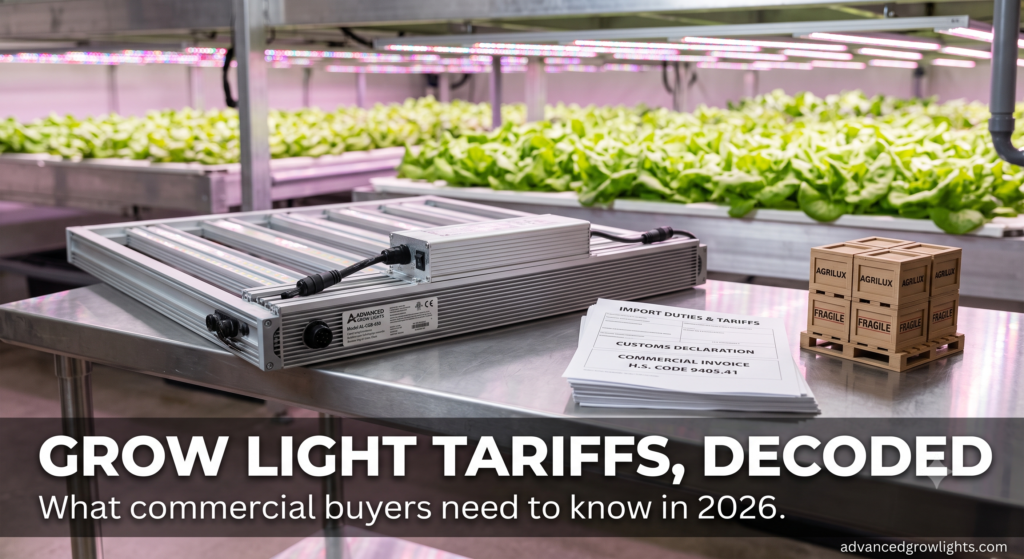
A Supreme Court ruling in February wiped out one entire layer of tariffs on Chinese goods. If you build a lighting budget this month, that sounds like relief. It isn’t, at least not for LED grow lights. Section 301 tariffs, the layer that covers most horticultural fixtures, survived the ruling untouched. Meanwhile a new universal tariff took its place within hours of the decision. For a commercial grower planning a fixture order this quarter, the practical question isn’t “did tariffs go down.” It’s “which tariffs apply to the specific HTS code my supplier files, and has that changed since my last quote.”
This isn’t a policy explainer for its own sake. Landed cost on a 40-fixture commercial order can swing by thousands of dollars depending on how a fixture gets classified at the border, where final assembly happens, and which of three overlapping tariff regimes is live when the shipment clears customs. Here’s what changed in 2026, what didn’t, and how to protect your capex budget before you sign a purchase order.
What the Supreme Court Struck Down
On February 20, 2026, the Supreme Court ruled 6-3 that the International Emergency Economic Powers Act does not give the president authority to impose tariffs. IEEPA lets a president regulate imports during a declared emergency, but the Court held that “regulate” doesn’t stretch to “tax.” Tariff authority sits with Congress under Article I, and the administration’s IEEPA-based tariffs, some of which had pushed rates on Chinese goods above 100% in targeted categories, fell within days. Customs and Border Protection implemented the termination at midnight on February 24.
The administration didn’t leave a vacuum. Within hours of the ruling, a new executive order imposed a flat 10% tariff on goods from every country, invoked under separate statutory authority than the one the Court had rejected that same morning. That tariff has been extended since its original term, and reporting on its exact current status varies by week. If you’re pricing an order right now, don’t trust a percentage you read in an article from three months ago. Ask your supplier or freight forwarder for the landed rate that applies to your shipment today.
Section 301 Never Left
Here’s the detail that matters most for grow light buyers and gets buried in general tariff coverage. Section 301 tariffs, the China-specific duties authorized under the Trade Act of 1974, rest on different legal footing than IEEPA. The Supreme Court’s ruling didn’t touch them. Section 301 covers most LED lighting fixtures at a 25% rate on top of the base Most Favored Nation duty, and that stack has applied continuously through the IEEPA litigation, the ruling, and its aftermath. A grower who assumed the February ruling lowered their grow light costs across the board got a partial answer at best.
A separate track matters too. In November 2025, President Trump and President Xi Jinping struck a trade deal that extended 178 existing Section 301 exclusions through November 10, 2026, and rolled back 10 percentage points of the fentanyl-related tariff that had stacked on top of standard China duties. Horticultural lighting fixtures don’t appear by name on the exclusion list published by USTR. If your supplier believes their product qualifies for an exclusion, get the exclusion number in writing before you count on the savings.
How CBP Classifies Your Grow Light, and Why It Changes the Math
Tariff rate depends on the Harmonized Tariff Schedule code your import gets filed under, and grow lights don’t have one clean answer. Customs and Border Protection’s published rulings show at least three different classification paths depending on what crosses the border and how.
A standalone LED lamp or lamp board, the kind used inside a hydroponic fixture, has been classified by CBP under HTS 8539.50.0090 in multiple rulings, carrying a 2% base duty before Section 301 applies. A complete LED luminaire, the assembled fixture with housing and driver, typically falls under HTS 9405.40.80 or a related 9405 subheading, with a base MFN rate closer to 3.9%. A complete hydroponic growing system imported unassembled, light included, has been classified under HTS 8424.82.0090 as horticultural equipment, at a 2.4% base rate. Three products that a grower might call “the same thing” carry three different starting points before Section 301’s 25% gets layered on top.
| Import type | Typical HTS code | Base MFN duty | Plus Section 301 |
|---|---|---|---|
| Standalone LED lamp/lamp board | 8539.50.0090 | ~2% | +25% (China-origin) |
| Complete LED luminaire/fixture | 9405.40.80 (or related 9405 subheading) | ~3.9% | +25% (China-origin) |
| Complete horticultural system, unassembled | 8424.82.0090 | ~2.4% | +25% (China-origin) |
Base rates in that table come from published CBP CROSS rulings on comparable products, not from your specific supplier’s paperwork. Classification is fact-specific, and two fixtures that look identical on a spec sheet can be filed differently depending on what’s assembled where and how the import documentation describes it. This is exactly the kind of detail worth confirming with your supplier’s customs broker before an order ships, not after.
Manufacturers Are Already Adjusting
Some grow light brands have started communicating tariff impact directly to customers rather than quietly repricing. Spider Farmer posted a public notice urging customers to place orders ahead of anticipated tariff-driven price increases, a signal that at least one major hobbyist and prosumer brand expects landed costs to keep climbing through 2026. That kind of direct communication is useful. It tells you the supplier is watching the same tariff stack you are, and it gives you a data point for negotiating timing on a larger commercial order.
The broader lighting industry is responding with two strategies worth knowing about even if you never touch the supply chain yourself. First, some manufacturers now offer semi-knocked-down shipping, where fixtures cross the border partially disassembled and get final-assembled domestically. Depending on how CBP classifies the resulting import, this can shift a product into a lower duty category than a fully assembled fixture would carry. Second, reshoring investment into US-based LED and driver assembly has picked up, driven by a combination of CHIPS Act incentives, tariff-driven cost recalculation, and supply chain risk management that predates the current tariff environment. Neither strategy eliminates the tariff question. Both are worth asking a manufacturer about directly if landed cost is a deciding factor in your purchase.
What This Means for Your Next Fixture Order
None of this changes the fundamentals you should already be evaluating a fixture on. PPFD, DLI, and photon efficacy still determine whether a light does its job in your canopy. What tariffs change is the gap between sticker price and landed cost, and that gap is wide enough now to affect which fixture wins a bid.
A higher-efficacy fixture that qualifies for a utility rebate under DLC’s Hort V4.0 requirements can offset a meaningful chunk of a tariff-inflated purchase price, sometimes enough to make the higher-efficiency option cheaper on a net basis than a cheaper, lower-efficacy fixture that doesn’t qualify. Run both numbers, landed cost after tariffs and net cost after rebate, before you compare two quotes on sticker price alone.
A Worked Example: Landed Cost on a 40-Fixture Order
Say you’re pricing 40 commercial LED fixtures at a quoted factory price of $650 each, or $26,000 total, sourced from a China-based manufacturer and classified as complete LED luminaires under HTS 9405.40.80. Base MFN duty at 3.9% adds $1,014. Section 301’s 25% China-specific layer, which applies on top of the entered value regardless of the MFN rate, adds $6,500. Before freight, brokerage fees, and any additional layer active at the time of entry, your landed cost sits closer to $33,500, a 29% premium over the quoted factory price. That’s the conservative case. If an additional universal tariff layer is active on your entry date, the premium climbs further.
Compare that to a fixture assembled domestically from imported components, where only the components carry Section 301 exposure rather than the full finished-fixture value. The math shifts meaningfully in favor of domestic final assembly once your order size crosses a few dozen units, which is exactly the range most commercial retrofits and new builds fall into. Ask any manufacturer you’re evaluating where final assembly happens and get their answer in writing.
Five Questions to Ask Before You Buy
- What HTS code does your customs broker file this product under, and what’s the current combined duty rate?
- Where does final assembly happen, and does that qualify the product for a different tariff treatment than a fully imported fixture?
- Is this product covered by any active Section 301 exclusion, and can you provide the exclusion number?
- Does your quoted price already include current tariffs, or is landed cost added separately at shipment?
- Does this fixture qualify for DLC Hort V4.0 rebate eligibility, and does that offset apply before or after your local utility calculates the incentive?
A supplier who can answer all five without hesitation is one who’s tracking their own supply chain exposure. That’s worth something on its own, independent of the number they quote you.
Tariff policy will keep moving. What won’t change is the value of comparing fixtures on landed cost and verified efficacy rather than a factory quote that doesn’t survive contact with customs. Browse verified specs across manufacturers in the AGL grow light directory before your next order.
Did the February 2026 Supreme Court ruling lower tariffs on LED grow lights?
Partially. The ruling eliminated IEEPA-based tariffs, but Section 301 tariffs on Chinese-origin lighting, which rest on separate legal authority, remained fully in effect before, during, and after the ruling. A new universal tariff took effect the same day under different statutory authority. Check current rates before assuming the ruling changed your cost.
What tariff rate applies to a complete LED grow light fixture imported from China?
Most complete fixtures classify under HTS 9405, with a base MFN duty near 3.9%, plus a 25% Section 301 surcharge for China-origin goods. Any universal tariff active at the time of entry stacks on top. Exact rates depend on the specific HTS subheading your customs broker files.
Are all grow lights classified the same way at the border?
No. CBP rulings show standalone LED lamp boards, complete assembled luminaires, and complete unassembled horticultural systems each fall under different HTS codes with different base duty rates. Two products that look similar on a spec sheet can carry different landed costs purely based on classification.
Does buying a DLC-qualified fixture reduce my tariff exposure?
No, DLC qualification and tariff classification are unrelated. But a rebate-eligible fixture can offset enough of a tariff-inflated purchase price that the net cost comes out lower than a cheaper, non-qualifying fixture. Compare net cost after rebate, not sticker price.
Will domestically assembled fixtures avoid tariffs entirely?
Not entirely. Imported components used in domestic assembly can still carry duties. But because tariffs typically apply to entered value, assembling domestically from components can produce a lower total duty burden than importing a fully finished fixture, especially on larger commercial orders.
Are cannabis cultivators and CEA greenhouse operators facing different tariff treatment?
No. Tariff classification depends on the product’s HTS code and country of origin, not the end use of the crop. A fixture destined for a leafy greens vertical farm and one destined for a cannabis flower room face identical duty treatment if they’re the same product.
How do I find the exact current tariff rate on a fixture I’m about to buy?
Ask your supplier’s customs broker for the HTS code they file and the current combined duty rate for that code and country of origin. CBP’s CROSS ruling database and the current Section 301 exclusion list published by USTR are the two most reliable primary sources, and both change often enough that a rate you read in an article isn’t a substitute for a current quote.
Should I delay a fixture purchase hoping tariffs drop further?
That’s a bet on litigation and trade policy outcomes nobody can predict reliably. What you can control is getting a landed-cost quote, not a factory-price quote, comparing net cost across DLC-qualified and non-qualified options, and locking pricing with a supplier who’s transparent about their own exposure.