BLOG POST
NLC V5.2: DLC Just Made Grow Light Controllers Rebate-Eligible for the First Time
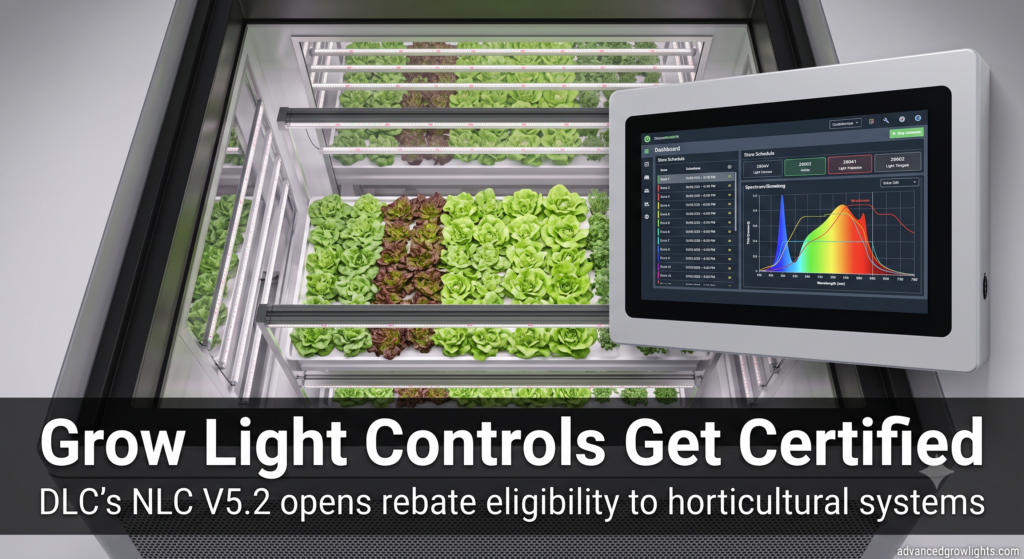
On August 17, 2026, the DesignLights Consortium’s Networked Lighting Controls Technical Requirements Version 5.2 takes effect, and for the first time, horticultural control systems can qualify for the same certified products list that utilities already use to hand out rebates. If you’ve spent the last two years chasing DLC Horticultural Qualified Products List status for your fixtures, this is the sequel you didn’t know was coming: the software and hardware that schedule, dim, and network those fixtures now has its own path onto a rebate-recognized list.
Most growers treat controllers as an afterthought. You buy the light, then you buy whatever timer or app the light comes with. DLC’s move signals that utilities and program administrators no longer see it that way. Controls are becoming a distinct, fundable category, and manufacturers who want a piece of the incentive dollars attached to that category have a new set of requirements to meet starting this month.
What Changed in NLC V5.2
DLC released the final NLC V5.2 requirements in June and confirmed the effective date in its official release letter. The update builds on NLC V5.1 rather than replacing it wholesale, and four themes drove the revision, according to DLC’s own release documentation:
- Expanded recognition of lighting-to-HVAC integration, so controls that share occupancy and operational data with smart thermostats get counted toward energy savings
- Standardized configuration reporting aligned with the ANSI/NEMA C137.9 industry standard, though DLC kept this as a reported capability rather than a mandatory requirement
- Cleaner terminology and reporting structure on the Qualified Products List itself
- Expanded eligibility for additional market segments, named explicitly as including horticultural applications
Cybersecurity requirements did not change in this revision. DLC introduced those mandates in earlier NLC versions and left them untouched here. The bigger structural shift is the fourth bullet: horticultural control systems now sit inside the same qualification pathway as commercial office and warehouse lighting controls, provided they meet the general NLC requirements. DLC did not carve out a separate, lighter technical bar for grow rooms. A horticultural system has to clear the same interoperability and reporting requirements as any other networked control system seeking a QPL listing.
Why “Eligible” Is a Bigger Deal Than It Sounds
Before V5.2, the NLC program existed, but its qualifying language didn’t name horticultural or grow-room systems as a recognized segment. A commercial cultivator with a networked control system had no clean lane to get that system onto the QPL under the horticultural label, whatever the manufacturer’s marketing claimed. DLC’s own cover letter for the release states the goal plainly: expand opportunities for additional market segments, including horticultural applications, to participate in the NLC program.
That distinction matters because the NLC QPL isn’t a marketing badge. Trade press coverage of the release puts the current list at roughly 96 networked lighting control systems from more than 60 manufacturers, and over 100 utilities already reference that list when deciding what controls qualify for incentive dollars. Fixture certification through the separate DLC Horticultural QPL already governs which grow lights clear the rebate bar in most territories, requiring a minimum photosynthetic photon efficacy around 2.5 µmol/J under the current V4.0 fixture requirements. NLC V5.2 opens a parallel door for the controls layer sitting on top of those fixtures.
The Rebate Logic Growers Already Know, Applied to Controls
You already navigate this pattern for fixtures: check DLC status, confirm your utility’s program still recognizes the current version, get pre-approval before you install, and only then can you count on the rebate showing up. Utility incentive programs treat controls the same way once a control system has a QPL listing. A grower who upgrades fixtures without touching the control layer captures one slice of the available incentive. A grower whose scheduling, dimming, and thermostat-integration hardware also carries an NLC listing has a shot at stacking a second incentive on top, assuming their utility’s horticultural program has adopted V5.2 by the time they apply.
That last condition is the catch. DLC sets the technical requirements; individual utilities decide which DLC list version they’ll pay against, and on what timeline. Nothing forces a utility to recognize horticultural NLC listings the day V5.2 takes effect. Ask your program administrator directly whether horticultural control systems are in scope yet, rather than assuming DLC eligibility automatically means your utility will write a check for it.
What a Qualifying Control System Looks Like Today
As of the V5.2 release, the NLC Qualified Products List doesn’t yet carry a system marketed specifically as a horticultural control platform. That’s the gap this update opens, not a gap it has already filled. In the meantime, growers are choosing between two architectures that predate any of this certification news, and the choice affects how easily a given system could clear NLC requirements later.
| System type | Architecture | Typical scale | What it trades off |
|---|---|---|---|
| Wired hub-and-spoke (e.g. TrolMaster’s RJ12-based Hydro-X line) | Centralized controller, wired sensor and relay network | Multi-zone commercial rooms | No wireless dropout risk; installation labor and cabling cost scale with room count |
| WiFi-networked fixtures (e.g. Gorilla’s GXi line) | Intelligence built into each fixture, coordinated over WiFi rather than a central hub | Single rooms up to modest commercial scale | Faster retrofit into existing wiring; depends on facility WiFi reliability |
| Multi-zone environmental controllers (e.g. Spider Farmer’s GGS Pro) | Central controller managing lighting alongside climate | Manufacturer specs cite up to eight zones and 20 devices per zone | Bundles lighting with temperature, humidity, and CO2 control; ties you to one vendor’s ecosystem |
None of these figures come from independent lab testing. They’re manufacturer-published specifications, and you should verify current capacity and compatibility directly with the vendor before treating them as a purchasing decision on their own. The point of the comparison isn’t to crown a winner. It’s that DLC’s requirements now give you a concrete reason to ask each of these manufacturers a question they may not have fielded before: do you have a roadmap to NLC certification, and if so, what’s your timeline?
A Worked Example: What the HVAC Integration Piece Is Worth
DLC’s supporting materials for NLC-HVAC integration cite a potential 8% to 21% HVAC energy reduction when a networked lighting control system shares occupancy and operational data with a facility’s thermostats, according to trade coverage of the release. Treat that as a cited range from DLC’s own promotional materials, not a guarantee, since your actual savings depend on climate zone, existing HVAC controls, and how much of your facility’s heat load lighting already contributes.
Here’s how to size that range for your own operation. Take your facility’s annual HVAC spend, say $60,000 for a mid-size indoor commercial room running supplemental cooling most of the year. An 8% reduction is $4,800 a year. A 21% reduction is $12,600 a year. Neither number accounts for the cost of the integration itself, and DLC’s figure describes buildings broadly, not grow rooms specifically, where lighting heat load and HVAC cycling behave differently than in an office. Use the range as a reason to ask your controls vendor for their own measured numbers from a comparable facility, not as a number to plug into your own ROI model unverified.
What to Ask Before You Buy or Upgrade
- Has this control system, or any version of it, been submitted for NLC listing, and under which requirements version?
- Does the system report configuration settings in a format aligned with ANSI/NEMA C137.9, even though DLC doesn’t mandate that format yet?
- Does my utility’s horticultural incentive program currently reference the NLC QPL at all, separate from the fixture-side Horticultural QPL?
- If I integrate lighting controls with HVAC, does the vendor have facility-level data on realized savings, beyond DLC’s cited range?
- What happens to my existing rebate application if the utility updates which DLC list version it recognizes mid-project?
That last question isn’t hypothetical. Fixture manufacturers spent early 2026 managing exactly this transition when DLC delisted products that hadn’t moved from Hort V3.0 to V4.0 requirements. Controls manufacturers are about to go through their own version of that process, and growers who buy early are the ones who feel it if a system never completes NLC certification.
The Bigger Pattern: Controls Are Catching Up to Fixtures
For years, DLC’s horticultural attention went almost entirely to the fixture: efficacy thresholds, spectral testing, photobiological safety, electrical code alignment. Manufacturers built controls to whatever protocol they chose, 0-10V or DALI, wired or wireless, with no certification layer connecting those controls to rebate dollars the way fixtures already had. NLC V5.2 starts closing that gap, and it does it by extending an existing commercial-buildings program to horticulture rather than building a grow-room-specific standard from scratch.
That approach has a real consequence for how fast this plays out at the grower level. Because horticultural systems have to meet the same general requirements as office and warehouse controls, expect the first NLC-listed grow control systems to come from manufacturers who already build for the broader commercial lighting-controls market and are extending into horticulture, not from companies who built for grow rooms first. Watch who applies in the months after August 17, and you’ll get a read on which controls manufacturers are serious about the commercial and utility side of this business versus the retail hobbyist side.
If you’re evaluating a lighting upgrade this year, treat the fixture and the controller as two separate certification questions from now on. Check the fixture against the current DLC Horticultural QPL under V4.0. Then ask, separately, whether the control system has any path to NLC listing. The two used to be effectively one conversation. As of this month, they aren’t anymore.
Frequently Asked Questions
What is NLC V5.2?
It’s the DesignLights Consortium’s fourth major revision to its Networked Lighting Controls Technical Requirements, the certification program utilities reference when deciding which networked control systems qualify for incentive programs. Version 5.2 takes effect August 17, 2026.
Is this the same list as the DLC Horticultural Qualified Products List for grow lights?
No. The Horticultural QPL certifies fixtures on efficacy, spectral output, and safety. The NLC QPL certifies the control systems, dimming, scheduling, and building-integration hardware, that operate those fixtures. They’re separate lists with separate requirements.
Does my utility automatically recognize horticultural NLC listings now?
Not automatically. DLC sets the technical requirements; each utility decides independently which list version its incentive program recognizes and on what timeline. Confirm directly with your program administrator.
Did the cybersecurity requirements change in V5.2?
No. DLC left cybersecurity requirements unchanged from the prior version in this release.
Is ANSI/NEMA C137.9 configuration reporting mandatory now?
No. DLC recognizes it as a reported capability that manufacturers can document, not a mandatory requirement for NLC qualification.
Should I wait for an NLC-certified controller before upgrading my grow room?
That depends on whether your utility’s horticultural program currently offers, or plans to offer, a control-system incentive at all. If it doesn’t, certification status shouldn’t be the deciding factor in your purchase. If it does, ask the vendor for their certification timeline before you commit.
Where can I check whether a control system is on the NLC Qualified Products List?
DesignLights Consortium maintains the QPL on its own site, separate from the Horticultural fixture list. Ask your manufacturer for their listing status directly, since the list updates as new systems are submitted and approved.
For the fixture side of this equation, see our breakdowns of DLC Horticultural certification, the V4.0 rebate bar, and dimming protocol comparisons. Browse verified fixture specs in the AGL directory.
What is NLC V5.2?
It’s the DesignLights Consortium’s fourth major revision to its Networked Lighting Controls Technical Requirements, the certification program utilities reference when deciding which networked control systems qualify for incentive programs. Version 5.2 takes effect August 17, 2026.
Is this the same list as the DLC Horticultural Qualified Products List for grow lights?
No. The Horticultural QPL certifies fixtures on efficacy, spectral output, and safety. The NLC QPL certifies the control systems, dimming, scheduling, and building-integration hardware, that operate those fixtures. They’re separate lists with separate requirements.
Does my utility automatically recognize horticultural NLC listings now?
Not automatically. DLC sets the technical requirements; each utility decides independently which list version its incentive program recognizes and on what timeline. Confirm directly with your program administrator.
Did the cybersecurity requirements change in V5.2?
No. DLC left cybersecurity requirements unchanged from the prior version in this release.
Is ANSI/NEMA C137.9 configuration reporting mandatory now?
No. DLC recognizes it as a reported capability that manufacturers can document, not a mandatory requirement for NLC qualification.
Should I wait for an NLC-certified controller before upgrading my grow room?
That depends on whether your utility’s horticultural program currently offers, or plans to offer, a control-system incentive at all. If it doesn’t, certification status shouldn’t be the deciding factor in your purchase. If it does, ask the vendor for their certification timeline before you commit.
Where can I check whether a control system is on the NLC Qualified Products List?
DesignLights Consortium maintains the QPL on its own site, separate from the Horticultural fixture list. Ask your manufacturer for their listing status directly, since the list updates as new systems are submitted and approved.