BLOG POST
Grow Light Control Protocols Compared: 0-10V, DALI, and the Multi-Zone Wiring Mistakes Costing Growers Money
Signify switched on a 60-acre GrowWise Smart Spectrum installation at an AppHarvest greenhouse in Kentucky this January, targeting 18% energy savings and higher tomato yields through zone-by-zone spectral control. That single project put more networked dimming channels into commercial production than most manufacturers ship in a year. It also exposed a problem AGL hears about constantly from integrators: nobody in horticultural lighting agreed on how dimming signals should travel down the wire.
Office lighting solved this in the 2000s. Commercial buildings standardized on DALI, a two-way digital protocol that lets a single network address 64 fixtures with individual feedback. Horticultural lighting never got there. Most commercial grow light fixtures still ship with 0-10V analog dimming, a decades-old technology built for one-way, one-size-fits-all brightness control, not the zone-level spectral tuning growers now want.
That gap matters more in 2026 than it did two years ago. DLC’s Horticultural Technical Requirements V4.0 becomes mandatory for incentive eligibility on July 1, 2026, and its Custom rebate tier rewards facilities that can document real energy savings through monitored, zoned control. A grower chasing that rebate needs a control topology that reports back. A 0-10V bus, by design, can’t.
The three ways commercial grow lights get dimmed
Walk into any commercial flower room or greenhouse bay and you’ll find one of three control architectures running the fixtures. Each has a different cost, a different failure mode, and a different ceiling on what it can do.
0-10V: the default almost every fixture ships with
0-10V dimming sends a low-voltage DC signal down a dedicated control wire, and the fixture’s driver scales its output proportionally. Fluence ships a modular version of this as its DIM FLEX wiring system across its commercial fixture line. It’s cheap, it’s simple, and nearly every LED grow light manufacturer supports it as a baseline option.
The tradeoff is scale and visibility. A single 0-10V controller reliably handles around ten fixtures before signal degradation becomes a problem, and the protocol is one-way. The controller tells the driver what to do; the driver never reports back. For a grower on a DLC Custom rebate that requires documented energy savings, that silence is expensive. You can prove what you set the lights to. You can’t prove what they did.
DALI: the standard office buildings solved this with
DALI, standardized under IEC 62386 and certified through the DALI Alliance’s DALI-2 program, replaces the one-way analog signal with a digital network. A single DALI network addresses up to 64 individually controllable devices, each reporting status back to the controller. That’s the feedback loop 0-10V can’t provide, and it’s why DALI dominates commercial office and retail lighting.
Horticulture hasn’t followed. General lighting-controls comparisons put DALI hardware at roughly three to five times the per-zone cost of 0-10V, plus commissioning work most grow facility electricians haven’t done before. We could not find a major commercial grow light brand publishing DALI-2 certification on its fixture spec sheets. The industry’s dimming standard for buildings hasn’t crossed over into greenhouses and flower rooms at any real scale.
Proprietary networked control: what GrowWise runs on
The third path is the one Signify chose for GrowWise: a manufacturer-specific control system that talks to its own fixtures over its own protocol, then exposes a Modbus TCP/IP interface so growers can fold it into a climate computer or greenhouse management platform. It delivers real zone-level spectral tuning, the kind AppHarvest is running in Kentucky, but it locks the grower into one manufacturer’s ecosystem. Swap in a fixture from a different brand and you’re back to running that zone on its own native controls.
This is the quiet reality of 2026 grow light control: DALI’s cross-vendor interoperability barely exists in horticulture. Growers choose between cheap-and-blind (0-10V) or capable-and-locked-in (proprietary networked systems). Nobody is shipping the DALI-style middle ground that commercial buildings take for granted.
Where multi-zone 0-10V installs break
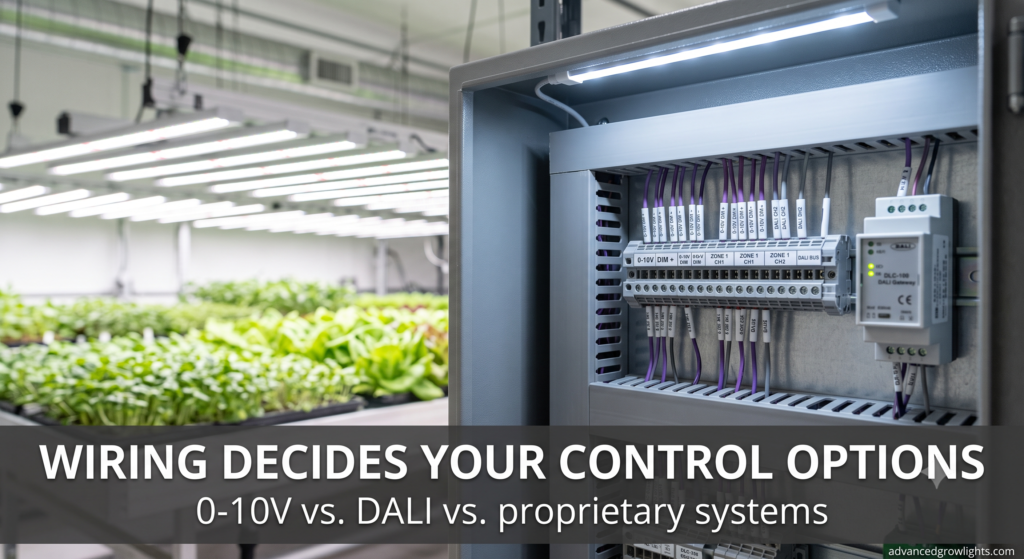
Ask any commercial lighting electrician about 0-10V retrofits and you’ll hear the same complaint: wiring mistakes that are invisible until the whole zone misbehaves. 0-10V dimming runs two separate low-voltage circuits per fixture, a relay for on/off and a dimmer line for intensity, and it’s common for those two circuits to land on the wrong home run at the controller. One fixture’s dimming signal can end up controlling a completely different zone as a result.
The failure isn’t cosmetic. Low-voltage 0-10V wires occasionally get crossed with 277V neutral conductors during multi-zone buildouts, which creates a real shock hazard for anyone servicing the panel later and can destroy driver electronics outright. And because the analog bus has no addressing, one miswired or failing fixture can drag an entire zone’s dimming with it. There’s no diagnostic message. The lights do something the grow log doesn’t match, and the electrician starts from zero.
The working fix, per commercial lighting-controls integrators, isn’t to force every brand onto one shared low-voltage bus. It’s to standardize wiring discipline within each 0-10V run and let each fixture brand operate on its own native dimming circuit rather than trying to unify mixed-brand zones on a single controller.
A worked example: wiring a four-zone flower room two ways
Take a commercial flower room split into four independently dimmed zones of ten fixtures each, 40 fixtures total. This is a realistic single-room commercial buildout, not a hypothetical extreme.
On 0-10V, you need four separate controllers, one per zone, because a single controller tops out around ten fixtures before the signal degrades. Each controller needs its own home run wiring back to the panel: eight low-voltage conductors per zone (relay pair plus dimmer pair, doubled for four zones), 32 total. Hardware cost per controller runs roughly $40 to $70. Total control hardware: under $300. You get four independently dimmable zones and zero feedback on whether any of them are running at the setpoint you logged.
On DALI, all 40 fixtures fit on a single network, since one DALI bus addresses up to 64 devices. That’s one two-wire run instead of four separate wiring topologies, with each fixture individually addressable and reporting status back to the controller. Hardware cost lands at roughly $200 or more for the DALI gateway and commissioning software, before accounting for the labor to individually address and test 40 devices, work most grow-facility electricians have never billed for. You get real per-fixture feedback and the ability to reprogram zone boundaries in software instead of rewiring the panel.
Neither answer is universally right. A single-crop flower room replicating the same recipe across all four zones has little use for DALI’s per-fixture addressing and should keep the wiring simple. A research greenhouse or multi-crop CEA facility running different light recipes per zone, and needing to prove energy performance for a DLC Custom rebate, is exactly the case DALI-style digital control was built for.
0-10V vs. DALI vs. proprietary networked control
| Factor | 0-10V | DALI (IEC 62386) | Proprietary networked (e.g. GrowWise) |
|---|---|---|---|
| Signal type | Analog, one-way | Digital, two-way | Digital, two-way (single vendor) |
| Fixtures per network | ~10 per controller | Up to 64 per bus | Varies by vendor, typically high |
| Feedback / diagnostics | None | Per-fixture status reporting | Per-fixture, vendor dashboard |
| Approx. hardware cost | $40-70 per controller | $200+ per gateway/zone | Bundled into fixture/system price |
| Cross-brand compatibility | Universal (basic dimming only) | Standardized, but rare in hort fixtures | Locked to one manufacturer |
| Best fit | Single-recipe rooms, budget builds | Multi-zone, rebate-documented facilities | Large single-vendor greenhouse deployments |
What this means for your next fixture order
Check three things before you sign a purchase order for a multi-zone commercial install. First, confirm which dimming protocol the fixture ships with. A “dimmable” label on a spec sheet tells you nothing about which of the three protocols above it uses. Second, if you’re chasing a DLC Custom rebate, ask your utility program administrator directly whether 0-10V control satisfies its documentation requirements or whether you need networked feedback. Some programs will accept manual verification; others want continuous monitoring data. Third, if you’re mixing fixture brands across zones, plan for each brand to run its own native dimming circuit rather than budgeting time to unify them on a shared bus. That unification project is the one that turns into a service call.
None of this changes the efficacy and PPFD math that should still drive your fixture selection first. See our PPFD, DLI, and efficacy guide for that groundwork, and our manufacturer overview for how the major brands compare on the numbers that matter before you even get to wiring.
Frequently asked questions
Do all commercial LED grow lights support 0-10V dimming?
Most do, since it’s the lowest-common-denominator control option manufacturers build in. Confirm on the individual spec sheet rather than assuming; some compact and low-cost fixtures only support on/off relay control with no analog dimming input at all.
Can I mix 0-10V and DALI fixtures in the same facility?
Yes, but not on the same zone or controller. Run each protocol on its own dedicated wiring and controller, and integrate at the facility management level, through a climate computer or BMS, rather than trying to merge the two signal types electrically.
Why hasn’t DALI become the standard for grow lights the way it has for office lighting?
Cost and installed base. Office buildings had decades to amortize DALI’s higher per-zone hardware and commissioning cost across long-lived fixtures. Commercial cultivation is younger, more price-sensitive on fixture counts in the hundreds, and most growers have not needed per-fixture feedback until recent rebate and monitoring requirements started asking for it.
Does DLC Hort V4.0 require networked or monitored dimming control?
Not for prescriptive rebates, which pay a fixed amount per qualifying fixture regardless of control type. Custom rebate tiers, which pay based on calculated or measured energy savings, typically require documentation that a 0-10V-only system without any reporting can’t easily produce. Confirm requirements directly with your utility’s program administrator before ordering fixtures.
What causes a whole zone of lights to dim incorrectly?
In 0-10V systems, the most common cause is a crossed home run, where a fixture’s relay or dimmer wire gets connected to the wrong zone’s controller during installation. Because the protocol has no addressing or feedback, there’s no error message. The first sign is usually a zone running at the wrong intensity or failing to respond to a schedule change.
Is a proprietary system like GrowWise a bad choice because it’s not an open standard?
Not on its own merits. For a large single-vendor deployment, like AppHarvest’s 60-acre Kentucky installation, a proprietary system with a Modbus integration layer can deliver more real functionality than DALI or 0-10V alone. The tradeoff is vendor lock-in on that zone’s fixtures, not reduced capability.
How many fixtures can one 0-10V controller run?
Roughly ten, as a practical ceiling, before voltage drop and signal degradation start causing inconsistent dimming across the run. Manufacturers publish exact limits per controller model; treat ten as a planning baseline, not a hard spec.
Should a small single-room grow bother with DALI at all?
Usually not. DALI’s value is per-fixture addressing and feedback across many zones running different recipes. A single room running one light recipe across all its fixtures gets little practical benefit for a meaningfully higher hardware and commissioning cost.
Browse verified fixture specs, including dimming and control compatibility, in the AGL grow light directory.
Do all commercial LED grow lights support 0-10V dimming?
Most do, since it’s the lowest-common-denominator control option manufacturers build in. Confirm on the individual spec sheet rather than assuming; some compact and low-cost fixtures only support on/off relay control with no analog dimming input at all.
Can I mix 0-10V and DALI fixtures in the same facility?
Yes, but not on the same zone or controller. Run each protocol on its own dedicated wiring and controller, and integrate at the facility management level, through a climate computer or BMS, rather than trying to merge the two signal types electrically.
Why hasn’t DALI become the standard for grow lights the way it has for office lighting?
Cost and installed base. Office buildings had decades to amortize DALI’s higher per-zone hardware and commissioning cost across long-lived fixtures. Commercial cultivation is younger, more price-sensitive on fixture counts in the hundreds, and most growers have not needed per-fixture feedback until recent rebate and monitoring requirements started asking for it.
Does DLC Hort V4.0 require networked or monitored dimming control?
Not for prescriptive rebates, which pay a fixed amount per qualifying fixture regardless of control type. Custom rebate tiers, which pay based on calculated or measured energy savings, typically require documentation that a 0-10V-only system without any reporting can’t easily produce. Confirm requirements directly with your utility’s program administrator before ordering fixtures.
What causes a whole zone of lights to dim incorrectly?
In 0-10V systems, the most common cause is a crossed home run, where a fixture’s relay or dimmer wire gets connected to the wrong zone’s controller during installation. Because the protocol has no addressing or feedback, there’s no error message. The first sign is usually a zone running at the wrong intensity or failing to respond to a schedule change.
Is a proprietary system like GrowWise a bad choice because it’s not an open standard?
Not on its own merits. For a large single-vendor deployment, like AppHarvest’s 60-acre Kentucky installation, a proprietary system with a Modbus integration layer can deliver more real functionality than DALI or 0-10V alone. The tradeoff is vendor lock-in on that zone’s fixtures, not reduced capability.
How many fixtures can one 0-10V controller run?
Roughly ten, as a practical ceiling, before voltage drop and signal degradation start causing inconsistent dimming across the run. Manufacturers publish exact limits per controller model; treat ten as a planning baseline, not a hard spec.
Should a small single-room grow bother with DALI at all?
Usually not. DALI’s value is per-fixture addressing and feedback across many zones running different recipes. A single room running one light recipe across all its fixtures gets little practical benefit for a meaningfully higher hardware and commissioning cost.