BLOG POST
DLC Hort V4.0: What the January 2026 Delisting Means for Your Rebates
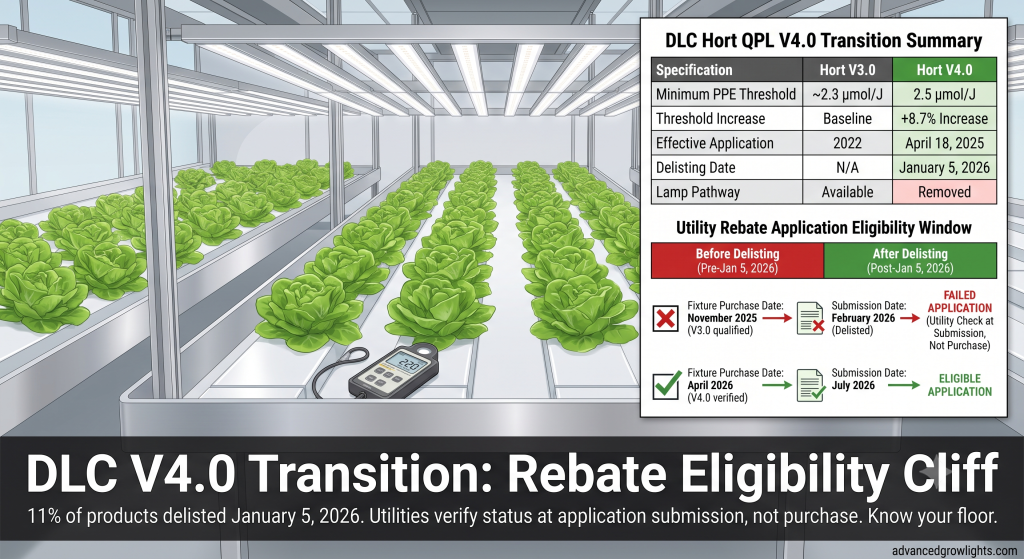
On January 5, 2026, the DesignLights Consortium removed about 11% of its Horticultural Qualified Products List in a single update. Fixtures that cleared utility rebates on January 4 did not qualify on January 6. If you purchased commercial grow lights after that date from a distributor using older spec sheets, you may hold equipment that forfeits rebates, and your utility will not flag it until they reject the application.
This is the DLC Hort V4.0 transition. Below is what changed, which fixtures were affected, and what to verify before your next rebate submission.
What the DLC Horticultural QPL Actually Does
The DesignLights Consortium runs the Horticultural Qualified Products List (QPL): a database of LED grow lights that have passed third-party efficacy testing and meet minimum performance standards. Utility rebate programs across North America use the QPL as their eligibility gate. A fixture absent from the list earns no rebate, regardless of manufacturer claims.
As of early 2025, the Hort QPL contained more than 1,200 products from over 130 manufacturers, covering an estimated 90% of the non-residential horticultural lighting market. Fluence, Gavita, Lumatek, PHOTOBIO, DimLux, and most major commercial brands maintain active QPL entries.
The QPL is not a one-time certification. It is a versioned standard that evolves with industry capability. Each revision sets a higher minimum threshold, and manufacturers must update their listings to stay eligible.
What Hort V4.0 Changed
The DLC released Hort V4.0 on March 12, 2025. The central change: the minimum photosynthetic photon efficacy (PPE) threshold rose to 2.5 µmol/J. The prior V3.0 floor sat at about 2.3 µmol/J, calculated from the DLC’s published figure of an 8.7% increase. That new threshold puts DLC-qualified LED fixtures more than 45% above the 1,000W double-ended high-pressure sodium fixture, the most efficient conventional alternative.
V4.0 also removed lamps as a qualifying product category. The DLC introduced lamp qualification in 2021. Uptake compared to full fixtures was minimal, and V4.0 closed the pathway rather than maintain a standard with few takers.
For spectrally tunable products, V4.0 added testing requirements that specify which operating state manufacturers must use for PPE measurement. Before this change, some manufacturers submitted favorable configurations that did not reflect normal operating performance. V4.0 addressed that gap.
| Specification | Hort V3.0 | Hort V4.0 |
|---|---|---|
| Minimum PPE threshold | ~2.3 µmol/J | 2.5 µmol/J |
| Threshold increase | Baseline | +8.7% |
| Effective application date | 2022 | April 18, 2025 |
| Delisting date | N/A | January 5, 2026 |
| Lamp qualification pathway | Available | Removed |
| Tunable product test state | Manufacturer’s choice | Defined test state required |
The January 5 Delisting
The DLC set the delisting date at January 5, 2026. Manufacturers had until October 31, 2025 to submit update applications for existing products. The DLC removed any product from the QPL that failed to update by that deadline or whose tested efficacy fell below 2.5 µmol/J.
About 130 products came off the list. The fixtures most exposed were mid-tier bar lights and entry-level quantum boards in the 2.0 to 2.4 µmol/J range. These products appear in many commercial retrofits where procurement teams chose upfront cost over long-term rebate eligibility. It is a trade-off that now shows up as a rejected application.
High-end commercial fixtures from Gavita, Fluence, Lumatek, and PHOTOBIO were already operating at 2.7 µmol/J and above, well clear of the new floor. The delisting hit the lower segment of the market hardest.
For manufacturers with unchanged product designs, the DLC offered a Simplified V4 Update application at $500 per product family. Brands that lost QPL status either missed the October 2025 deadline or could not clear 2.5 µmol/J with their existing hardware.
What This Means for Your Rebate Application
Utility programs check QPL status at the time of rebate application submission, not at the time of purchase. A fixture purchased in November 2025 under V3.0 certification, then delisted on January 5, 2026, fails a rebate application submitted in February 2026, even though the fixture held QPL status when you ordered it.
Energy Trust of Oregon made this enforcement date explicit. Starting July 1, 2026, the program requires every submitted product to appear on the DLC Hort V4.0 list. V3.0 archived listings do not satisfy the V4.0 requirement, even if the product once held certification.
Energy Trust’s horticultural incentive pays $0.15 per annual kilowatt-hour saved, capped at $350 per fixture, with a $750,000 per-site annual ceiling. For a 200-fixture installation replacing 1,000W HPS with 750W LED running 18 hours per day, the calculation runs as follows.
| Variable | Value |
|---|---|
| Old fixture draw | 1,000W HPS |
| New fixture draw | 750W LED |
| Annual energy savings per fixture | 1,642 kWh (18 hrs/day, 365 days) |
| Energy Trust incentive rate | $0.15 per kWh saved |
| Rebate per qualifying fixture | $246 |
| 200-fixture installation total | $49,200 |
That $49,200 holds only when every fixture on the invoice carries a valid V4.0 QPL listing on the submission date. Other utility programs across the Pacific Northwest, Midwest, and Northeast follow similar QPL-based structures. Confirm your utility’s version requirement before signing purchase orders.
How to Verify Your Fixture’s Status
The DLC QPL is searchable at designlights.org. Navigate to the Horticultural Lighting section, apply the V4.0 filter, and search by manufacturer or product name. Each listing shows tested PPE, total PPF output, input wattage, and the qualifying version.
Three checks before submitting any rebate application:
- Confirm the product appears under V4.0, not the V3.0 archive. Archived listings remain visible in QPL search results but do not satisfy V4.0 program requirements.
- Match the product ID on your invoice to the exact QPL entry. Manufacturers run multiple SKUs at different wattages with different efficacy ratings. A 630W version and an 800W version of the same fixture may carry separate QPL entries.
- Check that your invoice date aligns with your rebate program’s eligibility window. Some utilities use purchase date; others use installation date. Confirm with your account manager before submitting.
One more variable: distributors carry old stock. A fixture shipping from a warehouse in April 2026 may have been manufactured to V3.0 specs. Confirm QPL status before the order ships, not after.
Which Commercial Fixtures Clear the 2.5 µmol/J Floor
The fixtures below represent the upper tier of commercially deployed LED grow lights. Efficacy figures come from manufacturer-published specifications and AGL directory data. Verify current DLC V4.0 listing status in the QPL before purchasing — QPL status is dynamic and changes with each revision cycle.
| Fixture | Input Wattage | Efficacy (µmol/J) | Buffer Above 2.5 Floor |
|---|---|---|---|
| Gavita RS 2400e | 750W | 3.2 | +0.7 µmol/J |
| Fluence SPYDR 3 | 800W | 3.0 | +0.5 µmol/J |
| Lumatek ZEUS 600W PRO | 600W | 2.85 | +0.35 µmol/J |
The fixtures at 2.85 µmol/J and above hold meaningful buffer above the V4.0 floor. That buffer protects against the next DLC revision. A fixture at 2.5 µmol/J passes today; a future V5.0 raising the floor to 2.7 µmol/J leaves it out.
Budget-tier fixtures from brands like Spider Farmer and ViparSpectra span a wide range across their product lines. Some models clear 2.5 µmol/J; others do not. Search the QPL for the specific model number before assuming certification. The brand name alone tells you nothing.
The Pattern Behind Each DLC Revision
The 8.7% increase from V3.0 to V4.0 follows the direction of every prior DLC revision. The minimum has risen with each cycle. The DLC has not reduced the efficacy floor in any revision to date.
Commercial operations planning three to five-year equipment cycles need to factor this trajectory into purchasing decisions. A fixture purchased at 2.6 µmol/J today may sit below the floor if the DLC raises the minimum to 2.7 or 2.8 µmol/J in a V5.0 revision. Based on prior revision cadence, V5.0 could arrive as early as 2027 or 2028.
Buying 0.4 to 0.6 µmol/J above the current floor is not over-engineering. It is rebate protection across your depreciation cycle.
For a full breakdown of how PPE, PPFD, and DLI relate to fixture selection, see our guide to PPFD, DLI, and Efficacy Explained. The AGL directory lists commercial grow light fixtures with verified specifications across manufacturers, including DLC-certified options at multiple efficacy tiers.
What is DLC Hort V4.0?
DLC Hort V4.0 is the DesignLights Consortium’s fourth version of its Horticultural Technical Requirements for LED grow lights. Released March 12, 2025, it raised the minimum photosynthetic photon efficacy to 2.5 µmol/J and removed the lamp qualification category. The DLC removed products that failed to meet V4.0 requirements from the Qualified Products List on January 5, 2026.
What does PPE mean for grow lights?
PPE stands for photosynthetic photon efficacy: the number of photosynthetically active photons a fixture delivers per joule of electrical energy consumed, measured in µmol/J. A higher PPE means more usable light per watt, which lowers your energy cost per unit of crop output. The DLC’s minimum PPE threshold is the primary technical gate for rebate eligibility. See our PPFD, DLI, and Efficacy guide for a full breakdown.
How do I check if my fixture was delisted?
Search the DLC Horticultural QPL at designlights.org using the V4.0 version filter. If your fixture does not appear in V4.0 results, the DLC either delisted it or it never qualified. Contact the manufacturer for current QPL status before submitting any rebate application.
Does DLC V4.0 affect all utility rebate programs?
No. Each utility sets its own version requirement. Energy Trust of Oregon requires V4.0 from July 1, 2026. Other utilities may still accept V3.0 listings during a transition period. Confirm your utility’s version requirement before purchasing.
Can I still use a delisted grow light?
Yes. DLC QPL status is a rebate eligibility requirement, not a legal or safety standard. A delisted fixture is a functional grow light. You cannot claim utility rebates for it after it exits the QPL.
What do manufacturers need to do to maintain QPL status under V4.0?
Manufacturers with unchanged product designs could submit a Simplified V4 Update application to the DLC at $500 per product family. Products with design or performance changes required full update applications with supporting test documentation. The DLC’s deadline for update submissions was October 31, 2025.
Are HPS or CMH fixtures on the DLC QPL?
No. The DLC Horticultural QPL covers LED fixtures and LED-based modules only. High-pressure sodium and ceramic metal halide fixtures are not eligible for QPL listing and do not qualify for LED-specific rebate programs.
Which fixture brands maintain DLC V4.0 certification?
Major commercial brands including Gavita, Fluence, Lumatek, PHOTOBIO, DimLux, ThinkGrow, HLG, and SANlight maintain active QPL listings. Search designlights.org for current V4.0 status, as certification changes with each revision cycle. The AGL directory also lists DLC-qualified fixtures with verified specifications.