BLOG POST
Photoperiodic Injury: The Hidden Risk of 24-Hour Grow Lights in Greenhouse Tomatoes
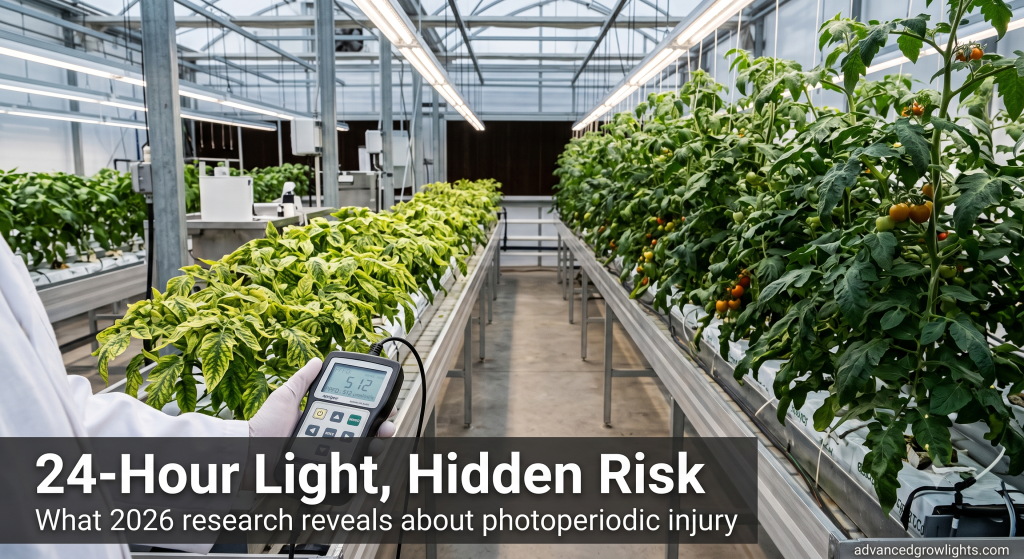
Push a greenhouse tomato past 16 hours of light and the plant usually rewards you with more fruit. Push it to 24 hours and the reward can turn into a liability: pale, blotchy leaves between the veins, stalled photosynthesis, and in severe cases plant death. Growers have known about this for decades, but two studies published in Frontiers in Plant Science in 2026 quantify what happens inside the leaf and show a way around it.
The timing matters. Electricity rate structures and DLI banking strategies have pushed more commercial growers toward longer photoperiods to hit daily light integral targets at lower fixture intensity. Time-of-use electricity pricing rewards spreading photon delivery across more hours at lower peak draw, and a grower chasing that rate advantage has an obvious incentive to stretch a photoperiod from 16 hours toward 20, then toward 24. Tomato is one of the crops where that strategy can backfire hardest. Lettuce tolerates near-continuous light with few problems. Tomato does not.
What Continuous Light Does to a Tomato Leaf
The injury has a name: continuous light injury, or photoperiodic injury. Symptoms show up first as interveinal chlorosis, yellowing between the leaf veins while the veins themselves stay green. Photosynthetic efficiency drops. Left long enough, leaves die and the plant’s growth stalls.
Researchers spent years arguing over the cause. Wageningen University’s Alejandro Velez-Ramirez and colleagues tested five competing explanations in a 2017 Functional Plant Biology study: spectral mismatch between sunlight and artificial light, continuous photoreceptor signaling, an oversupply of photosynthate, photo-oxidative stress, and circadian asynchrony. Their conclusion pointed to one factor above the rest. A mismatch between the plant’s internal circadian clock and an external light cycle that never turns off triggers the injury, not carbohydrate overload or light quality alone. Tomato depends on a period of darkness to reset that clock. Take the darkness away and the plant’s internal timing drifts out of sync with its own physiology.
That mechanism explains why some fixes work and others don’t. A short daily temperature dip can partially substitute for a dark period, because temperature swings help re-entrain the circadian clock even when light stays on. Spectral tricks alone rarely solve the problem on their own, since the clock, not the photoreceptor pool, is the trigger.
Earlier work traced part of the downstream damage to a specific gene: CAB-13, which codes for a light-harvesting protein tied to photosystem I. Under continuous light, tomato down-regulates CAB-13 expression, which throws photosystem I and photosystem II out of balance and drives the oxidative stress that shows up as chlorosis. The circadian mismatch is the trigger; the CAB-13 disruption is one of the downstream mechanisms that turns that mismatch into visible leaf damage.
Tomato isn’t the only crop that reacts this way, though it’s the best studied. Other Solanaceae, including pepper and eggplant, show comparable sensitivity to continuous light in smaller trials, even though the 2026 research covered here focused specifically on tomato. Growers working mixed Solanaceous crops should treat any of them as a candidate for injury risk until proven otherwise, rather than assuming immunity because a given trial didn’t test that species directly.
Two 2026 Studies, Two Different Angles on the Same Problem
The mechanism was established science by 2017. Two independent teams added the missing piece in 2026: proof, backed by whole-plant yield data and cellular-level carbon tracing, that growers can dodge the injury entirely while still running lights around the clock.
Harrow’s Whole-Plant Trial
Jason Lanoue’s team at Agriculture and Agri-Food Canada’s Harrow Research and Development Centre ran cherry tomato cultivars ‘Tomary’ and ‘Black Cherry’ through six lighting treatments: conventional 16-hour photoperiods at low and high blue fractions, and 24-hour treatments using either static (constant intensity and spectrum) or dynamic (varying intensity and spectrum through the day) supplemental lighting. The static 24-hour treatment produced the injury you’d expect: reduced plant health metrics across the board. The dynamic 24-hour treatment did not. Plants under dynamic 24-hour light held photosynthetic efficiency comparable to the 16-hour controls and matched their yields, while cutting electricity cost by roughly $0.45 per kilogram of fruit produced. Low-blue treatments outperformed high-blue ones on energy efficiency in the same trial.
The Carbon-Tracing Trial
A separate team, T.R.J.G. Marie and colleagues from Queen’s University and the University of Guelph, published a companion piece of evidence in June 2026 using steady-state 14CO2 tracing to watch carbon move through tomato leaves in real time. Under static continuous light, the coupling between how much carbon a leaf fixes and how much it exports to the rest of the plant broke down within four days, well before any visible injury appeared. Export declined roughly 12% faster than photosynthesis itself, and the leaf’s retained carbon pool grew by about 45%. By week three, net carbon exchange rate had fallen 64.4%, export had dropped 61.7%, and water-use efficiency had collapsed from a healthy 8.74 to 8.95 mmol CO₂ per mol H₂O down to 3.29. Under dynamic 24-hour schedules, none of that happened. Carbon assimilation and export stayed stable and comparable to the 16-hour control for the full three weeks.
Put the two studies together and the pattern holds at every scale researchers looked, from whole-plant yield down to individual carbon molecules. Static round-the-clock light breaks tomato physiology. Dynamic round-the-clock light, varying intensity and spectrum on a schedule, does not.
Static vs. Dynamic 24-Hour Lighting, Side by Side
| Metric | 16-Hour Conventional | Static 24-Hour Light | Dynamic 24-Hour Light |
|---|---|---|---|
| Leaf symptoms | None | Interveinal chlorosis by week 2-3 | None observed |
| Yield vs. control | Baseline | Reduced with severe injury | Comparable to control |
| Water-use efficiency | Baseline (healthy) | Down to ~3.29 mmol CO₂/mol H₂O | 8.74-8.95 mmol CO₂/mol H₂O |
| Carbon assimilation-export coupling | Stable | Breaks down within 4 days | Stable for 3+ weeks |
| Electricity cost vs. 16h baseline | Baseline | Not tested for cost in cited trials | ~$0.45/kg fruit lower |
| Verdict | Safe, established practice | Avoid for tomato | Viable alternative with correct programming |
Read the water-use efficiency row twice. A drop from roughly 8.8 down to 3.29 mmol CO₂ per mol H₂O means the plant burns through nearly three times as much water to fix the same unit of carbon. That’s an irrigation and humidity-control problem on top of the yield problem, and it shows up well before growers would notice visible leaf damage.
What This Means for a Commercial Greenhouse’s Electric Bill
Take a 1-hectare cherry tomato greenhouse producing roughly 500,000 kg of fruit annually, a reasonable midpoint for hydroponic cherry tomato production at that scale. Apply the Harrow trial’s per-kilogram savings figure to a switch from 16-hour conventional lighting to properly programmed dynamic 24-hour lighting, and the arithmetic lands around $225,000 per year in electricity savings (500,000 kg × $0.45/kg).
Treat that number as a directional estimate, not a guarantee. The Harrow trial ran on specific cultivars, a specific facility, and Ontario electricity rates. Your actual savings depend on local time-of-use pricing, cultivar, fixture efficacy, and how closely your control system can replicate the intensity and spectrum curve the trial used. The direction is clear even if the magnitude varies: dynamic scheduling captures real savings that static round-the-clock lighting cannot, because static 24-hour light forces you to choose between running lights at full intensity (high energy cost) or accepting the injury and yield loss that comes with it.
Scale the same math down to a single 30,000-square-foot bay producing roughly 34,000 kg of cherry tomatoes a year, and the same $0.45/kg figure works out to about $15,300 in annual savings, a smaller number in absolute terms but the same percentage improvement. For growers deciding whether the controller upgrade needed to run a dynamic 24-hour schedule pencils out, that per-square-foot version of the math is often the more useful one, since it maps directly onto a single production bay rather than an entire facility.
How to Extend Photoperiod Without Triggering Injury
Three approaches have research support behind them, and none require exotic hardware.
Vary intensity and spectrum through the 24-hour cycle. This is what the Harrow trial tested directly. Rather than running fixtures at one constant output level around the clock, the control system ramps intensity and shifts the red-to-blue ratio on a schedule, the same principle behind the spectrum-tuning research AGL has covered for UV and far-red supplementation. Fixtures from Gavita, Fluence, and Lumatek in the AGL directory all support multi-channel dimming that can execute a scheduled curve like this; check your controller’s programming depth before assuming it can.
Alternate red and blue wavelengths instead of running them together. A 2019 Frontiers in Plant Science trial found that switching between red-dominant and blue-dominant light on a cycle, rather than blending them continuously, prevented injury in continuously lit tomato even without a dark period. The mechanism ties back to the same circadian entrainment problem Velez-Ramirez identified: alternating spectra appears to give the clock a cue to latch onto that constant blended light does not provide.
Build in a temperature dip. A 2017 Frontiers in Plant Science trial found that a daily temperature drop of even a few degrees, timed consistently, restored normal photosynthetic patterns in tomato under continuous light by giving the circadian clock an environmental cue other than darkness. This costs nothing beyond climate control programming most greenhouses already have.
None of these approaches are plug-and-play defaults on off-the-shelf fixtures. Growers running commercial-scale operations should check with their controller vendor or review the manufacturer overview for systems with the multi-channel, schedule-driven dimming these protocols require, rather than assuming a basic on/off timer will replicate the trial conditions.
Not Every Crop Reacts the Same Way
Tomato sits toward the sensitive end of the spectrum here. Lettuce and other leafy greens tolerate much longer photoperiods with little injury risk, which is part of why AGL’s earlier coverage of dynamic light scheduling in lettuce production focused on energy efficiency rather than injury avoidance. That distinction matters for anyone running mixed-crop facilities: a scheduling protocol tuned for lettuce will not protect a tomato crop from continuous-light injury, and the reverse is also true. Match the protocol to the crop, not the other way around.
Before You Push Past 18 Hours
Confirm your cultivar’s sensitivity first. Solanaceous crops (tomato, pepper, eggplant) carry documented injury risk under continuous light; leafy greens generally do not. Check whether your fixture and controller can execute a genuine intensity and spectrum curve across 24 hours rather than a simple dimming ramp at sunrise and sunset. Budget a pilot run on a small block before committing a full greenhouse bay, since cultivar-specific response varies and the Harrow and Guelph trials, while rigorous, were run on specific cherry tomato lines rather than the full range of commercial cultivars. And track water-use efficiency alongside yield, since the carbon-tracing data shows that metric moving well before visible symptoms would tip you off.
Log the pilot block’s water use, canopy temperature, and fruit set on a fixed schedule from day one, before leaves show any symptoms. Both 2026 trials found measurable physiological decline days before any visible chlorosis appeared, which means a grower relying on a visual check alone will miss the early warning window entirely. A simple weekly log of irrigation volume against fruit load gives you a proxy for water-use efficiency without needing a gas-exchange lab, and a sustained upward drift in that ratio is your signal to back off the dynamic protocol and review the programming before the crop shows outward damage.
Explore verified fixture specs and controller capabilities across manufacturers in the AGL grow light directory before programming a 24-hour lighting protocol for your next tomato crop.
What is photoperiodic injury in tomato plants?
Photoperiodic injury, also called continuous light injury, is physical damage tomato plants develop when they receive too little darkness. Symptoms include interveinal chlorosis (yellowing between the leaf veins while veins stay green), reduced photosynthetic efficiency, and in severe cases leaf death. Research points to circadian asynchrony, a mismatch between the plant’s internal clock and an external light cycle that never turns off, as the main trigger.
Why does continuous light harm tomato but not lettuce?
Different crops depend on darkness for different physiological processes. Tomato and other Solanaceous crops use a dark period to reset their circadian clock, and without it their internal timing drifts out of sync with their own metabolism. Lettuce and most leafy greens don’t share that same dependency, which is why they tolerate near-continuous lighting with far less risk.
Can dynamic lighting replace a dark period for tomato?
Two 2026 Frontiers in Plant Science trials, one from Agriculture and Agri-Food Canada’s Harrow center and one from Queen’s University and the University of Guelph, found that varying intensity and spectrum through a 24-hour cycle prevented injury and kept yield, photosynthesis, and water-use efficiency comparable to conventional 16-hour lighting. Static 24-hour light at constant intensity did not get the same result.
How much electricity can dynamic 24-hour lighting save?
The Harrow trial measured roughly $0.45 per kilogram of fruit in electricity savings for dynamic 24-hour lighting versus conventional 16-hour lighting, in that specific facility and cultivar. Treat that figure as a directional estimate. Your actual savings depend on local electricity rates, cultivar, fixture efficacy, and how closely your controller replicates the trial’s intensity and spectrum curve.
Do pepper and eggplant carry the same risk as tomato?
The 2026 research covered here tested tomato specifically, but smaller studies show comparable sensitivity to continuous light in other Solanaceous crops, including pepper and eggplant. Growers running mixed Solanaceous crops should treat any of them as a candidate for injury risk rather than assuming a crop is safe because a specific trial didn’t test it.
Is a temperature dip enough to prevent continuous-light injury on its own?
A 2017 Frontiers in Plant Science trial found that a daily temperature drop of a few degrees, applied consistently, helped restore normal photosynthetic patterns in tomato under continuous light by giving the circadian clock an environmental cue other than darkness. Treat it as one tool among several rather than a complete substitute for a properly programmed dynamic lighting schedule, since results vary by cultivar and facility.
How would I know if my crop is developing photoperiodic injury before it’s visible?
Both 2026 trials found measurable declines in carbon assimilation, export, and water-use efficiency days before any visible chlorosis appeared. Tracking irrigation volume against fruit load on a fixed weekly schedule gives growers a practical proxy for water-use efficiency without lab equipment, and a sustained upward drift in that ratio is an early warning sign worth acting on.
What controller features do I need to run a dynamic 24-hour lighting protocol?
You need multi-channel dimming that can execute a scheduled intensity and spectrum curve across the full 24-hour period, rather than a basic sunrise and sunset ramp. Check your fixture and controller’s programming depth before assuming it can replicate published trial conditions, since a simple on/off timer will not reproduce the dynamic protocols the 2026 research tested.