
BLOG POST
Grow Light Efficacy in 2026: What Actually Clears the DLC V4.0 Rebate Bar
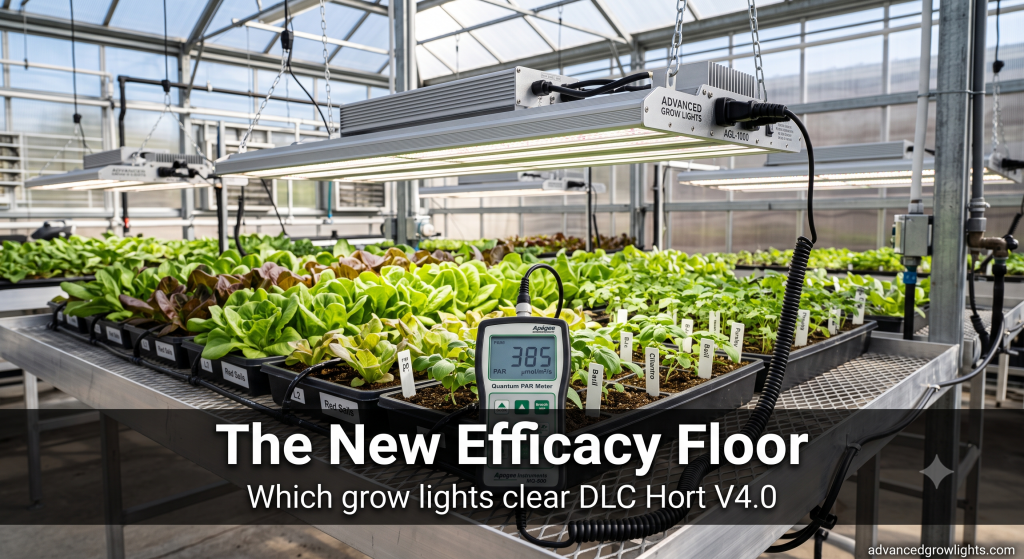
As of July 1, 2026, Energy Trust of Oregon accepts horticultural lighting rebate applications only for fixtures listed under DesignLights Consortium Horticultural Technical Requirements V4.0. The program announced the change back in November 2025. Most growers filed it under “handle later” and moved on. Later is now.
Energy Trust is not an outlier. It is the first utility to put a hard date on what the rest of the DLC-aligned rebate market has been building toward since the January 5, 2026 delisting: V4.0 is no longer a technical footnote. It is the eligibility floor. If you specify a fixture for a new build or retrofit this quarter, “DLC listed” is not enough information to act on. You need to know the generation, the SKU, and the exact efficacy figure attached to that listing.
We covered the delisting mechanics in our January 2026 breakdown of Hort V4.0. This piece picks up where that one left off: how utilities are enforcing the new standard in practice, and which commercial fixtures clear the bar with room to spare.
Why “DLC Listed” Stopped Being a Useful Answer
The DLC Horticultural Qualified Products List sets a minimum photosynthetic photon efficacy of 2.5 µmol/J under V4.0, an 8.7% increase over the old V3.0 floor of roughly 2.3 µmol/J. Manufacturers that wanted to stay listed had to submit update applications by October 31, 2025. About 11% of the QPL did not make the cut and came off the list on January 5, 2026.
Here is the part that trips up procurement teams: a brand staying on the QPL does not mean every SKU that brand ever sold is still there. Manufacturers often carry multiple generations of the same product line, and older generations frequently sit below the new floor even when the current generation clears it easily. Lumatek’s ZEUS 600W PRO line is the clearest example on the market right now. Lumatek’s own published specs put different production runs of the same fixture name at 2.6, 2.9, and 3.1 µmol/J depending on when the unit left the factory. Only the higher-efficacy runs comfortably clear V4.0. A distributor quote naming only “Lumatek ZEUS 600W PRO” tells you the brand, not the number a utility auditor will check.
Utilities check the number, not the brand name on the invoice. Energy Trust’s incentive terms tie eligibility to the exact QPL entry, which means the specific model and hardware revision, not the product family. Submit a PO for last year’s hardware revision and the rebate gets rejected even though the box says the right thing.
The Efficacy Floor Is Moving Faster Than the Marketing Copy
Three commercial fixtures with verifiable manufacturer specs show how far the top of the market has pulled away from the 2.5 µmol/J minimum.
| Fixture | Efficacy (µmol/J) | PPF Output | Wattage | Source |
|---|---|---|---|---|
| Gavita RS 2400e V2 | 3.2 | 2,400 µmol/s | 750W | Gavita product literature |
| Fluence SPYDR 3 | Up to 3.06 | Up to 2,260 µmol/s | 390–800W (multi-tap) | Fluence spec sheet (June 2025 rev.) |
| Lumatek ZEUS 600W PRO (current rev.) | 2.9–3.1 | Up to 1,990 µmol/s | ~615W | Lumatek Lighting spec sheet |
Every fixture in that table clears the 2.5 µmol/J floor by a wide margin. That gap matters more than it looks. A grower replacing HPS or an early-generation LED does not need to hunt for the cheapest DLC-listed option that squeaks past the minimum. The commercially available ceiling right now sits 25 to 28% above the new floor, and that difference compounds daily across a photoperiod that runs 12 to 18 hours.
Why Efficacy Varies Inside One Product Line
Manufacturers rarely redesign a fixture from scratch every time efficacy climbs. More often, a running product line gets incremental upgrades: a higher-binned diode batch, a revised driver with lower conversion loss, better thermal management that lets the diodes run cooler and closer to peak efficiency. Each upgrade usually keeps the same product name and the same enclosure, so two units sitting on a shelf side by side can carry the same model number and a meaningfully different efficacy rating.
That’s exactly the pattern in Lumatek’s ZEUS 600W PRO line. The 2.6 µmol/J version and the 3.1 µmol/J version share a name, a footprint, and a place on a distributor’s website. They do not share a DLC listing, because the DLC ties qualification to submitted test data for a specific hardware configuration, not to a marketing name. Gavita and Fluence follow the same practice of versioning within a product family, which is why this piece cites the RS 2400e V2 and the SPYDR 3 specifically rather than “Gavita” or “Fluence” as brands.
A Worked Example: What the Gap Between 2.3 and 3.2 µmol/J Costs
Take a hypothetical 5,000 sq ft flower room that needs 480,000 µmol/s of total PPF output across the canopy to hit its PPFD target, running a 12-hour photoperiod, 350 days a year. Two fixture options, both DLC listed, sit at opposite ends of the efficacy range discussed above.
- At 2.3 µmol/J (the old V3.0 floor): 480,000 ÷ 2.3 = 208,696W of connected load.
- At 3.2 µmol/J (Gavita RS 2400e V2): 480,000 ÷ 3.2 = 150,000W of connected load.
That’s a 58.7 kW difference to deliver the identical photon output. Over a 12-hour photoperiod, that’s 704.4 kWh saved per day. At a representative commercial electricity rate of $0.12/kWh, the higher-efficacy fixture saves roughly $84.50 a day, or about $29,600 across 350 operating days. None of that includes the rebate itself. It’s the electric bill difference alone, for hitting the same PPFD target with less connected load.
Run the math for your own room before you sign a purchase order. The inputs that matter are your target PPF output, your local commercial electricity rate, and the actual efficacy figure on the specific SKU’s current DLC listing, not the number on last year’s spec sheet.
How to Verify a Fixture Before You Submit a Rebate Application
Four checks catch most of the rejections utilities are now issuing.
- Pull the exact model number and hardware revision off the quote, not the product family name.
- Search that model number directly in the DLC’s Horticultural QPL at designlights.org, not a manufacturer’s marketing page.
- Confirm the listing shows V4.0 as the qualifying technical requirement, not a carried-over V3.0 entry pending update.
- Check your utility’s own program page for the effective date it enforces. Energy Trust’s cutoff is July 1, 2026. Other programs may sync to the DLC’s January 5 delisting date instead, or set their own schedule entirely.
That fourth check matters because rebate programs are not required to move in lockstep with the DLC’s own calendar. A utility can grandfather V3.0 fixtures purchased before a cutoff, require V4.0 immediately, or set an intermediate deadline. Energy Trust gave manufacturers and growers roughly seven months of public notice between its November 2025 announcement and the July 1 enforcement date. Confirm your own utility’s specific terms directly. Do not assume the DLC’s national delisting date and your local program’s enforcement date are the same day.
What This Means If You’re Not in Oregon
Energy Trust of Oregon is the first program we’ve confirmed with a public, dated V4.0 enforcement announcement. Given that DLC Hort qualification is the standard nearly every horticultural lighting rebate program in North America already leans on, expect other utilities to publish similar enforcement dates over the coming months rather than none at all. If your program hasn’t announced one yet, that’s a gap in public information, not a guarantee your fixture is safe indefinitely.
The practical move: treat every rebate-eligible purchase from here forward as if V4.0 enforcement is already live in your territory, even if your specific utility hasn’t set a date. The fixtures in the table above clear the floor with margin. Specifying to that standard now costs nothing extra in most cases and removes the risk of a rejected application six months from now.
Programs that haven’t published a V4.0 date yet tend to fall into one of three patterns once they do. Some cut over hard on a fixed date, the way Energy Trust did. Some grandfather equipment purchased or contracted before the cutover, so a signed PO ahead of the deadline can lock in eligibility even if the fixture ships later. Others set an intermediate step, allowing V3.0 fixtures at a reduced incentive rate for a transition window before requiring V4.0 outright. None of these patterns is guaranteed, and a program can also choose to offer no grace period at all. Two calls are worth making before you commit budget to a large order: one to your utility’s program administrator to ask directly which pattern applies and get the answer in writing, and one to your distributor to confirm the exact model number and hardware revision they intend to ship, not the product family you priced out.
For the fundamentals behind these numbers, including how PPFD, DLI, and efficacy relate to each other, see our explainer on the three numbers that matter most. For a broader look at manufacturer options beyond the three fixtures compared here, see our 2026 manufacturer overview.
Browse verified specs on these and other fixtures in the AGL grow light directory.
What is DLC Hort V4.0?
It’s the DesignLights Consortium’s current technical standard for horticultural LED fixtures, effective March 12, 2025. It raised the minimum photosynthetic photon efficacy to 2.5 µmol/J and removed the qualification pathway for lamps.
When did older fixtures get delisted?
The DLC delisted non-updated V3.0 products from the Horticultural Qualified Products List on January 5, 2026, affecting roughly 11% of the list.
Why did Energy Trust of Oregon set a separate July 1, 2026 date?
Utility rebate programs set their own enforcement schedules independent of the DLC national delisting calendar. Energy Trust announced in November 2025 that only V4.0-listed fixtures would qualify for its horticultural lighting incentives starting July 1, 2026, giving the market roughly seven months of notice.
Does a fixture staying “DLC listed” mean my specific unit still qualifies?
Not necessarily. Manufacturers frequently sell multiple hardware generations under one product name, and older generations can fall below the current efficacy floor even when the current generation clears it. Verify the specific model number and hardware revision against the live QPL entry.
What efficacy should I look for above the DLC minimum?
The 2.5 µmol/J figure is a floor, not a target. Commercially available fixtures from established manufacturers are currently verified between 2.9 and 3.2 µmol/J, roughly 16 to 28% above the minimum, with meaningful differences in operating cost at that spread.
Where do I check if my fixture is currently DLC Hort qualified?
Search the exact model number in the DesignLights Consortium’s Horticultural Qualified Products List at designlights.org. Don’t rely on a manufacturer’s marketing page or a distributor’s product description alone.
Will other utilities follow Energy Trust’s approach?
Most North American horticultural rebate programs already require DLC Hort qualification as a baseline, so it’s reasonable to expect more utilities to publish V4.0-specific enforcement dates. Check your own utility’s program page directly rather than assuming a uniform national timeline.
Does higher efficacy always mean lower total cost?
Not automatically. Higher-efficacy fixtures often carry a higher purchase price, and the payback period depends on your local electricity rate, operating hours, and any available rebate. Run the connected-load comparison for your specific room before deciding, using the method outlined in this article.