
BLOG POST
The Full-LED Greenhouse Heat Trade-Off: Why Some Growers Save 40% and Others Watch Bills Climb
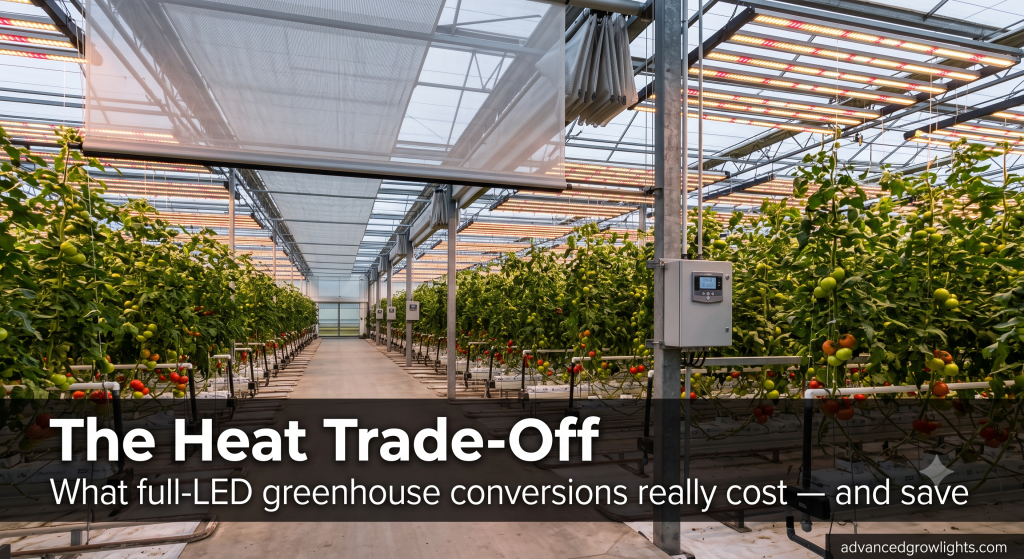
Grodan and Philips Horticulture LED Solutions spent three years proving a full-LED greenhouse can cut heat input by half. A separate body of peer-reviewed modeling work found the opposite: swap high-pressure sodium (HPS) for LED toplights in a cold-climate greenhouse, and the boiler works harder, not less. Both findings hold up. The gap between them is the entire story a commercial grower needs before signing a fixture order.
The heat nobody puts in the proposal
HPS fixtures throw off heat, and plenty of it. Ballasts run hot, lamps radiate infrared alongside visible light, and greenhouses built around HPS toplighting were engineered with that heat as part of the climate plan. Pull the HPS out, drop in LED, and you remove a heat source the boiler had leaned on for years.
LED converts electricity to photons with far less waste heat per photon than HPS, and the heat it does produce comes through convection, not radiation. On paper, that sounds like a straightforward win. In a Quebec or Scandinavian winter, it isn’t automatic.
What the modeling shows
Researchers running the open-source GreenLight greenhouse model compared HPS and LED toplighting scenarios in Montreal and Copenhagen. In both cities, the LED scenario needed more boiler energy for space heating than the HPS scenario: 2,163 MJ/m² in Montreal versus a lower HPS baseline, and 1,973 MJ/m² in Copenhagen under the same comparison. Total annual energy load still dropped overall, because lighting savings outweighed the added heating demand. The heating line item on its own moved the wrong direction.
Here’s why. All the electricity a fixture draws ends up as heat somewhere in the greenhouse envelope, either as usable photons absorbed by the canopy or as waste heat radiating off the fixture itself. HPS at about 1.7 µmol/J needs far more electrical input than LED at 3.0-3.7 µmol/J to hit the same PPFD target. Swap one for the other and total electrical draw for lighting drops by close to half. The fixture’s contribution to keeping the room warm drops with it. Growers who built their heating system around that contribution feel the difference the first cold snap after conversion.
When the conversion pays off
Grodan, Philips Horticulture LED Solutions, Ridder, BASF, Wireless Value, and Normec Groen Agro Control ran a multi-year full-LED tomato trial at the Botany Research Centre in the Netherlands, testing whether an integrated approach could offset the heating gap the GreenLight modeling predicted. It did better than offset it. The trial team reported a 50% reduction in heat input compared to commercial practice, without giving up fruit quality.
The result didn’t come from the lights alone. Ridder’s Hortimax Pro climate computer coordinated screens with the lighting schedule instead of treating them as separate systems. Spectral dimming shaved another 3% off light energy consumption on top of the heat savings. On the irrigation side, the team ran nutrient solution at a lower EC (2.8 mS/cm versus a standard 3.8 mS/cm) and got fruit about 10% larger at the same Brix level, evidence the lower-heat regime didn’t cost flavor.
A commercial-scale case: Woodeumgee Farm, South Korea
Trial data is one thing. A grower reinvesting real money after seeing the results firsthand is a stronger signal. Woodeumgee Farm Co., a 12-hectare tomato and lettuce operation in Buyeo, South Korea, installed Philips GreenPower LED toplighting compact fixtures (up to 3.7 µmol/J at 645W, dimmable down to 10% output) in its tomato greenhouse in 2022. The results were strong enough that the farm expanded the same fixture line into a new lettuce nursery greenhouse.
Reported results: 27% higher tomato yield and 40% energy savings. “Stable and uniform lighting during the young plant stage is a critical factor that determines overall crop quality,” said Ho-Yeon Kim, the farm’s chairman. Han Lee, CEO of Signify Korea, framed the reinvestment itself as the proof point: a grower choosing to expand a lighting platform after living with it for years carries more weight than any spec sheet.
What separates the winners from the modeling’s worst case
Line up the Botany trial and Woodeumgee against the GreenLight modeling and a pattern emerges. The operations that saved money treated lighting, climate, and irrigation as one connected system. The scenarios where heating costs climbed treated the lighting swap as an isolated fixture upgrade, bolted onto a greenhouse still running its old climate strategy.
- Climate screens synced to the lighting schedule rather than running on a fixed timer independent of light output.
- Dimming tied to real-time PPFD and DLI targets instead of a static on/off schedule that ignores outdoor conditions.
- A climate computer that reads light and heat as one input, not two separate systems reporting to two separate teams.
- Irrigation and EC tuned for the new heat profile, since a cooler canopy microclimate changes how a crop takes up water and nutrients.
Skip any one of these and the fixture upgrade alone won’t replicate the Botany or Woodeumgee numbers. The lights are necessary. They aren’t sufficient on their own.
A worked example
Take a one-acre high-wire tomato bay running at 200 µmol/s/m² PPFD for a 16-hour photoperiod. A double-ended 1000W HPS fixture at about 1.7 µmol/J needs about 118 watts of electrical input for every µmol/s of output it delivers. LED toplighting at 3.5 µmol/J needs about 57 watts for the same output, less than half the draw.
Cut the electrical draw in half and you cut the fixture’s electrical heat contribution to the room by about the same amount. In a greenhouse designed around HPS running through an Ontario or Minnesota winter, that missing heat has to come from somewhere. Without the screens, dimming logic, and climate-computer integration the Botany trial used, “somewhere” is the boiler, and the heating bill absorbs the difference the lighting bill just gave back.
HPS versus full LED: the heat and energy picture
| Full HPS baseline | Full LED, lights swapped only | Full LED, climate-integrated | |
|---|---|---|---|
| Lighting electrical use | Baseline | 40-60% lower | 40-60% lower |
| Fixture heat contribution | High (radiative + convective) | Low | Low |
| Boiler / heating demand | Baseline | Higher in cold climates | Neutral to lower |
| Total annual energy load | Baseline | Lower overall | Lowest (Botany trial: -50% heat input) |
| What it requires | HPS ballasts and lamps | LED toplighting only | LED toplighting + climate computer + screens + irrigation tuning |
Where this leaves a commercial grower evaluating a conversion
Full LED isn’t a guaranteed energy-cost win in a cold climate, and it isn’t a guaranteed loss either. The GreenLight modeling and the Botany trial aren’t in conflict; they describe two different operating strategies applied to the same physics. A fixture order without a climate-integration plan behind it is a bet on a warmer bill. A fixture order paired with dimming logic, synced screens, and irrigation tuned to the new heat profile is a bet the Botany team and Woodeumgee Farm already won.
Before signing off on a full-LED conversion, ask the manufacturer or integrator for the climate-control side of the plan, not just the PPFD and efficacy numbers on the fixture itself. A grower who has verified specs on both halves of that equation is in a far stronger position than one working off a spec sheet alone. Browse verified commercial fixtures, including manufacturer specs and efficacy data, in the AGL directory.
Common questions about the full-LED heat trade-off
Does switching to full LED always lower a greenhouse’s total energy bill?
Yes, in most cases, on a total-energy basis. Peer-reviewed modeling of Montreal and Copenhagen greenhouses found LED toplighting reduced overall annual energy load even though heating demand rose, because the lighting savings were larger than the heating increase. The heating bill on its own can still go up.
Why would heating costs go up after an LED conversion?
HPS fixtures radiate a meaningful amount of heat that older greenhouse designs relied on as a supplemental heat source. LED fixtures draw less electricity for the same PPFD and produce far less waste heat. Remove that heat source without adjusting the climate strategy, and the boiler has to make up the gap, a bigger problem in cold-climate winters than anywhere else.
What does “heat input” mean in a greenhouse energy context?
It refers to the total energy, from lighting, boilers, and other sources, needed to keep the greenhouse at target temperature while running the crop’s lighting schedule. Reducing heat input means hitting the same climate and light targets with less combined energy from all sources, not just the fixtures.
How did the Grodan and Philips trial cut heat input by half?
By treating lighting, climate screens, and irrigation as one coordinated system rather than separate upgrades. Ridder’s Hortimax Pro climate computer synced screens to the lighting schedule, spectral dimming trimmed light energy use further, and a lower-EC irrigation regime maintained fruit quality under the reduced-heat regime.
Do LED fixtures affect crop quality the way heat pipes do?
They affect it in a different way, not a smaller one. Heat pipes deliver heat straight to the root zone and lower canopy; LED toplighting changes the light and heat distribution overhead. The Botany trial’s EC adjustment (2.8 mS/cm versus a 3.8 mS/cm standard) responded to that shift, and it produced larger fruit at unchanged Brix, evidence the trade-off can be managed rather than accepted as a quality loss.
What climate equipment should I budget for before converting to full LED?
At minimum, a climate computer capable of coordinating screens with the lighting schedule, dimmable fixtures tied to PPFD/DLI targets rather than a fixed timer, and an irrigation plan reviewed for the new canopy heat profile. Treat these as part of the conversion budget, not a follow-up project.
Is this heat trade-off different in warm climates?
The GreenLight modeling cited here covers Montreal and Copenhagen winters, where heating demand is a large share of total greenhouse energy use. Warm-climate operations that run cooling more than heating face a different calculation, since removing HPS’s waste heat can reduce cooling load rather than add to a heating load. A grower in a warm climate should model their own site instead of borrowing these cold-climate figures as a stand-in.
Where can I find verified efficacy specs for full-LED greenhouse fixtures?
Manufacturer spec sheets and the DLC horticultural Qualified Products List are the two primary sources worth checking firsthand rather than relying on marketing copy. The AGL directory lists verified PPF, efficacy, and coverage data across active commercial brands.