
BLOG POST
Manufacturer Spotlight: Inside Black Dog LED’s 8-Color Spectrum Bet
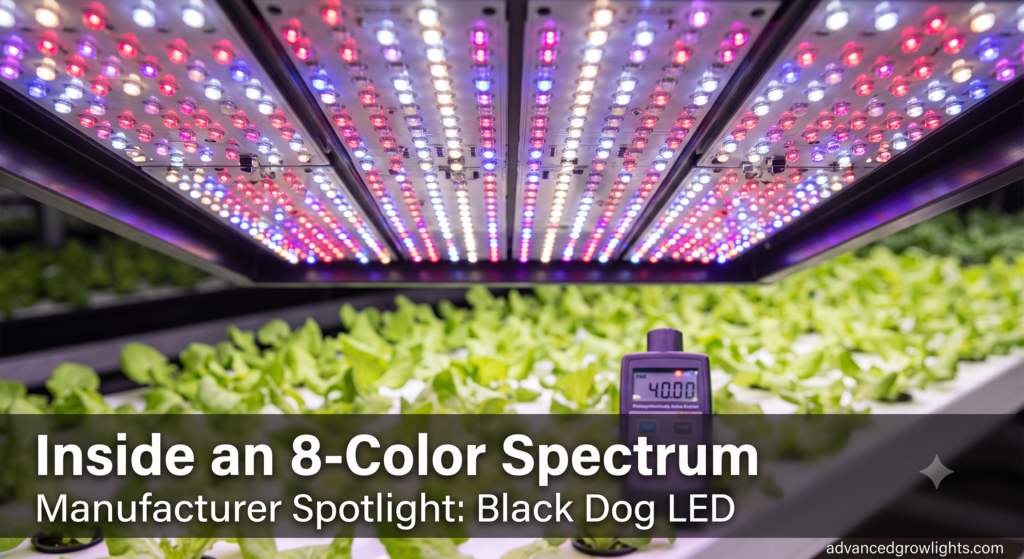
Corey Drew spent over a year hunting for an LED grow light that could actually finish a flowering plant before he gave up and built one himself. In 2010, in Longmont, Colorado, that search became Black Dog LED. Fifteen years of botany and horticulture work went into the first units. The company still designs, builds, and repairs every light in the same Colorado shop today.
Black Dog LED is the first entry in AGL’s new Manufacturer Spotlight series, a weekly profile of one grow light company at a time: the people who run it, the engineering choices behind the fixture, and the numbers that hold up under scrutiny. Not an ad. Not a press release rewrite. A profile built from primary sources, with unverified claims flagged right next to the verified ones, not buried in a footnote.
A Founder’s Complaint Becomes a Company
Drew’s frustration in 2009 was specific. Early LED grow lights on the market amounted to hype more than substance: a handful of blue and red diodes, a marketing page full of promises, little engineering behind either. He wanted a light built around what a flowering plant’s photoreceptors respond to, not around what looked impressive in a product photo. He built the predecessor to Black Dog LED’s first commercial units himself, after months of finding nothing on the market that met that bar.
The company’s stated philosophy hasn’t moved much since. Black Dog LED’s own site states it this way: “We don’t always worry about providing the cheapest light or even the most profitable light, but it does mean that we don’t cut any corners.” Whether that holds up in practice is a fair question for any manufacturer’s own copy. Black Dog LED’s pricing backs the claim in one respect at least: it sits at the premium end of the market, not the budget end, and has for over a decade.
The product line grew from there in stages rather than a single launch. Black Dog LED’s site and archived press coverage show four named generations of the core fixture, PhytoMAX through PhytoMAX-4, each one built on spectrum data pulled from the company’s own test grows rather than a redesign for its own sake. We couldn’t pin down exact release years for every generation from a primary source, so we’re not going to guess at a timeline here. What’s verifiable is that the current line, PhytoMAX-4, is the fourth documented iteration of the same core spectrum research, not a rebrand of an older product.
Who Runs Black Dog LED
Noah Miller serves as CEO. In a 2019 interview with LEDinside, Miller described the company’s research direction without much hedging: “We are pushing the limits of what is currently known about using artificial light to grow plants.” He credited the approach to combining spectrum breadth with raw power, arguing that most competitors optimize for one or the other, not both.
Kevin Frender has represented Black Dog LED alongside Miller in trade press coverage, including joint appearances discussing the company’s spectrum research in LEDs Magazine. The technical side of the company runs through BDL Labs, Black Dog LED’s in-house research and development arm, where staff with horticulture and engineering backgrounds run experimental grows to test new spectrum combinations before any of them reach a shipping product. The company states its team carries more than 80 years of combined indoor growing experience. It hasn’t published a breakdown of how that figure gets calculated, and we’re noting that rather than repeating it as an audited number.
What sets this apart from a lot of small horticultural lighting brands isn’t the existence of an R&D team; most manufacturers claim one. It’s that BDL Labs runs live grows on-site rather than relying only on lab-bench photon measurements, and the company has been willing to talk about that process on the record with trade press for years, not only in marketing copy aimed at buyers.
The Phyto-Genesis Spectrum: Eight Colors, One Bet
Most LED grow lights build a spectrum from one or two diode colors, usually a warm white plus a deep red, and call the result “full spectrum” in the marketing copy. Black Dog LED’s Phyto-Genesis Spectrum® uses eight distinct LED colors sourced from multiple diode manufacturers, layered to target the absorption peaks of chlorophyll a and b rather than a spectrum that merely looks balanced to a human eye.
Two design choices stand out. First, the inclusion of ultraviolet light in a ratio the company says mirrors natural sunlight, which it links to thicker cell walls, more compact growth, and better pathogen resistance. Second, a deliberate slice of far-red output in the 700-750nm range, aimed at triggering the Emerson Effect: a documented phenomenon where far-red light boosts the efficiency of red light absorption when the two arrive together. AGL covered the underlying science, and where the marketing claims built on top of it get ahead of the research, in a separate look at UV and far-red supplemental lighting.
Black Dog LED claims its spectrum approach cuts cooling costs by up to 60% relative to less efficient lighting, and that fixtures can run effective grows at ambient temperatures near 80°F without heat-stressing plants. Both are company claims. We could not verify either against a measurement we could check ourselves, so treat them as marketing until a grower or a third party publishes a side-by-side test.
The PhytoMAX-4 Line, By the Numbers
Black Dog LED’s current commercial line is the PhytoMAX-4 series, spanning seven wattage classes from the 2S up to the 24S, all built on the same Phyto-Genesis Spectrum ratio and scaled up in diode count. AGL’s own directory carries manufacturer-provided specs on three of those models: the 8S, 12S, and 24S. One of them, the PhytoMAX-4 24S, is verified by AGL against its published spec sheet. The other two carry manufacturer numbers we have not yet verified ourselves. One consistent, useful detail across the line: Black Dog LED labels wattage by wall draw, not by diode count or theoretical maximum, which makes its numbers a cleaner apples-to-apples comparison than some competitors that label wattage by diode rating instead of what the fixture pulls from the outlet.
| Model | Wall-Draw Wattage | PPF Output | Efficacy | Veg Coverage | Flower Coverage | Verification |
|---|---|---|---|---|---|---|
| PhytoMAX-4 8S | 500W | 1,063 µmol/s | 2.13 µmol/J | 4×4 ft | 3×3 ft | Manufacturer-provided |
| PhytoMAX-4 12S | 750W | 1,594 µmol/s | 2.13 µmol/J | 5×5 ft | 4×4 ft | Manufacturer-provided |
| PhytoMAX-4 24S | 1,500W | 3,187 µmol/s | 2.13 µmol/J | 8×8 ft | 6×6 ft | AGL Verified (July 8, 2026) |
Efficacy holds flat at roughly 2.12-2.13 µmol/J across the entire PhytoMAX-4 line, from the 125W 2S up through the 1,500W 24S, per Black Dog LED’s own published spec sheet. That’s a deliberate, size-independent rating: the company scales the fixture by adding diodes in the same spectral ratio rather than by improving efficacy at larger sizes, so a buyer choosing between wattage classes is choosing coverage area, not photon efficiency.
The 24S carries a $2,479 MSRP, UL 1598 and UL 8800 listings, ETL, CE, FCC, and RoHS marks, a five-year warranty, and 0-10V dimming from 15-100%. AGL’s PPFD, DLI, and efficacy explainer is worth reading alongside this table if 2.13 µmol/J doesn’t mean much on its own. For context, AGL-verified listings from two of the higher-efficacy commercial players in the directory put Gavita’s RS 2400e at 3.2 µmol/J and Fluence’s SPYDR 3 at 3.0 µmol/J. Black Dog LED isn’t competing on that number, and doesn’t market itself as though it is. Its argument is spectrum composition, not photons per watt.
Built in Longmont: What the Warranty Actually Covers
Every PhytoMAX-4 fixture ships from the same facility where Black Dog LED designs it. The company doesn’t outsource warranty claims to a third-party call center; repairs happen at the Longmont office. Buyers get a 90-day hassle-free return window on new purchases and a five-year warranty on the fixture itself, terms the company positions as a differentiator against import brands that route support through a reseller.
None of that is unusual for a US-based boutique manufacturer, and we’d apply the same scrutiny to any brand claiming it: a five-year warranty is only worth what the company’s continued existence backs it with. Black Dog LED has been operating out of the same state for a decade and a half at this point, which is a longer track record than most of the direct-import competitors it gets compared against on grower forums.
What Independent Growers Say
Independent reception is harder to pin down than a spec sheet, and we looked for it in places Black Dog LED doesn’t control. Threads on THCFarmer and the ILGM growers forum show a recurring pattern: buyers who spent real time researching before purchase, drawn in by the spectrum argument specifically, not the price, since Black Dog LED almost never wins on price. GrowersHouse’s independent review of the PhytoMAX line noted growers targeting close to a gram of yield per watt of wall draw, a common cannabis cultivation benchmark, though individual results swing hard with genetics, technique, and environment. We’d treat any single-number yield claim with real skepticism regardless of which manufacturer makes it.
One aquaponics grower reviewing the line, writing as PolyGuarden, singled out the UV inclusion as the deciding factor for food-crop growing, calling it “the best and most effective light spectrum” they’d tested for that application. That’s one voice, not a consensus, but it points at something real: Black Dog LED’s spectrum choices show up in reviews from growers working outside cannabis too, which matters as the company pushes further into broader CEA and research markets beyond its cannabis-cultivation roots.
Forum criticism, where it exists, tends to focus on price relative to output rather than build quality or spectrum performance. Growers comparing PhytoMAX-4 against higher-efficacy commercial fixtures from Gavita or Fluence on a straight cost-per-µmol basis tend to conclude Black Dog LED loses that specific math. Growers who weight spectrum composition and US-based support more tend to land the opposite way. Neither camp is wrong; they’re optimizing for different things.
Where Black Dog LED Fits
Black Dog LED occupies a specific niche: a US-made, boutique-scale manufacturer built on a technical argument rather than a price argument or a large-fleet commercial argument. That puts it in different territory than high-volume players like Gavita or Fluence, which compete on efficacy-per-dollar at scale, not on a spectrum story, and AGL’s manufacturer overview covers that broader competitive field in full. Black Dog LED’s pitch reads closer to a specialty instrument than a commodity fixture: fewer SKUs, a narrower buyer, serious individual and small commercial growers who read spec sheets before buying, and a spectrum story the company can defend in technical detail when pressed on it.
What We Could Verify, and What We Couldn’t
We confirmed Black Dog LED’s founding story, leadership names, Colorado manufacturing base, and the PhytoMAX-4 24S specs against AGL’s own verified directory listing. We could not confirm current DLC Qualified Products List status for the PhytoMAX-4 line from a primary source as of publication; growers who need DLC-eligible fixtures for utility rebate programs should check DesignLights Consortium’s database themselves before purchasing. We also could not verify the specific “60% cooling cost reduction” and “80°F ambient” performance claims, the $250K funding figure reported by third-party company databases, exact release years for each PhytoMAX generation, or the precision behind the “80 years combined experience” figure. All of these are presented above as company or third-party claims, not confirmed facts, and we’d rather publish that gap than paper over it.
See the full spec sheet and current pricing in AGL’s Black Dog LED directory listing.
Where is Black Dog LED made?
Longmont, Colorado. The company designs, assembles, and performs warranty repair work at its own facility rather than outsourcing manufacturing overseas.
Who founded Black Dog LED?
Corey Drew founded the company in 2010 after failing to find an LED grow light he considered technically sound for flowering plants. Noah Miller currently serves as CEO.
What is the Phyto-Genesis Spectrum?
Black Dog LED’s proprietary spectrum design, built from eight distinct LED colors including ultraviolet and far-red wavelengths, aimed at matching what plant photoreceptors absorb rather than optimizing for how the light looks to a human eye.
Is Black Dog LED DLC listed?
We could not confirm current DLC Qualified Products List status from a primary source at time of publication. Check DesignLights Consortium’s database yourself if DLC eligibility affects a utility rebate you’re planning around.
How does Black Dog LED compare on price?
It sits at the premium end of the market. The PhytoMAX-4 24S carries a $2,479 MSRP for a 1,500W fixture, well above budget quantum-board competitors and closer to boutique commercial fixtures than mass-market ones.
What’s the warranty on PhytoMAX-4 fixtures?
Five years, backed by a 90-day hassle-free return policy on new purchases, with repairs handled at the company’s own Longmont facility.
Does Black Dog LED work for non-cannabis crops?
The company’s spectrum research grew out of cannabis cultivation, but the UV and far-red design has drawn interest from growers in aquaponics and other food-crop applications, based on reviews outside the company’s own marketing.
Is the PPF output figure AGL-verified?
For the PhytoMAX-4 24S, yes. AGL verified that listing against the manufacturer’s published spec sheet on July 8, 2026. The 8S and 12S listings in AGL’s directory are manufacturer-provided for now, and AGL has not verified them yet.