
BLOG POST
Samsung Is Exiting Horticultural LEDs: What Changes Inside Your Next Grow Light
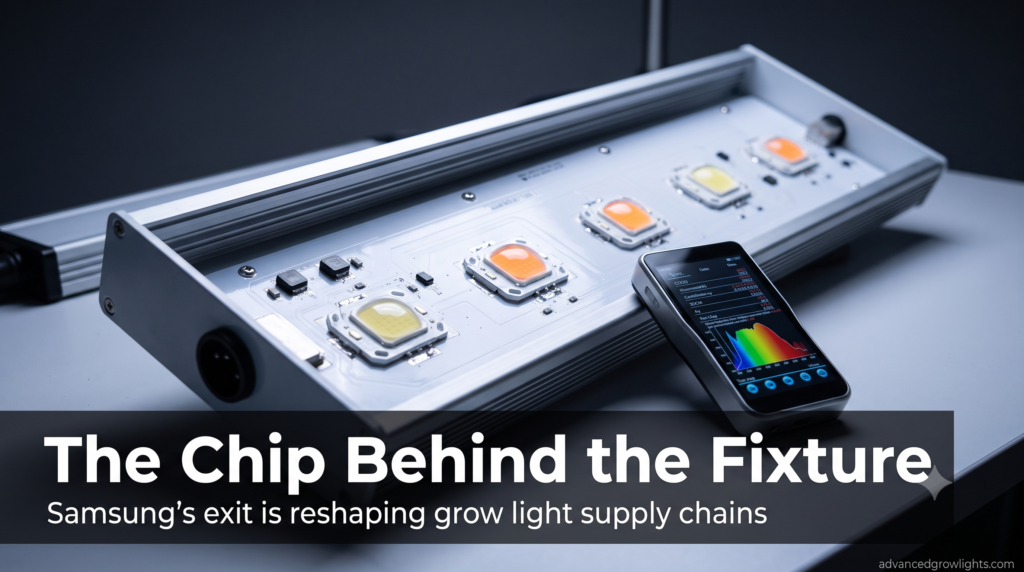
Samsung is stepping back from the horticultural LED chip market. For a decade, its LM301 series set the benchmark every full-spectrum quantum board fixture measured itself against. That benchmark is disappearing, and it’s changing what’s inside grow lights on the market right now, sometimes without the model name on the box changing at all.
If you bought a fixture in the last two years and plan to buy another one like it, the chip inside may no longer be the chip you remember. That matters for efficacy claims, for DLC rebate eligibility, and for whether a replacement driver or module will exist five years from now.
What’s happening to Samsung’s horticultural chips
Samsung Electronics is redirecting its LED and semiconductor R&D toward higher-margin segments: automotive lighting, microLED displays, and AI-related chip production. Horticultural lighting is a small, low-margin niche next to those businesses, and Samsung’s mid-power LED lines, including the LM301 family that powered a generation of quantum board fixtures, are winding down as a result.
Mars Hydro, a fixture manufacturer that has shipped Samsung-based boards for years, addressed the shift in its own knowledge base in April 2026: the industry is moving away from Samsung-based grow lights as the company narrows its horticultural chip line. Existing Samsung LM301 and EVO stock isn’t disappearing overnight. Remaining inventory keeps moving through the supply chain, but manufacturers are building new fixture designs around other chips.
Who’s filling the gap
Four chip suppliers are absorbing the volume Samsung leaves behind, each with a different tradeoff.
| Chip supplier | Typical system efficacy | Spectrum type | Notable strength |
|---|---|---|---|
| Samsung EVO (LM301, outgoing) | 2.8-3.0 umol/J | Full spectrum | Incumbent baseline, deep field history |
| Bridgelux 3030 | 2.7-2.9 umol/J | Full spectrum | Lower per-chip cost, comparable output |
| Osram OSLON Square | 4.0-4.6 umol/J | Deep red (660nm) only | Flowering-response boost, paired with white |
| Seoul Semiconductor SunLike | 2.3-2.8 umol/J | Full spectrum | Color consistency, spectral quality |
| San’an Optoelectronics | 2.0-2.7 umol/J | Full spectrum | Cost, large-scale production capacity |
Bridgelux is picking up the most volume among full-spectrum replacements. Spider Farmer’s SE Series is the clearest public example: its SE1000 and SE5000 listings now specify Bridgelux diodes, while some SE1200W units still on the market carry Samsung LM301H EVO chips. The same model line is running two different chip generations depending on when a given unit was manufactured. That’s the situation buyers now have to check for, SKU by SKU, rather than assume by brand name.
The Chinese chip makers filling the low end of the gap, San’an Optoelectronics among them, come with a wider quality spread than the established brand-name suppliers. Retailers tracking the transition note that output and binning consistency vary more from batch to batch at this tier. That’s not a reason to rule those chips out of a budget build, but it is a reason to ask for LM-80 data on the specific bin you’re buying rather than a general product-line spec sheet.
Cree LED is making a play for the space too
On December 2, 2025, Cree LED and Austrian fixture maker SANlight announced a partnership putting Cree’s J Series chips into SANlight’s new STIXX-Series luminaires. Cree LED and SANlight rate the STIXX modules at up to 3.1 umol/J, backed by LM-80 testing with TM-21-projected lifetimes above 53,000 hours, and an IP68 rating for dust and water resistance. SANlight demonstrated the fixtures at MJBizCon in Las Vegas the same week. It’s a small deal in isolation, but it signals that chip makers outside the Samsung-Bridgelux-Osram cluster now see enough addressable market in horticulture to compete for design wins with fixture manufacturers.
SANlight positioned the STIXX line across three use cases: toplighting, undercanopy lighting, and vertical farming racks. The IP68 rating matters most in that last category. Vertical farm modules run closer to irrigation lines and higher ambient humidity than a single-tier greenhouse fixture, and a chip-and-housing combination rated for dust and water ingress carries less long-term failure risk in that environment than a standard IP65 fixture repurposed for stacked racks.
What changes inside your fixture when the chip changes
Manufacturers switching chip suppliers hold three things constant on purpose: PPF output, spectral ratio, and light uniformity. Bridgelux’s own comparison data against Samsung EVO shows why that’s achievable. The two chips share matching spectral peaks at 450nm and 660nm, and at matched power input, the yield difference between them is under 5%. A grower running either chip in an otherwise identical fixture shouldn’t see a meaningful difference at the canopy.
Cost and power draw are where the swap shows up. Bridgelux chips run about $2-3 each against $4-5 for Samsung EVO, and module power consumption drops from the 45-60W range to 40-55W for equivalent output. That difference compounds at commercial scale, and it’s the real reason manufacturers are making the switch, not a spectrum upgrade.
A worked example
Take a 1,000W fixture running 12 hours a day at $0.11/kWh. Annual electricity cost: 1 kW x 12 hours x 365 days x $0.11 = $481.80. An 8% efficiency gain from a Bridgelux-class chip against Samsung EVO saves about $38 a year per fixture. On a single light, that’s not a lot. Scale it to a 200-fixture commercial room and it’s over $7,700 a year in electricity alone, before counting the lower upfront chip cost. That’s the math driving the supply shift from the manufacturer side, and it’s worth running against your own facility’s fixture count before you assume a chip swap is a wash.
Why this matters for DLC rebate eligibility
The DesignLights Consortium ties every QPL listing to a tested configuration, not to a model name. Per DLC’s own product update policy, a manufacturer changing a fixture’s internal components, including the LED chip, has to submit new test data to keep that listing current. If the manufacturer wants both the old and new versions listed side by side, DLC requires a new part number so the two configurations aren’t confused under one listing.
That means a fixture you bought under one QPL listing two years ago may not be the same tested product a utility rebate program qualifies under that model number today. Before you submit a rebate application, pull the current QPL entry for the exact part number on your invoice, not the marketing name, and confirm the efficacy figure matches what you were quoted.
The stakes went up in 2026. Hort V4.0 raised the minimum photosynthetic photon efficacy for QPL listing to 2.5 umol/J, an 8.7% jump over the V3.0 floor, and the delisting deadline for non-compliant V3 products passed on January 5, 2026. That single change removed about 11% of the products on the Hort QPL, the bulk of them older, less efficient listings. A fixture riding on a discontinued Samsung chip and an unrefreshed test report is the kind of product that floor targets. A silent chip swap is one more reason the part number on paper and the part number in the box need to match. See our PPFD, DLI, and efficacy breakdown for how that floor is calculated.
What to ask before you buy
A few questions separate a fixture that performs as advertised from one that undercuts its old spec sheet without telling you.
- Ask what chip is in this specific part number, not the product line in general.
- Ask whether the manufacturer publishes LM-80 or TM-21 data for that chip in that fixture.
- Check whether the current QPL listing for this exact part number matches the efficacy figure on the spec sheet.
- If the chip changed from a prior version, ask what changed in the spectrum ratio, not total PPF alone.
- Confirm the driver is rated for the new chip’s forward voltage, rather than carried over from the old design.
Commercial-tier fixtures from brands like Fluence and Gavita often run custom-binned or vertically-controlled diode sourcing, which insulates them from a single supplier’s exit. That doesn’t mean they’re immune to the broader chip-market consolidation. A change seldom shows up as a surprise mid-model-run swap the way it can with prosumer-tier fixtures. Check our manufacturer overview for how different tiers approach component sourcing.
The bigger picture
None of this is a crisis. Bridgelux, Osram, Seoul Semiconductor, and now Cree all make chips that hold their own against what Samsung is leaving behind, and in some cases cost less to run. The risk isn’t performance, it’s assumption. A brand name and a model number used to be a reliable shorthand for what chip sat under the lens. That shorthand is breaking down as suppliers consolidate, and the fixtures that used to all look the same on a spec sheet are diverging underneath it. Read the part number, not the product page, and you’ll avoid most of the surprises this transition creates.
Compare current fixture specs and verified manufacturer data in the AGL directory before your next purchase.
Is Samsung discontinuing all horticultural LEDs at once?
No. Existing LM301 and EVO stock continues moving through the supply chain, and fixtures installed in the field keep operating as before. The shift shows up in new fixture designs, which now draw on other chip suppliers instead of Samsung.
Does a Bridgelux chip mean lower quality than Samsung?
Not based on the published comparison data. Bridgelux 3030 and Samsung EVO show matching spectral peaks and under 5% yield difference at matched power input, with comparable LM-80/TM-21 lifespan ratings above 50,000 hours.
How do I know which chip is in the fixture I’m buying?
Ask the manufacturer for the specific part number’s chip source, and check it against the current DLC QPL listing for that part number. Product pages and marketing copy don’t always reflect the most recent chip revision.
Does a chip swap affect my DLC rebate eligibility?
It can. DLC ties listings to tested configurations. If a manufacturer changes the chip without a new part number and new test data, the listing may not reflect what’s in the box. Verify the exact part number against the live QPL before applying for a utility rebate.
Are commercial-tier brands like Fluence and Gavita affected by this?
Less exposed than most. Brands with vertically-integrated or custom-binned diode sourcing sit further from a single supplier’s market exit, though the broader consolidation in the LED chip industry touches the whole market over time.
What’s driving Samsung’s exit from this market?
Samsung is redirecting R&D and production toward higher-growth, higher-margin segments including automotive lighting, microLED displays, and AI-related chips, according to manufacturer statements. Horticultural lighting is a small niche next to those priorities.
Will grow light prices go up because of this?
Not on its own. Bridgelux chips cost less per unit than Samsung EVO right now, which is part of why manufacturers are adopting them. Prices tend to hold steady or drop on new designs rather than rise because of the chip transition itself.
Should I replace a fixture just because its chip changed?
No. If your current fixture performs to spec, a chip change in newer inventory isn’t a reason to replace it. This matters most when you’re buying new, not for fixtures running in your facility now.