BLOG POST
Customizable vs. Predefined Spectra: How DLC Hort V4.0 Tests Multi-Channel Grow Lights
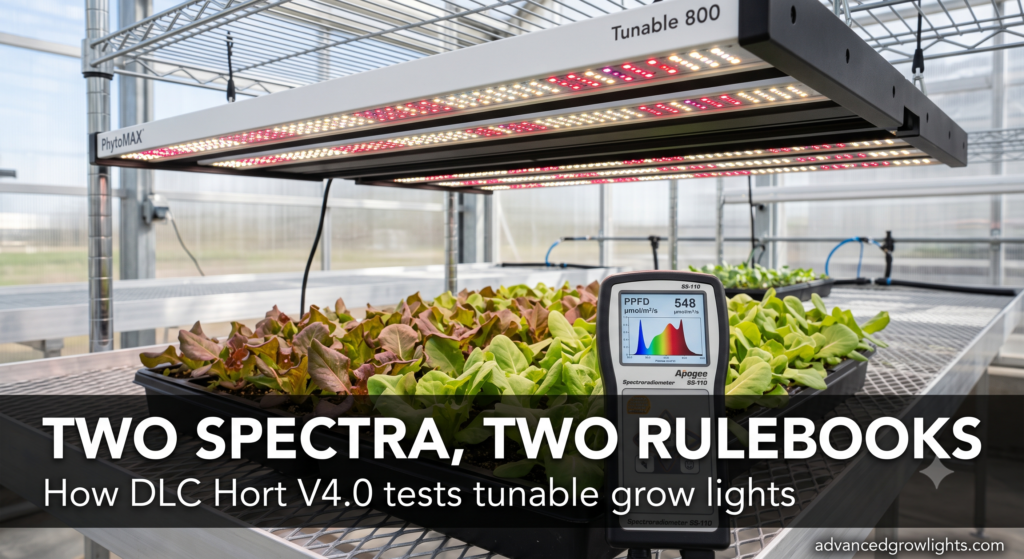
Grow light manufacturers have spent the last two years shipping fixtures with independently addressable spectral channels: white, deep red, far-red, sometimes UV, each dimmable on its own. DimLux markets a blue-to-red ratio you can slide from 1:1 to beyond 1:10 on the Xtreme series, delivered through independently controlled white and red channels. California LightWorks built two-channel digital spectrum control into MegaDrive for automatic daylight balancing. Newer entrants are shipping four-channel and five-recipe fixtures aimed squarely at commercial buyers who want a different spectrum for veg than for flower.
None of that was tested consistently until this year. DesignLights Consortium’s Hort V4.0 technical requirements were released March 12, 2025, and began accepting applications April 18, 2025. A subsequent October 1, 2025 revision corrected how DLC applies its efficacy tolerance, and manufacturers had until October 31, 2025 to move existing V3.0 listings onto V4.0 before the January 2026 delisting sweep. The rulebook splits every spectrally tunable product into one of two buckets, and each bucket carries its own testing burden. If you’re evaluating a multi-channel fixture for a rebate-eligible commercial install, the bucket that fixture falls into determines how much of its performance claim you can trust.
Two Categories, One New Rulebook
DLC’s technical requirements document defines the split in Section 7.1, and the language is precise enough to matter. A fixture with Customizable Spectra lets the grower adjust individual control points continuously, through a slider, a color wheel, or a similar interface DLC calls a “custom spectral controller.” A fixture with Predefined Spectra instead offers a fixed menu: manufacturer-designed “spectral recipes” built for a specific crop stage such as vegetative growth, flowering, or fruiting. A fixture capable of both is classified as Customizable Spectra for testing purposes, regardless of how the presets are marketed.
The distinction sounds like marketing language until you see what it triggers downstream. DLC requires every spectrally tunable fixture to be tested first at its “maximum power” state, defined as whichever spectral setting draws the most input wattage, not necessarily the setting where every LED runs at full output. From there, the two categories diverge sharply in how much additional testing DLC demands before a fixture can carry a rebate-qualifying listing.
Customizable Spectra: Test Every Channel at Its Extreme
For a fixture with continuously adjustable channels, DLC requires a full LM-79/SQD test report for each individually controllable channel, run at that channel’s maximum designed output while every other channel sits at its minimum. A four-channel fixture, white plus deep red plus far-red plus UV, needs four separate full-fixture spectral test reports beyond the baseline maximum-power test. Each report needs its own accompanying TM-33 XML file and its own named setting for the QPL listing.
That is real lab time and real cost, and it explains why fewer commercial fixtures ship with true continuous channel control than the marketing copy around “spectral tuning” might suggest. A five-channel customizable fixture is not a five-times markup on ideas. It is closer to a five-times markup on accredited lab invoices before the product ever reaches a QPL listing.
Predefined Spectra: Test Every Recipe by Name
A fixture that ships with a fixed menu, a “Vegetative” button and a “Flower” button, for example, gets tested differently. DLC requires a full test report for each named recipe, and that recipe’s name is what shows up on the QPL. Three-recipe fixtures need three test reports. This tends to run cheaper than continuous-channel testing because the manufacturer only validates the specific combinations they intend to sell, not every possible position along a slider.
Both categories share a thermal wrinkle worth knowing before you buy. DLC requires In-Situ Temperature Measurement Testing on the hottest LED of each type, and that testing has to happen at whatever channel setting produces the hottest thermal condition for that specific LED type. In practice, the same physical fixture often gets tested multiple times at different spectral settings to find the worst-case thermal load for each color channel. A manufacturer who skips this and tests only at one convenient setting is not meeting the letter of V4.0, regardless of what the spec sheet claims.
The Efficacy Floor Still Applies, Per Channel Combination
None of this spectral testing replaces the core V4.0 efficacy requirement. Every qualifying state, including every individual channel-max test on a customizable fixture, still has to clear a photosynthetic photon efficacy of at least 2.5 µmol per joule, measured across 400 to 700 nm. DLC allows a 5 percent tolerance against that threshold, which puts the real accepted floor at 2.38 µmol/J on any single test report. A four-channel fixture that hits 3.0 µmol/J at maximum power but drops to 2.2 µmol/J when the far-red channel runs alone at its designed maximum will not qualify at that far-red setting, and DLC’s own tolerance language is explicit that no additional rounding applies beyond the stated tolerance.
That matters for buyers because a fixture can be DLC listed at its default or maximum-power configuration while individual channel settings fall short. Ask your rep which specific spectral settings appear on the QPL listing, not only the top-line efficacy number on the box.
Worked Example: Why “AC Derated PPE” Isn’t the Number on the Driver Label
Many multi-channel fixtures ship as DC-powered light bars fed by a shared driver, and V4.0 handles that combination with its own math. DC-powered fixtures must meet the 2.5 µmol/J threshold at their AC derated PPE, not their raw DC-measured efficacy, because the AC-to-DC power source loses some power as heat before it ever reaches the LEDs.
DLC’s technical requirements document gives the exact worked case: a 100-watt light bar tests at a DC-powered PPE of 3.0 µmol/J. Its power source shows a worst-case efficiency of 90 percent at 20 percent load, the loading condition that produces the lowest conversion efficiency for that driver and fixture combination. Run through the derating math, that fixture gets listed on the QPL at 2.7 µmol/J AC Derated PPE and 105 watts AC Derated Input Wattage, not the 3.0 µmol/J a spec sheet might advertise from the DC-side test alone.
If you are comparing a DC light-bar system against a self-contained AC luminaire on efficacy alone, compare AC Derated PPE on both, not the DC-side number for one and the AC number for the other. A driver with a worse worst-case efficiency than the 90 percent example above can push a fixture that tests well over threshold on the DC side down toward, or below, the 2.5 µmol/J qualifying line once the derating is applied.
Customizable vs. Predefined Spectra at a Glance
| Factor | Customizable Spectra | Predefined Spectra |
|---|---|---|
| User control | Continuous, per-channel (slider, dial, color wheel) | Fixed menu of manufacturer-built “recipes” |
| Testing required | Full LM-79/SQD report per channel at that channel’s max, others at min | Full LM-79/SQD report per named recipe |
| Mixed capability | Classified here if the fixture also offers presets | Only if the fixture cannot be tuned continuously |
| Relative testing cost | Scales with channel count | Scales with recipe count, usually fewer test points |
| Best fit | Research, multi-crop facilities, growers who tune by feel | Single-crop commercial operations with a known light schedule |
What to Ask Before You Buy a Tunable Fixture
- Which spectral settings appear on the DLC Horticultural QPL listing, by name, and does the setting you plan to run every day clear 2.5 µmol/J?
- If it’s a DC light-bar system, what is the AC Derated PPE and AC Derated Input Wattage, not only the DC-side number?
- For a customizable fixture, has every channel been tested at its designed maximum, or only the factory default blend?
- Does the fixture’s warranty (DLC requires five years minimum) cover the driver and any external power source the same way it covers the LEDs?
None of this shows up on a glossy product page. It shows up in the QPL listing itself, which is why pulling the actual listing before signing a purchase order beats trusting a spec sheet summary.
Where Multi-Channel Fixtures Already Sit in the Market
DimLux’s Xtreme series has offered independent white and red channel control for several product generations, tunable across roughly a 1:1 to 1:10 blue-to-red ratio in DimLux’s own spec language, with the manufacturer recommending growers stay under about 1:4.5 in practice. California LightWorks built two-channel digital spectrum control into its MegaDrive platform specifically to auto-balance against available daylight in a greenhouse. Neither product’s exact DLC spectral-category listing is something to guess at from a marketing page. Pull the QPL entry directly and check which named settings were tested before assuming a fixture’s advertised tuning range matches the range DLC verified.
For the efficacy and delisting mechanics behind V4.0 more broadly, see our breakdown of the January 2026 delisting deadline and our explainer on DLC certification basics. For the underlying PPFD, DLI, and efficacy math that any of these efficacy numbers rest on, start with PPFD, DLI, and Efficacy Explained. For the science behind why far-red channels exist on these fixtures in the first place, see UV and Far-Red Supplemental Lighting. And for a brand-by-brand look at who makes what, our manufacturer overview is a good next stop.
What counts as a “spectrally tunable” fixture under DLC V4.0?
Any product that varies its spectral output beyond simple whole-fixture dimming. If the whole fixture only gets brighter or dimmer together, it doesn’t fall under this section at all. If individual color channels can move independently of each other, it does.
Can a fixture be both Customizable and Predefined at once?
Yes, and DLC’s rule is specific about which category wins. A fixture offering both continuous channel control and a set of preset recipes gets classified as Customizable Spectra for testing purposes, which means it carries the heavier per-channel testing load regardless of how the presets are marketed.
Does every channel on a multi-channel fixture have to clear the 2.5 µmol/J threshold?
Every tested qualifying state does, including each channel-max test on a customizable fixture and each named recipe on a predefined one. A channel or recipe that fails the threshold at its own maximum designed output does not get listed as qualifying, even if the fixture’s overall maximum-power state clears the bar comfortably.
Why does a DC-powered light bar get a different efficacy number than an AC fixture?
Because the AC-to-DC power source, the driver, loses power as heat before it reaches the LEDs. DLC requires DC fixtures to qualify at their AC Derated PPE, which reflects the driver’s worst-case conversion efficiency, not the raw efficacy measured on the DC side of that driver.
How much more does it cost to certify a customizable-spectrum fixture versus a predefined one?
DLC doesn’t publish cost figures, but the testing scope is public. A customizable fixture needs a full LM-79/SQD report for every individually controllable channel at its maximum designed output. A predefined fixture needs one report per named recipe. More channels or more recipes both mean more accredited lab reports, and channel-based testing tends to scale faster since continuous control implies more distinct extremes to characterize.
Is a fixture with more spectral channels always the better buy?
Not automatically. More channels mean more flexibility, but only if every channel setting you plan to run day to day has been tested and clears the efficacy floor. A three-recipe predefined fixture that matches your crop’s actual light schedule can outperform a five-channel customizable fixture where only the default blend has real, verified numbers behind it.
Where can I check a specific fixture’s spectral category and tested settings?
The DLC Horticultural Qualified Products List at designlights.org publishes the category, the named settings tested, and the flux output for each configuration. That listing is the authoritative source, not the manufacturer’s marketing page.
Does this apply to greenhouse supplemental fixtures or only sole-source indoor lights?
Both. V4.0’s spectral tuning rules apply regardless of whether the fixture is reported as sole-source or supplemental, and regardless of controlled environment, indoor stacked, indoor non-stacked, or greenhouse.