BLOG POST
Bumblebees See a Different Grow Light Than You Do
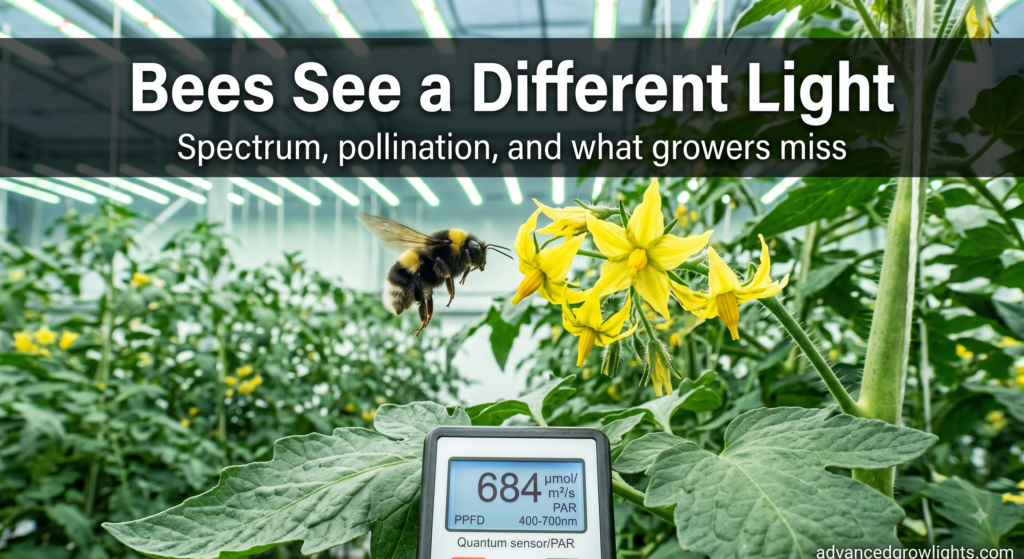
Commercial greenhouses growing tomatoes, peppers, cucumbers, and strawberries depend on bumblebees for pollination, not people with cotton swabs. Every one of those crops has a fruit-set problem without a working colony inside the structure, and every colony forages under whatever spectrum you chose for the plants. Bumblebees don’t see that spectrum the way a PAR meter reports it, and the mismatch has real consequences for how fast a colony finds flowers on a dark January morning.
Greenhouse operators have spent several LED generations chasing photosynthetic photon efficacy: more micromoles per joule, tighter red-blue ratios, better fixture uniformity. That optimization rarely accounts for a colony working the same canopy. Wageningen University researchers, the Dutch biocontrol supplier Koppert, and the horticultural LED manufacturer Valoya have all published findings on the gap between “efficient for plants” and “usable for bees.” The gap complicates the assumption that any DLC-qualified fixture is a safe default for a pollinated crop.
How a Bumblebee Reads Your Fixture
Human color vision runs on three receptor types tuned to red, green, and blue. Bumblebees have trichromatic vision too, but their receptors sit at different wavelengths: ultraviolet, blue, and green. They carry no red receptor at all. A spectrum built to push red photons at a plant’s phytochromes, the dominant strategy in narrow-band red-blue fixtures, delivers almost nothing a bumblebee’s eye can use to find a flower or navigate back to the hive entrance.
Koppert puts a number on what a colony needs: about 30 to 40 µmol of what the company calls “Beevision” light, the blue-green-UV band bees perceive, measured at the hive entrance and around open flowers. Daylight clears that bar without effort. A narrow red-blue LED fixture, tuned for plant efficacy rather than pollinator vision, can fall short of it even at high total PPFD, because most of the photon budget sits in a red band the bee’s eye discards.
What the Landing Data Shows
Lana de Vries and colleagues at Wageningen University tested that gap in 2020, publishing in the journal Biology Open. Using high-speed stereoscopic video, the team tracked 105 individual landing maneuvers by Bombus terrestris under white light and under a standard red-blue LED spectrum. Bees perceived the red-blue environment as about 8.2 times dimmer than white light, judged against their own visual sensitivity, not a human light meter.
They still landed. Total landing duration showed no reliable difference between the two conditions: 1.27 seconds under white light against 1.10 seconds under red-blue. One phase did suffer. The final leg-extension maneuver before touchdown took 25% longer under red-blue light, 0.24 seconds against 0.19 seconds, and the flight path leading into it grew more erratic. Bees compensate for a spectrum that’s hard to read. That compensation isn’t free, and a fixture that makes every landing a little harder adds up across a colony making thousands of flower visits a day.
The Trial That Turned This Into a Grower Decision
Valoya ran a field version of this comparison at PlantResearch in Made, Netherlands: its AP67 spectrum, which includes a green component, against standard high-pressure sodium fixtures in a mid-January tomato trial. This is manufacturer-reported, not independent peer review, and Valoya has an obvious interest in the outcome, so treat the numbers as a documented case study rather than settled science. Under AP67, bumblebees started flying to open flowers as soon as the lights switched on at 4 a.m. Under HPS, the same colonies stayed in the hive until natural light supplemented the fixture, about four hours later.
Run that four-hour gap across a stretch of overcast January days and the scale becomes clear. Ten consecutive dark mornings at a four-hour foraging delay works out to 40 hours of lost pollination window during the exact stretch of the season when growers most need every truss to set fruit. Valoya’s trial compared AP67 against HPS only, not against a red-blue LED, so it doesn’t settle the LED-versus-LED question on its own. It does establish that spectrum choice changes when a colony starts working, apart from how well that spectrum grows the crop.
Spectrum Choices, Compared for Pollinator Performance
These findings come from separate studies run under different protocols, not one head-to-head trial. Treat the comparison below as directional, not a lab-controlled ranking.
| Light Source | Beevision Match (UV/blue/green) | Documented Pollinator Effect | Source |
|---|---|---|---|
| HPS (Son-T type) | Poor — minimal blue-green content | Colonies delayed foraging until natural light arrived, about 4 hrs in a January trial | Valoya / PlantResearch field trial |
| Narrow red-blue LED | Partial — blue present, negligible green | Leg-extension landing phase 25% slower; total landing time unaffected | de Vries et al., 2020, Biology Open |
| Green-inclusive broad-spectrum LED (AP67-type) | Closer match to bee visual range | Foraging began at light-on in the same trial, no delay observed | Valoya / PlantResearch field trial |
The Caveat That Predates LED Entirely
Spectrum isn’t the only variable, and it may not be the biggest one. Canadian researchers L.A. Morandin, T.M. Laverty, and P.G. Kevan, based at the University of Guelph, compared bumblebee colony activity across commercial tomato greenhouses covered with different glazing materials, publishing the results in The Canadian Entomologist in 2001. The covering mattered more than any fixture in that study: colonies under UV-transmitting glazing showed activity levels 94% higher than colonies under UV-blocking covering, and mean colony size after ten days ran more than double, 86.0 bees versus 36.4 bees.
That points to a variable outside the fixture spec sheet. A pollinator-friendly LED spectrum won’t rescue a colony working under UV-blocking glass or polycarbonate, and a UV-transparent structure won’t fully offset a spectrum bumblebees can barely read. Both matter, and neither substitutes for the other. AGL covers the UV side of this equation in more depth in UV and Far-Red Supplemental Lighting: Science vs. Marketing.
What Koppert Tells Growers to Do About It
Koppert, which supplies bumblebee colonies to greenhouse operations across Europe and North America, publishes grower-facing guidance that treats spectrum as one lever among several. Company spokesperson Remco Huvermann states the trade-off in one line: “Growers want to limit their rising energy bills, but they need to be cautious when it comes to the impact some of their measures are having on environmental conditions and bumblebee behaviour.”
The field recommendations run alongside spectrum choice, not instead of it:
- Open energy screens during daylight hours, about 8 to 9 a.m. and again roughly two hours before sunset, so flowers stay open on the schedule bees expect.
- Keep flowers open until at least 11 a.m. before closing screens for heat retention.
- Hold relative humidity below 80% in the pollination zone. Bees cut activity in high humidity no matter how good the light is.
- During the darkest 8 to 12 weeks of the year, synchronize hive opening with a narrower daylight window rather than the full screen schedule, typically letting bees fly only between about 10 a.m. and 2 to 3 p.m., widening by roughly half an hour a week as days lengthen.
- Under short-day conditions, position hives high in or above the crop so the colony gets direct, early exposure to daylight, not tucked down among the leaves where both light and humidity work against it.
- Give colonies at least two to four hours of daylight-equivalent conditions before expecting a full day’s foraging.
- Switch to hand pollination during extended snow cover, when screens stay closed all day and no fixture spectrum compensates for a sealed structure.
A Buyer’s Checklist Before You Spec the Next Fixture
If your crop depends on bumblebee pollination, a spectrum decision is also a pollination decision. Before locking in a fixture, ask the manufacturer or your lighting designer for four things:
- The spectral power distribution curve, not a marketing spectrum chart. Look for measurable output in the 400-550 nm range, the blue-green band bumblebees use.
- Any third-party or in-house pollinator trial data. Few manufacturers publish it, and a fixture with documented foraging-onset results carries more weight than a spec sheet claim.
- Your greenhouse covering’s UV transmission rating. A pollinator-matched fixture paired with UV-blocking glazing addresses only half of what the Morandin research points to.
- A fallback pollination plan, hand pollination or a supplemental hive-placement strategy, for the darkest stretch of your growing season, apart from fixture choice.
None of this means giving up on efficacy targets. A fixture that hits 3.0 µmol/J and still carries a real green component isn’t a contradiction. It’s a design choice most narrow red-blue products skip, because pollinator performance has never been part of the DLC test protocol. AGL’s manufacturer overview is a starting point for comparing which brands publish this kind of data, and the PPFD, DLI, and efficacy breakdown covers the plant-facing math behind any spectrum decision.
Frequently Asked Questions
Do LED grow lights harm bumblebees?
No study reviewed here shows LED light injuring bees outright. The documented effects are behavioral: slower landing maneuvers under narrow red-blue spectra and delayed foraging onset under spectra that lack a green component. Valoya’s trial found bees ran cooler and showed fewer burn injuries under LED than under HPS.
Is HPS better than LED for pollinated crops?
The available data points the other way. In the Valoya field trial, colonies under HPS waited for natural light before foraging, while colonies under a green-inclusive LED spectrum started at light-on. HPS carries almost none of the blue-green band bees rely on.
What is “Beevision” light, and why does it matter?
Beevision is Koppert’s term for the UV, blue, and green wavelengths bumblebees can perceive, as opposed to the red-heavy range human PAR meters and plant-efficacy specs prioritize. Koppert recommends 30 to 40 µmol of Beevision light at the hive entrance and around open flowers for normal foraging and navigation.
Do narrow red-blue LED fixtures stop bumblebees from pollinating?
No. The Wageningen landing study found bees completed successful landings under red-blue light at rates matching white light, despite a slower final approach. Pollination continues; it becomes marginally less efficient per flower visit.
Does greenhouse covering material matter more than the fixture?
It may. A 2001 study in The Canadian Entomologist by Morandin, Laverty, and Kevan tied bumblebee colony activity in commercial tomato greenhouses more closely to UV transmission through the covering than to any single fixture. A pollinator-matched spectrum paired with UV-blocking glazing only solves part of the problem.
Which grow light brands publish pollinator-relevant spectrum data?
Valoya is the manufacturer with published field trial data on this specific question. Most manufacturers in AGL’s directory don’t currently report pollinator-focused testing, which is worth asking about directly if bumblebee pollination is part of your operation.
How much foraging time can a mismatched spectrum actually cost?
In the Valoya field trial, the gap ran about four hours per dark morning between an HPS compartment and a green-inclusive LED compartment. Across a ten-day overcast stretch, that’s roughly 40 hours of lost foraging window, concentrated during the low-light weeks when fruit set matters most.
Should growers switch fixtures just for pollinator performance?
Not on this evidence alone. The differences documented are real but specific: landing speed and foraging onset time, not colony survival or crop yield directly. For an active fixture decision on a pollinated crop, add pollinator spectrum data to the evaluation alongside efficacy, uniformity, and DLC status, rather than replacing working fixtures on this basis.
Spectrum decisions in a pollinated greenhouse serve two audiences at once: the crop and the colony working it. Browse AGL’s grow light directory to compare fixtures by efficacy, spectrum, and manufacturer before your next order.