BLOG POST
Counterfeit Safety Certifications Are Showing Up on Grow Lights: What CPSC’s 2026 Crackdown Means for Buyers
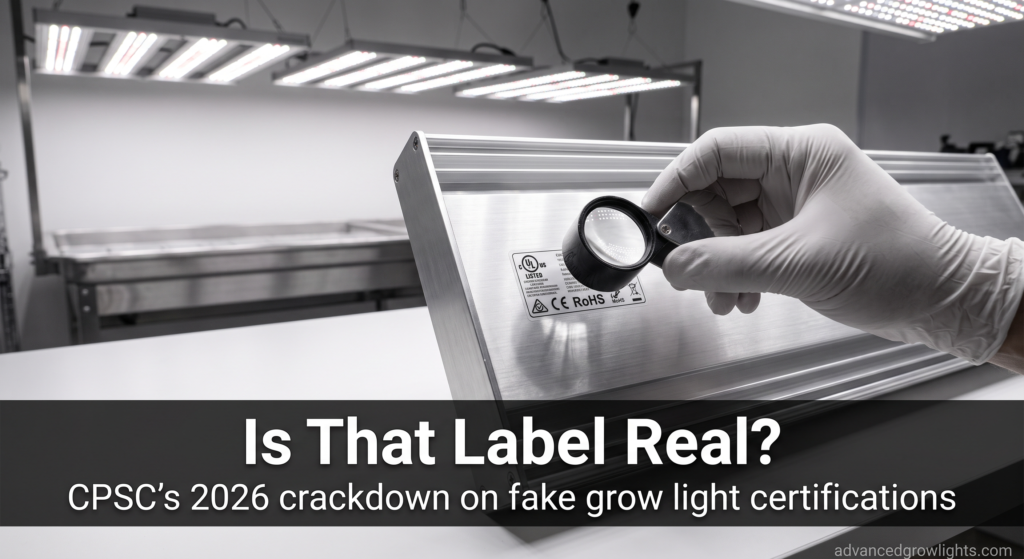
In May 2026, the Consumer Product Safety Commission opened a formal inquiry into a problem that most commercial growers have never thought to ask about: whether the safety label on their equipment is real. The agency’s Request for Information on Counterfeit Certification Markings, published May 6, 2026 under Docket CPSC-2026-0100, targets fake safety certification marks showing up on imported electrical products, the same category of mark that UL and similar bodies put on grow lights. A single room of commercial fixtures can run a five-figure total cost, operate at full power for most of the day, and hang directly over a canopy of flammable material. Getting the certification wrong is not a paperwork problem.
CPSC Acting Chairman Peter A. Feldman put it bluntly in the agency’s announcement: “Fake safety labels are being used to push dangerous products into American homes while evading U.S. law and undercutting honest businesses.” The commission stopped short of publishing a percentage or a unit count, calling the problem only “increasingly” common. Four China-based testing labs already lost their CPSC accreditation over findings of falsified results, a separate action the agency took before this RFI even opened. And the categories already hit, by CPSC’s own account, run from toys with choking hazards to faucets that leach lead to ordinary household electrical appliances.
Grow lights weren’t on that list. They didn’t need to be. The same import channels, the same marketplace dynamics, and the same price pressure that put a fake safety mark on a faucet apply with equal force to a $300 quantum board sold through a third-party Amazon storefront.
What CPSC Announced
The RFI is not a rule. It’s a data-gathering step, and the comment window closed July 6, 2026. CPSC asked stakeholders three things: how prevalent counterfeit certification marks are, how much consumers and buyers rely on those marks when they make a purchase, and what the financial fallout looks like for the businesses that get undercut by counterfeiters. The commission’s framing centers on bad actors, many operating out of the People’s Republic of China, who use fake labels to dodge U.S. safety requirements, deceive buyers, and push noncompliant products out through e-commerce and other trade channels.
That last part matters more for grow lights than for the categories CPSC did name. A toy or a faucet reaches one household at a time. A commercial fixture buy reaches a room, a facility, sometimes a whole portfolio of sites standardized on one SKU. If that SKU’s certification turns out to be fake, the exposure scales with the buildout.
Why Grow Lights Sit in the Crosshairs
Three things make horticultural fixtures an attractive target for counterfeit labeling, and none of them are unique to lighting, but together they’re unusually concentrated in this category.
First, the certification landscape confuses even buyers who pay close attention, and the marks aren’t as independent of each other as they look. A fixture can carry a DLC Horticultural Qualified Products List (QPL) listing, a UL or ETL safety listing, a CE mark, and an IEC 62471 photobiological safety rating. DLC verifies photometric performance for utility rebate eligibility, but DLC won’t even review an application unless the manufacturer already holds a UL 8800 safety certification from an OSHA-recognized lab. A fixture can hold that UL 8800 certification on its own without ever seeking DLC qualification, but the reverse shouldn’t happen: no fixture reaches the Horticultural QPL legitimately without safety certification already in hand. IEC 62471 covers a separate question entirely, whether the light itself can damage skin or eyes at close range, and doesn’t appear in the comparison below because it addresses optical exposure, not electrical safety or rebate eligibility. CE marking, in the EU system, is a manufacturer’s self-declaration, not third-party verification, unless the buyer checks further. The gap counterfeiters exploit isn’t a legitimate mismatch between these marks. It’s a seller claiming “DLC Qualified” or “UL Listed” for a product that never went through either process, and a buyer who never checks the databases has no way to tell the difference.
Second, the price gap between a properly certified fixture and an uncertified clone can run into hundreds of dollars per unit. Multiply that across a few dozen fixtures in a single room and the incentive to skip verification, or to accept a seller’s claim at face value, gets real fast.
Third, marketplace listings make claims that nobody checks before the listing goes live. A third-party seller can post “UL Listed” in a product title without the platform independently verifying the file number behind it. Neither does the buyer, most of the time, unless something goes wrong first.
A Grow Light Already Failed for This Exact Reason
The UK’s product safety database has a documented case that shows what the failure mode looks like in practice. In a report published September 9, 2024 (PSD 2408-0204), UK enforcement authorities flagged a YIKEDAN LED grow light sold via Amazon, model numbers RPD-LGL-AC-T6 and RPD-LGL-AC-T4, for inadequate earthing. The report’s own language is direct: if an electrical fault occurred, “the fuse would not provide the adequate protection required and the plug could explode from the socket,” creating a risk that “the plug to overheat and ignite, causing a fire.” The product failed both the UK’s Electrical Equipment (Safety) Regulations 2016 and its Plugs and Sockets etc. (Safety) Regulations 1994. UK border enforcement stopped the import and destroyed the units.
To be precise about what this case does and doesn’t prove: the report documents a real electrical safety failure in a grow light sold through a mainstream marketplace, not a confirmed counterfeit certification mark on that specific product. But it’s exactly the kind of product CPSC’s RFI is worried about, sold through exactly the kind of channel where a fake safety label would be hardest to catch before it reaches a grower’s ceiling.
Certification Types, Side by Side
Buyers conflate these four marks constantly. They answer different questions, and only two of the four involve independent, ongoing verification a buyer can check for free.
| Mark | What It Verifies | Independently Checkable? | Where to Verify |
|---|---|---|---|
| UL Listing | Electrical and fire safety, tested by UL | Yes, by file number | UL Product iQ (database.ul.com) |
| ETL Listing (Intertek) | Electrical and fire safety, tested by Intertek | Yes, by file number | Intertek’s directory of listed products |
| DLC Horticultural QPL | Photometric efficacy for utility rebate eligibility. Requires a prior UL 8800 safety certification as a listing prerequisite, but DLC doesn’t test safety itself. | Yes, by exact model number | DLC QPL search at designlights.org/qpl |
| CE Marking | Manufacturer’s self-declared conformity with EU directives | No independent database; self-attested | Request the manufacturer’s Declaration of Conformity directly |
The DLC row is the one that trips up the most buyers, and it trips them up in the opposite direction from what you’d expect. DLC listing isn’t independent of safety certification. It depends on it: DLC won’t add a fixture to the Horticultural QPL until the manufacturer already holds a valid UL 8800 safety certification. What DLC doesn’t do is retest that certification itself or guarantee it wasn’t fabricated somewhere in the application. AGL has covered how the QPL works and why version cycles matter for rebate timing in our DLC certification explainer, and separately covered the electrical code requirement itself in our UL 8800 and NEC 410 breakdown. A fixture that holds a legitimate DLC Qualification should already have real safety certification behind it. A counterfeit one might have neither, or might be leaning on safety paperwork that was never real to begin with. Checking both databases independently, rather than assuming one confirms the other, is still the only way to know which case is in front of you.
A Worked Verification Walkthrough
Say a distributor quotes a 640-watt fixture as “UL Listed, DLC Qualified” at a price noticeably below three comparable fixtures you’ve already priced out. Here’s the sequence that takes five minutes and settles the question before you sign a purchase order.
- Ask the seller for the UL file number itself, not the word “Listed” alone. A legitimate manufacturer has this on hand instantly.
- Search that file number in UL’s Product iQ database. Confirm the listed manufacturer name and product category match what’s in front of you. A file number existing in the database is not enough on its own.
- Search the exact model number, including wattage suffix, in the DLC Horticultural QPL. A near-match model number from the same manufacturer is not the same listing.
- Compare the physical label on the unit itself against the certification body’s format guidelines. Blurred logos, missing hologram security features, or a file number printed in the wrong font are common tells.
- If anything doesn’t reconcile, ask for the manufacturer’s original certificate, not a screenshot of a listing page.
None of this requires special access. UL and DLC built these databases to be searched by exactly this kind of buyer.
What a Counterfeit Fixture Costs You Beyond the Purchase Price
The listing requirement for horticultural lighting equipment was introduced in NEC Article 410, Part XVI (§410.172) starting with the 2020 cycle, and it has carried forward through the 2023 and 2026 editions. Inspectors in jurisdictions that have adopted one of those cycles check for it. A facility running fixtures with a fake or unverifiable Listing mark can fail inspection outright, and in a commercial cultivation license context, a failed electrical inspection can delay or jeopardize the license itself.
Insurance is the sharper edge. Many commercial property and equipment policies condition coverage on Listed electrical equipment, language buried in the policy that most operators never read until they need to file a claim. Terms vary by carrier, but if a fire investigation traces back to a fixture with a counterfeit UL mark, an insurer that requires Listed equipment has grounds to deny the claim entirely, not reduce it. The operator is left covering fire damage, lost crop, and lost revenue out of pocket, on top of having paid for equipment that never passed a real safety test in the first place.
Utility rebate exposure runs in a similar direction if the DLC side of the label is also misrepresented. Many rebate programs reserve the right to audit installed fixtures against the QPL, and program terms commonly allow recapturing a rebate paid out against a fixture that never qualified in the first place, or one delisted between the sale and the audit, from the customer of record rather than the seller.
What This Doesn’t Mean
None of this is a case for panic or for assuming every budget fixture is fraudulent. Plenty of value-tier manufacturers hold real, verifiable UL and DLC listings and compete honestly on price. The CPSC’s inquiry is aimed at a specific, identifiable failure mode, sellers using fake marks to skip certification entirely, not at the existence of affordable equipment. The fix is the same five-minute check regardless of price point: verify the file number before the fixture ships, not after it’s already bolted to the ceiling.
Frequently Asked Questions
What’s the actual difference between a UL listing and a DLC Qualified fixture?
UL verifies electrical and fire safety through independent testing. DLC verifies photometric efficacy for utility rebate eligibility, and DLC requires a valid UL 8800 safety certification to already be in place before it will qualify a fixture. A UL listing can exist on its own, but a legitimate DLC listing shouldn’t exist without one.
Does a DLC Qualified fixture automatically meet electrical safety code?
Not automatically. DLC requires proof of a valid UL 8800 safety certification before it qualifies a fixture, so a fixture that legitimately holds DLC Qualification should already carry one. But the National Electrical Code requirement for horticultural lighting to be Listed is satisfied by the actual UL or ETL listing on the product, not by a DLC database entry, so confirm the safety listing directly rather than treating DLC Qualification as a stand-in for it.
How do I check if a UL certification on a grow light is real?
Ask the seller for the UL file number and search it directly in UL’s Product iQ database at database.ul.com. Confirm the manufacturer name and product description in the database match the fixture you’re buying.
Are marketplace sellers required to verify certification claims before listing a product?
Amazon and comparable marketplaces don’t independently verify a UL, ETL, or DLC claim before a third-party seller posts it. CPSC’s May 2026 announcement names e-commerce and other trade channels as a route counterfeit marks use to reach buyers.
What happens to my insurance coverage if a counterfeit-labeled fixture starts a fire?
Many commercial property and equipment policies require Listed electrical equipment as a coverage condition. If an investigation finds the fixture’s UL mark was counterfeit, an insurer can have grounds to deny the claim rather than pay it.
Can a utility claw back a rebate if the fixture’s DLC qualification turns out to be fake, or if the fixture gets delisted later?
Both scenarios carry the same risk. Many utility rebate programs reserve the right to audit installed equipment against the current QPL, and program terms commonly allow recovery of a rebate paid against a fixture that never qualified in the first place, or one that fell off the QPL between the sale and the audit, from the customer of record rather than the seller.
Is this only a risk with cheap, unbranded fixtures?
Price is a signal, not a guarantee either way. The safest approach is verifying the file number for any fixture before purchase, regardless of brand recognition or price point.
What should I do if I already installed a fixture and I’m not sure its certification is genuine?
Pull the file number off the label and search it in UL’s Product iQ or the DLC QPL. If it doesn’t resolve to a matching, current listing, contact the manufacturer for the original certificate before your next inspection or insurance renewal.
Before you place your next fixture order, run it through AGL’s brand-neutral grow light directory to compare verified specs against what a seller is claiming.
What’s the actual difference between a UL listing and a DLC Qualified fixture?
UL verifies electrical and fire safety through independent testing. DLC verifies photometric efficacy for utility rebate eligibility, and DLC requires a valid UL 8800 safety certification to already be in place before it will qualify a fixture. A UL listing can exist on its own, but a legitimate DLC listing shouldn’t exist without one.
Does a DLC Qualified fixture automatically meet electrical safety code?
Not automatically. DLC requires proof of a valid UL 8800 safety certification before it qualifies a fixture, so a fixture that legitimately holds DLC Qualification should already carry one. But the National Electrical Code requirement for horticultural lighting to be Listed is satisfied by the actual UL or ETL listing on the product, not by a DLC database entry, so confirm the safety listing directly rather than treating DLC Qualification as a stand-in for it.
How do I check if a UL certification on a grow light is real?
Ask the seller for the UL file number and search it directly in UL’s Product iQ database at database.ul.com. Confirm the manufacturer name and product description in the database match the fixture you’re buying.
Are marketplace sellers required to verify certification claims before listing a product?
Amazon and comparable marketplaces don’t independently verify a UL, ETL, or DLC claim before a third-party seller posts it. CPSC’s May 2026 announcement names e-commerce and other trade channels as a route counterfeit marks use to reach buyers.
What happens to my insurance coverage if a counterfeit-labeled fixture starts a fire?
Many commercial property and equipment policies require Listed electrical equipment as a coverage condition. If an investigation finds the fixture’s UL mark was counterfeit, an insurer can have grounds to deny the claim rather than pay it.
Can a utility claw back a rebate if the fixture’s DLC qualification turns out to be fake, or if the fixture gets delisted later?
Both scenarios carry the same risk. Many utility rebate programs reserve the right to audit installed equipment against the current QPL, and program terms commonly allow recovery of a rebate paid against a fixture that never qualified in the first place, or one that fell off the QPL between the sale and the audit, from the customer of record rather than the seller.
Is this only a risk with cheap, unbranded fixtures?
Price is a signal, not a guarantee either way. The safest approach is verifying the file number for any fixture before purchase, regardless of brand recognition or price point.
What should I do if I already installed a fixture and I’m not sure its certification is genuine?
Pull the file number off the label and search it in UL’s Product iQ or the DLC QPL. If it doesn’t resolve to a matching, current listing, contact the manufacturer for the original certificate before your next inspection or insurance renewal.