BLOG POST
Speed Breeding Under LEDs: The Light Recipe Behind Seven Wheat Generations a Year
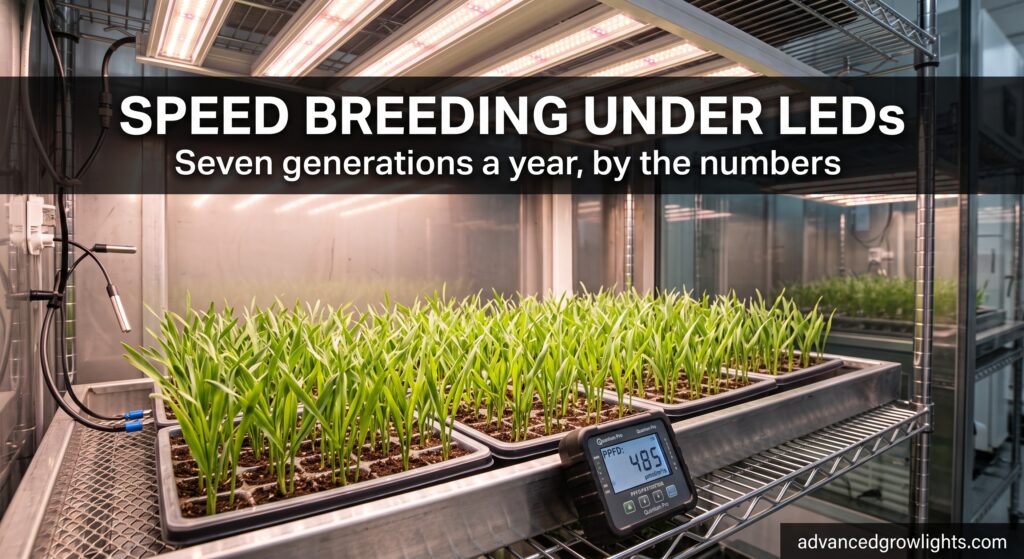
Wheat breeders need six to eight generations before a new trait breeds true. A field program burns most of a decade doing that one planting season at a time. Researchers at the Chinese Academy of Agricultural Sciences ran the same work in about fourteen months, using nothing exotic: LED fixtures, a stretched photoperiod, and a light recipe tuned to the hour.
That result, published in September 2025, is one of three peer-reviewed papers to land in the past several months with hard numbers on exactly how much intensity, what color temperature, and how many hours of light a speed breeding chamber needs. A second, from China Agricultural University, pinned down the daily light integral that gets wheat seedlings to flowering fastest. A third, out of Sabanci University with partners at Essex, Nottingham Trent, and Illinois, cracked a soybean protocol that runs six generations a year on a 63-day seed-to-seed cycle. None of this is cannabis or leafy-greens content. It is university and ag-biotech infrastructure, and it runs on the same PPFD, DLI, and spectrum controls that govern any other grow light purchase.
The Protocol That Started It
Speed breeding as a formal technique traces to a 2018 Nature Plants paper by Watson, Ghosh, and colleagues at the John Innes Centre and the University of Queensland. Their insight was simple: most breeding crops are long-day plants, and a photoperiod pushed past what a field ever provides, paired with a controlled temperature and humidity regime, drives them to flower faster without wrecking seed set. The original setup ran wheat, barley, chickpea, and pea to six generations a year, and canola to four, against two to three generations under standard glasshouse conditions.
The fixtures behind that protocol were Heliospectra LX602C units at the John Innes Centre and E602G units at Queensland, supplementing natural or high-pressure sodium light with a red-and-blue LED boost. Heliospectra does not build those fixtures anymore. The company filed for bankruptcy earlier this year, a reminder that a breeding program planning a light recipe around a specific manufacturer is planning around a company, not a spec sheet alone.
What the 2025-2026 Papers Measured
Intensity: More Photons Work, Until They Don’t
The Chinese Academy of Agricultural Sciences team, led by Jinglai Li, tested spring wheat under 300, 500, 700, and 900 µmol/m²/s. Seven hundred produced the highest yield and pushed plants into anthesis five to ten days earlier than the lower intensities. Nine hundred did not extend the gain. Photoinhibition set in and cut photosynthetic output by 13 percent. A breeding chamber pushing past 700 µmol/m²/s on wheat is buying electricity the crop cannot use.
Spectrum: Warmer Beat Cooler
The same study compared 3500K warm-white LEDs against 4500K cool-white at matched intensity. The warmer spectrum, which carries a higher red fraction (50 percent versus 41 percent at the cooler setting), produced a 13 percent yield increase and moved anthesis four days earlier. Growers chasing full-spectrum white light for its uniformity should note that in a breeding chamber, the red-heavy end of white light is doing measurable work, not filling out a marketing chart. The physiology lines up with what the UV and far-red research already shows: spectral ratios move flowering time, and the effect is large enough to design around.
Photoperiod: 22 Hours Beats Around-the-Clock
Continuous light, 24 hours a day, moved anthesis three to four days earlier than a 22-hour photoperiod. It also cut yield by 13 percent at the same daily light integral. The extra two hours of darkness let the plant’s photosystem recover overnight. Skip that recovery window and the crop flowers faster on paper while producing less seed to breed from, which defeats the purpose of running a speed breeding program in the first place.
The DLI Math Behind Every Speed Breeding Chamber
A January 2026 paper from Luming Zhong’s group at China Agricultural University isolated daily light integral, not photoperiod or intensity in isolation, as the seedling-stage variable that matters most. Their optimal figure: 39.6 mol/m²/day, delivered as 500 µmol/m²/s across a 22-hour photoperiod. Wheat grown at that DLI headed and flowered 5.9 and 7.5 days earlier, respectively, than wheat held at a minimal 10.8 mol/m²/day. Push the DLI higher than 39.6 and the gains flatten. Seedling biomass plateaus and the extra electricity buys nothing.
The formula behind that number is one every commercial grower already uses:
DLI (mol/m²/day) = PPFD (µmol/m²/s) × photoperiod (hours) × 3600 ÷ 1,000,000
Run the numbers from Zhong’s paper: 500 × 22 × 3600 ÷ 1,000,000 = 39.6. That is not a coincidence, it is the same DLI math behind any PPFD-to-DLI conversion, applied to a seedling stage that most commercial lighting guidance never touches. A breeding program scaling up from a single growth chamber to a full research greenhouse can use that same formula to hold DLI constant while trading intensity against photoperiod, which matters when a facility’s electrical service, not the light recipe, turns out to be the actual ceiling.
Wheat and Soybean Recipes Diverge
Wheat is a long-day plant and soybean is a short-day plant, so the published recipes for each push photoperiod in opposite directions, different enough that copying one onto the other would cost a program a season.
| Crop / Protocol | Photoperiod | Intensity | Spectrum | Generations/Year | Source |
|---|---|---|---|---|---|
| Wheat (original protocol) | 22 hours | ~440-500 µmol/m²/s | Red/blue LED + HPS supplement | Up to 6 | John Innes Centre / Univ. of Queensland, 2018 |
| Wheat (yield-optimized) | 22 hours | 700 µmol/m²/s peak | 3500K warm-white | 7+ | Chinese Academy of Agricultural Sciences, 2025 |
| Wheat (seedling DLI) | 22 hours | 500 µmol/m²/s (39.6 DLI) | Not spectrum-isolated | N/A (stage-specific) | China Agricultural University, 2026 |
| Soybean | 22 hours, post-flowering (R1) only | 550 µmol/m²/s | 6000K cool-white + 660nm red, 6:1 ratio | 6 | Sabanci University et al., 2025 |
The Soybean Wrinkle: When You Extend the Photoperiod Matters
Soybean is a short-day plant, and an extended photoperiod delays its floral induction instead of speeding it up. Seher Bahar Aciksoz’s team worked with that biology instead of against it: they held a standard photoperiod through vegetative growth and switched to 22 hours only after the plant reached the R1 flowering stage, once flowering was already underway and the extra light hours could speed pod fill instead of stalling flowering. That timing choice cut the seed-to-seed cycle to 63 days and delivered six generations a year, roughly double the one to three generations a standard glasshouse produces.
The tradeoff shows up in the plant’s own photosystem data. Pod-level photosynthetic efficiency (Fq’/Fm’) rose under the extended photoperiod, which is why seed filled faster. Leaf-level maximum efficiency (Fv/Fm) fell over the same window, a sign of photoinhibition building in the foliage even as the pods benefited. The team’s harvest protocol accounted for it: seeds picked at 58 days, still green, then pushed through a dormancy-breaking treatment of hydrogen peroxide, cold stratification, and gibberellic acid to hit 92 percent germination. Skip that step and an early harvest produces seed that won’t reliably sprout for the next generation.
Staged Lighting: The Energy Tradeoff Nobody Advertises
Running a wheat chamber at a flat 700 µmol/m²/s for the entire crop cycle is the yield-optimized approach, not the energy-optimized one. Li’s team also tested a staged strategy that matches intensity to growth phase: roughly 300 µmol/m²/s from seedling through tillering, up to 700 µmol/m²/s from elongation through heading, then back down to around 400 µmol/m²/s after flowering. That schedule cut energy use by about 30 percent against the flat 700 µmol/m²/s baseline, at a cost of 11 percent yield.
For a university program running a dozen chambers year-round, that trade is often worth making. A breeding pipeline optimizing for generations per year per dollar of electricity, not maximum yield per plant, gets more total throughput from the staged approach than from brute-force full intensity on every chamber, every stage.
What This Means for Fixture Selection
None of these protocols need a specialty “breeding” fixture. They need two things that plenty of commercial-grade LED fixtures already have: dimming fine enough to hold a target PPFD rather than a coarse “high” or “low,” and enough listed lifespan to survive a program running lights nearly around the clock, every day, for years. Photoperiod itself is not a fixture spec. It comes from whatever external controller drives the fixture’s 0-10V or DALI input, and that controller needs to hold a stable 22-hour cycle for months without drift. LM-80 lifespan projections are pinned to total operating hours, not a daily photoperiod rating, so a fixture accumulates its rated lifetime hours much faster on a near-continuous 22-hour breeding schedule than it would on a standard 12-hour commercial cycle.
Tunable-spectrum, DLC-listed fixtures built for commercial cultivation, such as Fluence’s SPYDR 3 (rated at 3.0 µmol/J), scale well from a pilot chamber into a full research greenhouse, since the same 0-10V or DALI dimming protocol that sets a commercial photoperiod also holds a 22-hour breeding schedule steady. Programs sourcing at that scale should weight manufacturer stability as heavily as spec sheet numbers. A multi-year breeding pipeline built around a fixture line whose maker exits the market, the way Heliospectra did, means re-validating a light recipe mid-program, which costs more than the fixtures themselves.
Speed breeding is still a lighting decision before it’s a genetics decision. The crop responds to PPFD, spectrum, and photoperiod exactly the way it does in a commercial cultivation room, measured against generations per year instead of grams per watt. Compare fixtures with verified specs in the AGL grow light directory before committing a multi-year breeding pipeline to hardware that may not still be supported in year three.
What is speed breeding?
Speed breeding uses extended photoperiods, typically 20 to 22 hours of light, along with controlled temperature and humidity, to push long-day crops through more generations per year than a field or standard glasshouse allows. The technique dates to a 2018 John Innes Centre and University of Queensland protocol and has since gained specific PPFD, spectrum, and DLI targets for individual crops.
Why does photoperiod matter more than raw light intensity?
Wheat is a long-day plant and soybean is a short-day plant, so day length itself is a flowering trigger for both, just in opposite directions. Extending the photoperiod pushes wheat to flower earlier through that signaling pathway; the same extension delays flowering in soybean, which is why speed breeding protocols hold a standard photoperiod through soybean’s vegetative stage. Pushing intensity higher without matching that photoperiod strategy moves the DLI number but doesn’t trigger the same response, and past a threshold it causes photoinhibition instead of faster development.
Does speed breeding work for every crop?
No. Long-day species (wheat, barley, chickpea, pea) and day-neutral canola respond to a simple extended photoperiod. Short-day species need the opposite handling: soybean’s protocol holds a standard photoperiod through vegetative growth, since extending it early would delay flowering, then switches to 22 hours only after the plant flowers to speed pod fill. Rice and other short-day crops need their own version of that same timing logic.
What DLI should a wheat speed breeding chamber target?
China Agricultural University’s 2026 study found 39.6 mol/m²/day, delivered as 500 µmol/m²/s over 22 hours, optimal for seedling-stage development. Pushing DLI higher produced no further gain in that study.
Why does 24-hour continuous light hurt yield if it speeds up flowering?
Plants need a dark period to recover photosynthetic capacity. Removing it entirely moved wheat anthesis three to four days earlier in the Chinese Academy of Agricultural Sciences study, but cut yield 13 percent at the same total daily light integral. A 22-hour photoperiod with two hours of dark captured most of the speed benefit without that yield penalty.
Can standard commercial LED fixtures run a speed breeding program, or is specialized equipment required?
Commercial-grade, dimmable, spectrum-tunable DLC-listed fixtures can run these protocols, provided the controller can hold a stable 20-to-22-hour photoperiod for months. The fixture’s rated lifespan itself doesn’t change, it stays a fixed pool of total operating hours, but a facility running that schedule burns through those hours nearly twice as fast as a standard 12-hour commercial cycle would, so plan replacement around that pace, not the calendar.
Does DLC listing matter for a breeding chamber the way it does for commercial cultivation?
DLC listing signals efficacy and quality thresholds that reduce a chamber’s electricity draw over years of near-continuous operation, which matters even when a university program isn’t chasing a utility rebate. Programs that are chasing a rebate need a currently listed fixture, since delisted products lose rebate eligibility.
What’s the real tradeoff between energy cost and generations per year?
Li’s team measured it directly on wheat: a staged lighting schedule that matches intensity to growth phase, instead of running flat at the yield-optimal 700 µmol/m²/s throughout, cut energy use about 30 percent for an 11 percent yield cost. Programs running many chambers continuously often come out ahead on total throughput per dollar by choosing the staged approach over maximum intensity everywhere.