
BLOG POST
Red Light and Disease Resistance: What a New Lettuce Study Means for Your Grow Light Spectrum
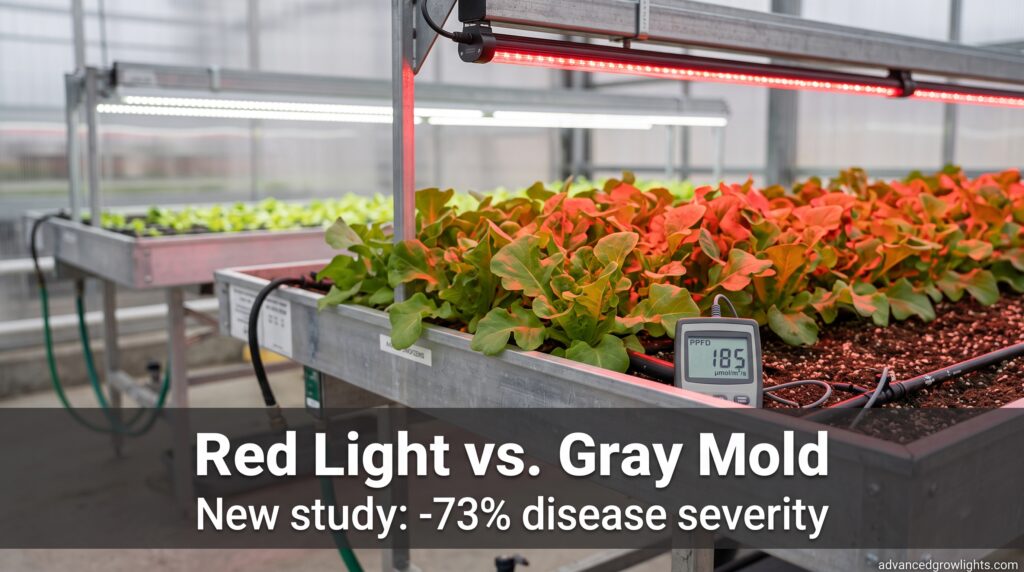
Plant pathologists have documented fungicide resistance in Botrytis cinerea, better known as gray mold, for decades. Commercial growers already lean on cultural controls to fill the gap chemistry leaves open. A study published in the journal Agriculture on August 27, 2026 points to a control lever most greenhouse operations already own and rarely think about this way: the red channel on their supplemental LED fixture.
Researchers at Lincoln University in New Zealand, working with the University of Pisa in Italy, grew green oak leaf lettuce under four lighting regimes, then infected the harvested leaves with Botrytis in a controlled assay. Plants that received supplemental red light produced 45% more fresh biomass than unlit controls. Their leaves also developed 73% less cumulative disease damage after inoculation. Full-spectrum light raised biomass too, and white light’s gain didn’t reach statistical significance, but neither came close to red light’s effect on the infection outcome.
Inside the Trial
Gagandeep Jain led the team, with co-authors from three Lincoln University departments and from the University of Pisa’s agriculture faculty. They ran the trial in a greenhouse near Christchurch from September to October 2025, using green oak leaf lettuce sourced from Zealandia Horticulture. Five-week-old seedlings went into four-liter pots under one of four conditions: ambient greenhouse light alone, or ambient light plus one of three supplemental LED treatments.
The three supplemental fixtures differed in spectrum and wattage. A narrowband red LED bar peaked at 660 nanometers and drew 30 watts. A broadband white fixture drew 52 watts. A full-spectrum fixture drew 90 watts. The paper names the fixtures by product and wattage and plots their spectral output in its Figure 1, but it doesn’t describe their diode composition, so treat the white and full-spectrum units as broader-spectrum alternatives to the red bar, not precisely defined recipes. Each fixture delivered 150 µmol/m²/s of supplemental light for six hours a day, on top of whatever the greenhouse let through, for 42 straight days.
After 42 days, the team measured biomass, chlorophyll, and photosynthetic efficiency, then moved to the part that makes this study worth a second look. They detached leaves from each treatment group, inoculated them with Botrytis cinerea spores, and tracked lesion growth at one, three, and five days post-inoculation.
The Numbers
Start with growth. Red light produced the heaviest plants at 416.6 grams of fresh shoot mass, a 45% jump over the 286.3-gram control. Full-spectrum light landed at 381.3 grams, up 33%. White light reached 318 grams, a gain the authors’ own statistics couldn’t separate from noise.
The disease numbers tell a sharper story. Researchers tracked lesion area over the five-day assay and calculated the area under the disease progress curve (AUDPC), a standard plant pathology metric that sums lesion area over time rather than measuring a daily rate. Control leaves reached an AUDPC of 2,436.57 mm²·day. White-light leaves came in lower, at 2,220.98, and full-spectrum leaves lower still, at 1,862.57, though neither difference from control reached statistical significance. Red-light leaves posted the only result that did: an AUDPC of 668.24, a drop of roughly 73% against the control, confirmed by Tukey’s HSD test.
| Treatment | Fixture | Fresh Shoot Mass | Disease Severity (AUDPC, mm²·day) | Energy Use Efficiency (g/kWh) |
|---|---|---|---|---|
| Control | Ambient only | 286.3 g | 2,436.57 | n/a |
| White | Broadband, 52 W | 318 g (not significant) | 2,220.98 (not significant) | 145.6 |
| Full-spectrum | 90 W | 381.3 g (+33%) | 1,862.57 (not significant) | 100.9 |
| Red | 660 nm, 30 W | 416.6 g (+45%) | 668.24 (−73%, significant) | 330.6 |
Antioxidant capacity moved the same direction. The team measured free radical scavenging with a DPPH assay, scored by IC50, the concentration of leaf extract needed to neutralize half the free radicals in the test solution. A lower IC50 means a more potent antioxidant response. Red-light leaves scored 8.24 mg fresh weight per mL. Full-spectrum came in at 12.19. Control and white light both sat near 19.7, essentially identical to each other. Red light also maintained higher photosystem II efficiency during peak midday irradiance, meaning those plants handled bright-sun stress with less photochemical downregulation than the other groups.
A Worked Example
Energy use efficiency turns these numbers into something you can put in a budget. Red light delivered 330.6 grams of fresh biomass per kilowatt-hour of lighting energy. White managed 145.6, and full-spectrum trailed at 100.9, despite its fixture drawing three times the wattage of the red bar. Run those figures against an illustrative commercial rate of $0.15 per kWh and the gap turns into real money: producing a kilogram of fresh lettuce cost roughly $0.45 in supplemental lighting energy under red light, $1.03 under white, and $1.49 under full-spectrum. That gap exists before disease losses even enter the calculation.
Why the 90-Watt Fixture Lost to the 30-Watt Bar
Wattage and photon delivery are separate measurements. Wattage is what a fixture pulls from the wall. PPFD is what lands on the canopy. The study reports all three supplemental fixtures at 150 µmol/m²/s for six hours a day, so every treated plant received the same count of supplemental photons. The 90-watt full-spectrum fixture did not put more light on the crop than the 30-watt red bar. It drew three times the electricity to deliver the same amount.
The paper reports the wattages and the matched PPFD but doesn’t explain the gap. Lower diode efficacy, different optics, or a different mounting height could each contribute, and the study doesn’t say which. With photon count held level, the red treatment still produced the biggest biomass gain, the strongest antioxidant response, and the only significant drop in lesion severity. That points to spectrum, not photon quantity, as the variable that mattered. It also accounts for part of the energy use efficiency gap: the red bar delivered the same photons on a third of the full-spectrum fixture’s electricity, and the plants under it grew larger.
A Plausible Mechanism, Not a Proven One
The study didn’t isolate a signaling pathway, and its authors don’t claim to have found one. The authors measured a set of outcomes: higher chlorophyll, better midday photochemical efficiency, stronger antioxidant capacity, and smaller lesions after infection. A February 2026 review in AgriEngineering lays out the broader context. Light quality functions as a signal to plants, not only an energy source, and specific wavelengths can modulate defense pathways alongside growth and photosynthesis. The review describes phytochrome, the red and far-red photoreceptor, as a regulator of the salicylic acid and jasmonic acid pathways plants use to resist biotrophic and necrotrophic pathogens. It also cites a strawberry study in which supplemental red light at 660 nm and 250 µmol/m²/s, five hours a day from flowering to harvest, reduced postharvest Botrytis development and coincided with higher expression of defense-related genes, a pattern the review reads as tissue primed for a faster immune response.
None of that confirms causation in this specific lettuce-Botrytis system. It does explain why a lighting change engineered for growth might also shift a plant’s baseline defense posture. A plant under less midday photoinhibition stress has more resources on hand. Reactive oxygen species management overlaps directly between photoprotection and pathogen response, and the antioxidant data in this study sits right at that intersection.
What This Doesn’t Prove
Four limits matter before anyone treats this as a fungicide substitute. The disease assay used detached leaves, not whole plants growing on the bench, and whole-plant infection dynamics differ from a leaf disc under controlled inoculation. The trial tested one cultivar of one crop against one pathogen. It was a single experimental run with 10 plants per treatment, grown under two fixtures each. And red-light leaves still developed lesions. Red light reduced lesion severity. It didn’t prevent disease.
Whether the effect holds at commercial PPFD levels, under natural infection pressure, or in crops like tomatoes or cannabis remains untested. Strawberries have related evidence, but that work measured postharvest fruit, not in-season leaf disease. The authors describe their findings as a sustainable strategy with potential to influence subsequent disease responses, language that leaves plenty of room for the effect to shrink, disappear, or reverse outside a research greenhouse.
Testing This Without Buying New Hardware
Most commercial fixtures with independently dimmable channels already give growers the tool this study used. Manufacturers like Fluence, Gavita, DimLux, PHOTOBIO, and ThinkGrow build multi-channel spectrum control into their higher-end lines specifically so growers can shift the red-to-white ratio without swapping fixtures. Bumping the red channel’s contribution during a known disease-pressure window, such as a humid stretch before harvest, costs nothing beyond a controller setting change.
Run it as a trial on a subset of benches first. Track it against your existing PPFD (light intensity) and DLI (daily light total) targets so a spectrum shift doesn’t accidentally undershoot your light budget, and compare disease incidence against an unchanged control section for at least one full crop cycle before rolling a change out facility-wide. That’s the same caution the study’s own authors apply to their data, and it costs a grower nothing to borrow it.
Growers already running UV-based disease suppression should treat this as a different tool, not a replacement. UV-C treatments work by damaging pathogens directly on contact, a germicidal effect independent of the plant. This study points to something upstream: changing the plant’s own physiological state before a spore ever lands. The two approaches could plausibly stack, though nobody has tested that combination yet.
Every verified fixture spec relevant to a spectrum-shift trial like this lives in the AGL directory, the Advanced Grow Lights fixture database, sorted by channel count and tested efficacy rather than manufacturer marketing copy.
Does this study mean red light can replace fungicides for Botrytis?
No. Leaves from red-light plants still developed lesions once inoculated; the lesions grew more slowly. Pair a spectrum shift like this with your existing disease program rather than swapping anything out.
What exact light setup produced these results?
A 30-watt red LED bar peaking at 660 nanometers, run six hours daily alongside normal greenhouse light for six weeks straight before the plants faced any pathogen.
Would this work on cannabis, tomatoes, or strawberries?
Unknown for cannabis and tomatoes. The trial covered a single lettuce variety and a single fungus. A strawberry study cited in a 2026 review found supplemental red light reduced postharvest Botrytis development, so the idea has support beyond lettuce, but treat it as worth testing on your own crop, not a settled result.
Why did the 90-watt full-spectrum fixture perform worse than the 30-watt red bar?
Spreading photons across the whole visible spectrum means fewer of them land specifically in the red band that appears to drive the effect. Total wattage didn’t matter. Wavelength did.
Do I need to buy new equipment to test this?
Only if your current fixture can’t isolate a red channel. Most multi-channel commercial units already can, which makes this a settings change rather than a purchase.
Is this the same as UV-C disease control?
Different mechanism entirely. UV-C kills pathogens on contact from outside the plant. This effect, if it holds up, works from inside the plant, changing its physiology before a pathogen ever arrives.
How long did plants need to be under red light before the effect appeared?
Six weeks of daily exposure preceded the infection test in this trial. Shorter windows haven’t been studied.
Where can I read the full study?
“Supplementary Red LED Light Improves the Physiological Status of Lettuce Plants and Reduces Botrytis cinerea Disease Severity in a Detached Leaf Assay,” published open-access in Agriculture (MDPI) on August 27, 2026.