BLOG POST
California’s Title 24 Now Regulates Grow Light Efficacy: The 2025 Energy Code Explained
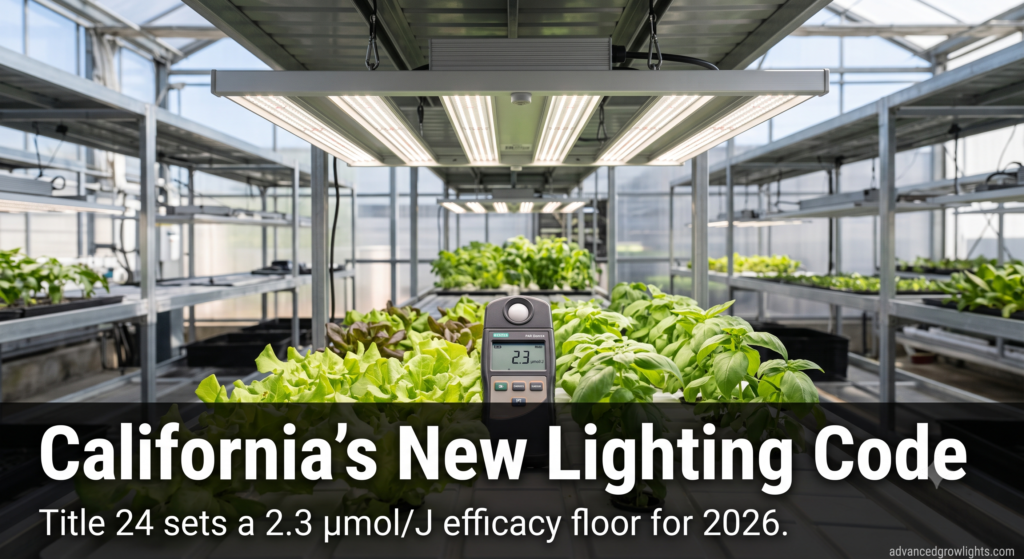
California’s 2025 Energy Code took effect January 1, 2026. If your facility submitted a permit for a new grow room, a conditioned greenhouse, or a lighting retrofit on or after that date, Title 24 Part 6 now treats your fixtures the way it treats HVAC and water heating: as a load the state regulates by number, not by good intentions. Growers in other states should pay attention. California’s building code has a history of becoming everyone else’s building code within a few permit cycles.
This is not the DLC Horticultural Qualified Products List. AGL covered DLC Hort V4.0 certification and the rebate math behind it already, and that program stays voluntary. You choose to chase a rebate. Title 24 is different: it sits inside the building permit, and a plan checker can reject your project over it before you pour a slab.
What Counts as a CEH Space Now
Controlled Environment Horticulture, or CEH, is not a new category. California introduced it in the 2022 code cycle, effective January 2023, and the 2025 cycle builds on that foundation rather than replacing it. The California Energy Commission’s own guidance defines a CEH space as one “dedicated to plant production by manipulating indoor environmental conditions,” and it folds in conditioned greenhouses alongside indoor-only rooms. Decorative plantings and unconditioned hoop houses stay outside the scope.
That 40 kilowatt aggregate-load trigger also carries over from 2022. What changed for 2025 is the number fixtures have to hit once they cross it, and the fact that greenhouse and indoor spaces now share a single threshold instead of two. Most commercial flower rooms and greenhouse ranges blow past 40 kW with a fraction of their canopy lit, so in practice this rule targets exactly the growers reading this article.
The Efficacy Floor: 2.3 µmol/J, Measured a Specific Way
For facilities above that 40 kW threshold, the California Energy Commission requires horticultural lighting systems to hit a photosynthetic photon efficacy of at least 2.3 µmol/J across the 400-700 nanometer band, tested to ANSI/ASABE S640. That standard, not a manufacturer’s marketing spec sheet, is what a plan checker will ask for.
Track the trend and the direction gets clear fast. The prior 2022 code, effective January 2023, set a lower bar: greenhouse luminaires needed only 1.7 µmol/J, indoor fixtures 1.9 µmol/J. The 2025 cycle folds both space types into one 2.3 µmol/J floor, a jump of about 21% over the old indoor number and 35% over the old greenhouse number. Fixtures that cleared code three years ago can fail it today.
Controls Aren’t a Suggestion Anymore
Efficacy is half the code. The other half lives in Section 110.9(b)(1) and Section 130.1(b), which require time-switch controls and multilevel lighting controls on every qualifying CEH space. A single wall switch feeding an entire flower room no longer satisfies the standard, regardless of how efficient the fixtures are.
In practice, that means zoning canopy by function: propagation, vegetative, and flower rooms each need independent control, and aisles, dry storage, and processing areas can’t share a circuit with active canopy. Growers already running phase-based light recipes have a head start. Facilities still wired as one big room per breaker do not.
Acceptance Testing: Where Projects Stall
Meeting the efficacy number and installing the right controls only gets a project halfway to occupancy. California requires a three-stage paper trail: a Certificate of Compliance at design, a Certificate of Installation confirming the as-built system, and a Certificate of Acceptance after functional testing. A certified Acceptance Test Technician, employed by a certified Acceptance Test Employer, has to sign off on that last one.
Contractors who treat acceptance testing as a formality tend to discover, at final inspection, that a dimming curve doesn’t match the submitted design, or that an electrician wired a zone to the wrong controller. Build the pre-functional check into your construction schedule two to four weeks before final, not the week of.
How Three Programs Regulate the Same Problem Differently
California isn’t the only jurisdiction putting numbers on grow light energy use, and the three current approaches don’t measure the same thing.
| Program | What It Regulates | Threshold | Enforcement Point |
|---|---|---|---|
| California Title 24 (2025) | Photon efficacy (PPE) + controls | 2.3 µmol/J minimum, ANSI/ASABE S640 | Building permit, tied to >40 kW load |
| Massachusetts 935 CMR 500.120 | Power density per canopy area | 36 W/sq ft (50 W/sq ft for Tier 1-2) | Cannabis cultivation license |
| DLC Horticultural QPL V4.0 | Photon efficacy (voluntary listing) | 2.5 µmol/J minimum to list | Utility rebate eligibility, optional |
Massachusetts gives cultivators an out: install fixtures that already sit on the DLC Horticultural QPL with a PPE at least 15% above that list’s minimum threshold, and the flat wattage cap no longer applies. California offers no equivalent escape hatch. Every qualifying CEH space has to hit the 2.3 µmol/J floor and run the required controls, with no flat-cap alternative on the table.
Worked Example: Does Your Canopy Design Clear the Bar?
Take a commercial flower room built around the Gavita RS 2400e, rated at 750W and about 2,400 µmol/s of PPF, for a measured efficacy near 3.2 µmol/J. Install 60 fixtures and the room draws 45 kW, well over the 40 kW CEH trigger. 3.2 µmol/J clears the 2.3 µmol/J floor by about 39%. That fixture choice satisfies the efficacy requirement with real margin, not a razor’s edge.
The Fluence SPYDR 3, at 800W and about 3.0 µmol/J, and the Lumatek ZEUS 600W PRO, at about 2.85 µmol/J, both clear the floor too, though with less headroom than the Gavita fixture. That margin matters. DLC’s own V4.0 threshold already sits at 2.5 µmol/J, and Title 24’s next update cycle in three years will not move the number down. Buying a fixture that barely clears today’s 2.3 µmol/J bar is buying a fixture that may need replacing before your next tenant improvement.
What This Means Outside California
Colorado and New York have both floated energy consumption limits for cannabis cultivation, and neither has finalized a rule as specific as California’s or Massachusetts’s. Boulder, Colorado already charges commercial growers a premium electricity rate unless they offset load with renewables, a blunter tool than an efficacy floor but aimed at the same target.
None of this is limited to cannabis. California’s CEH definition applies to any conditioned horticultural space, tomato greenhouses and leafy-green vertical farms included. A produce operation building a new range in 2026 has to run the same PPE and controls math as a licensed cultivator, and the crop growing under those lights never enters the code at all.
Growers outside California should treat this code cycle as a preview, not a California-only curiosity. Utility rebate programs already lean on DLC’s QPL as “the absolute authority for rebate eligibility” in most states, and a mandatory efficacy floor tends to follow a voluntary one within a few years once the compliance infrastructure, testing labs, certified technicians, standard test methods, already exists. California built that infrastructure first.
For the underlying efficacy math these codes are built on, see AGL’s breakdown of PPFD, DLI, and efficacy, and for context on which manufacturers are already publishing verified PPE numbers, see our 2026 manufacturer overview.
Where the 2.3 Number Came From
The California Energy Commission doesn’t set efficacy thresholds by guesswork. Each Title 24 cycle runs through a Codes and Standards Enhancement (CASE) study, where commission staff and outside consultants model the cost of compliant fixtures against the electricity a facility saves over its expected life. If the modeled payback pencils out within the standard’s assumptions, the threshold moves. The 2.3 µmol/J floor reflects what CASE analysts found the LED market could support in 2025, not an arbitrary round number.
That process matters for anyone planning past this code cycle. Title 24 updates every three years, and horticultural lighting has tightened every cycle it has appeared in: 1.7 to 1.9 µmol/J in 2022, then 2.3 µmol/J in 2025. A facility built to the bare minimum this year is a facility built to fail the 2028 revision. Fixture selection for a ten-year build should target where the CASE process is heading, not where it landed this cycle.
Tenant Improvements and Renovations: Read Your Scope Carefully
New construction is the easy case. Tenant improvements and lighting-only retrofits are where growers get surprised, because the trigger depends on how much of the project falls inside the energy code’s defined scope of work, not on whether cannabis or produce is involved. Swapping fixtures inside an existing, unconditioned structure may fall outside CEH scope entirely. Adding conditioning, expanding canopy square footage, or pulling new electrical service pulls the whole space into Title 24 review in most cases.
The Authority Having Jurisdiction, generally the local building department, makes the final scope call, and that call varies by county. Growers planning a retrofit should get a scope determination in writing before ordering fixtures, the same advice that applies to utility rebate pre-approval. Assuming a project is too small to trigger review, then discovering otherwise at permit submittal, costs far more than the phone call would have.
Frequently Asked Questions
What is a Controlled Environment Horticulture (CEH) space under California’s Title 24?
A CEH space is any building space where growers manipulate indoor conditions, lighting, irrigation, heating, cooling, or dehumidification, to produce plants. The definition covers indoor-only rooms and conditioned greenhouses. It excludes decorative plantings and unconditioned structures.
Does the code apply to every commercial grow room?
Only facilities with an aggregate horticultural lighting load above 40 kilowatts trigger the strictest efficacy and control provisions. Below that threshold, the CEH-specific rules don’t apply, though other parts of Title 24 may still govern the building.
What efficacy number do fixtures need to hit?
At least 2.3 µmol/J across the 400-700 nanometer band, tested to the ANSI/ASABE S640 standard. The prior 2022 code required only 1.7 µmol/J for greenhouses and 1.9 µmol/J for indoor rooms.
Does DLC Horticultural QPL listing satisfy Title 24?
Not on its own. Many QPL-listed fixtures clear 2.3 µmol/J, since DLC’s own V4.0 minimum sits at 2.5 µmol/J, but California requires the ANSI/ASABE S640 test method and the mandated controls independent of QPL status. Check both before you submit plans.
What lighting controls does the code require?
Time-switch controls under Section 110.9(b)(1) and multilevel lighting controls under Section 130.1(b), applied by zone and by growth phase. A single switch controlling an entire room fails the standard.
How does California compare to Massachusetts’s cannabis lighting rule?
Massachusetts caps power density at 36 W per square foot of canopy, or 50 W per square foot for Tier 1 and Tier 2 cultivators, under 935 CMR 500.120. Fixtures on the DLC Horticultural QPL rated 15% above that list’s minimum threshold can skip the wattage cap. California regulates efficacy and controls instead of a flat cap, with no equivalent alternative.
What happens if a project skips acceptance testing?
California requires a Certificate of Compliance, a Certificate of Installation, and a Certificate of Acceptance, with the last one signed by a certified Acceptance Test Technician working for a certified Acceptance Test Employer. Skipping that step stalls the certificate of occupancy, and paperwork alone will not fix it.
Is this specific to cannabis cultivation?
No. The CEH definition applies to any conditioned horticultural space, including tomato and leafy-green production. A produce grower building a new range in California in 2026 faces the same PPE and controls requirements as a licensed cannabis cultivator.