BLOG POST
UV-B Supplemental Lighting for Leafy Greens: The 2025 Dose-Response Numbers
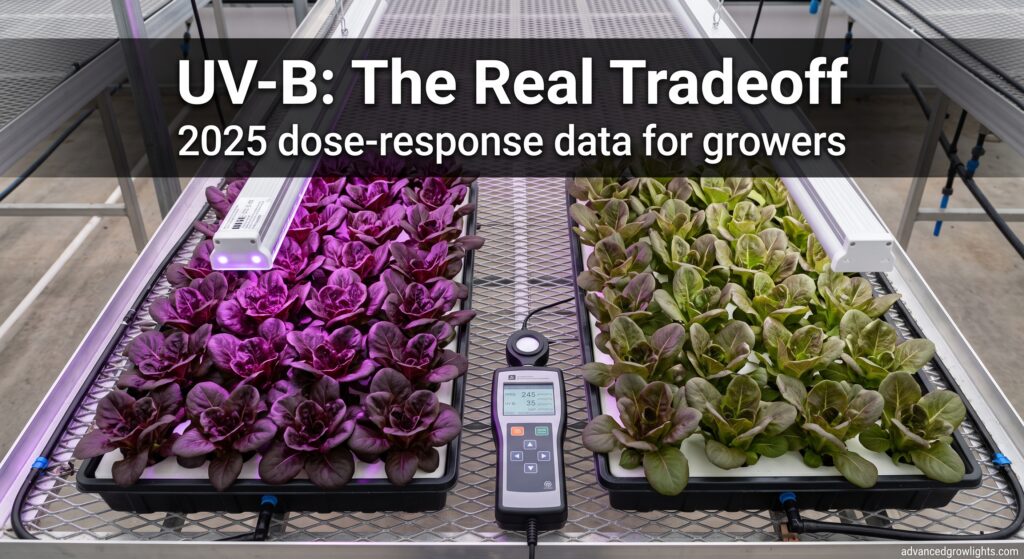
Grow light manufacturers have pitched UV-B supplementation for years, promising deeper color and higher antioxidant counts in leafy greens. Two studies published in 2024 and 2025 put hard numbers on that pitch, and the numbers cut both ways. Texas A&M researchers measured a 314% jump in anthocyanin content in one lettuce cultivar under end-of-production UV-B. The same treatment cost that crop up to 49% of its harvest weight. A separate 2024 trial compared UV-B against UV-C in the same species and found the two wavelengths produce almost opposite results, even though marketing copy often lumps them together. If you’re weighing a UV-B module for your next fixture order, the tradeoff is no longer a guess. Researchers have now measured it, cultivar by cultivar.
What the Texas A&M Trial Tested
Texas A&M’s Department of Horticultural Sciences grew two red-leaf lettuce cultivars, Red Salad Bowl and Rouxai, under a base of 200 µmol m⁻² s⁻¹ white LED light for 28 days. During the final week, one group received supplemental UV-B at 3 µmol m⁻² s⁻¹ for 16 hours a day, a dose equal to about 1.15 W m⁻². Separate groups got blue, red, violet, or UVA light instead, each at controlled intensities. The team published its results in PLOS One on July 30, 2025, after measuring anthocyanin content, total phenolics, ascorbic acid, and fresh weight across every treatment.
| Treatment | Cultivar | Anthocyanin change | Total phenolics change | Fresh weight vs. other EOP treatments |
|---|---|---|---|---|
| UV-B (3 µmol m⁻² s⁻¹, 16h/day, final 7 days) | Red Salad Bowl | +147% | +80% | -8.9% to -49%* |
| UV-B (3 µmol m⁻² s⁻¹, 16h/day, final 7 days) | Rouxai | +314% | +99% | -8.9% to -49%* |
| Blue light (60 µmol m⁻² s⁻¹) | Red Salad Bowl | +69.4% | +31.4% | No significant loss reported |
| Blue light (60 µmol m⁻² s⁻¹) | Rouxai | +77.8% | Not reported | No significant loss reported |
| Violet light | Red Salad Bowl | Not reported | Not reported | +39.9% (gain) |
| Violet light | Rouxai | Not reported | Not reported | +42.5% (gain) |
*This range compares UV-B’s fresh weight to the trial’s four other end-of-production treatments (blue, red, violet, UVA), not to an unsupplemented control, so read it as UV-B’s rank among the treatments tested rather than an absolute yield cost. The paper also reports one figure measured against the true control: Rouxai’s fresh weight fell 30.6% and its total leaf area fell 25.5% under UV-B compared to plants that got no supplemental light at all. Rouxai lost more ground than Red Salad Bowl under the identical protocol, which means a UV-B recipe tuned to one lettuce variety will not carry over to another without retesting. Violet light did the opposite of what you might expect. It increased fresh weight in both cultivars while still lifting antioxidant markers, without the yield penalty UV-B carried.
Ascorbic acid told a different story. Red light raised it 35% in Red Salad Bowl, blue light 24%, UVA 30%, and violet 19%. UV-B produced no measurable change. If vitamin C content is the trait you’re marketing, UV-B is not the tool for the job. Blue and red supplementation do more work at a lower cost, in yield and in equipment.
Don’t Confuse UV-B With UV-C
AGL has covered UV-C’s use as a fungicide replacement in an earlier piece, but that application exposes crops to UV-C between cycles to knock back powdery mildew. Using UV-B as a lighting treatment during the growing cycle, to boost quality rather than kill pathogens, is a separate question with its own answer. A 2024 study in the International Journal of Molecular Sciences tested both wavelengths side by side on two lettuce cultivars, Lollo Bionda and Lollo Rossa, and the results explain why growers should stop treating UV-B and UV-C as interchangeable.
Researchers ramped UV-B exposure over four days, from 15 minutes to 120 minutes, for a cumulative dose of 15.622 kJ m⁻². UV-C followed the same ramp structure at about 60% less total energy than UV-B, or about 38% of the UV-B dose, topping out at 6.008 kJ m⁻². Photosynthetic efficiency told the clearest story. UV-B caused no lasting drop in Fv/Fm, the standard measure of photosystem health, and both cultivars had normal readings by day four. UV-C dropped Fv/Fm on day one and kept dropping. Chlorophyll fell 62% in Lollo Bionda under UV-C, compared to a 9% dip under UV-B.
Sensory scores fell 31% to 39% under UV-C, driven by leaf bronzing, curling, and necrotic spotting that a produce buyer would reject on sight. UV-B produced none of that damage. It raised total phenolics 28% in Lollo Bionda and flavonoids close to threefold, without the visible injury.
| Metric | UV-B, Lollo Bionda | UV-C, Lollo Bionda | UV-B, Lollo Rossa | UV-C, Lollo Rossa |
|---|---|---|---|---|
| Total phenolics | +28% | No change | +7% | -18% |
| Total flavonoids | ~3x increase | ~2x increase | +60% | -17% |
| Anthocyanins | +15% | +46% | +71% | -30% |
| Chlorophyll | -9% | -62% | Minimal change | -3% |
| Sensory score | No damage reported | -31% to -39% | No damage reported | -31% to -39% |
Lollo Rossa is the outlier worth noting. UV-C hurt most of the measured traits in that cultivar, including a 30% drop in anthocyanins, the opposite of what happened in Lollo Bionda. Cultivar response is not a footnote here. It is the main variable. The same wavelength, at the same dose, produced gains in one variety and losses in another.
A Worked Example: Sizing an End-of-Production UV-B Protocol
The Texas A&M dose translates into a production schedule you can size for your own beds. At 3 µmol m⁻² s⁻¹ for 16 hours a day, a fixture delivers 3 × 16 × 3,600 seconds, or 172,800 µmol m⁻² of UV-B per day. Over the 7-day end-of-production window, that totals about 1.21 mol m⁻² of cumulative UV-B exposure for the batch.
Run that math against your harvest economics. Sell Rouxai at $4 a pound wholesale, average 0.3 pounds a head at harvest, and a 1,000-head bed brings in $1,200 at full weight. The study’s control-based figure for Rouxai, a 30.6% fresh-weight loss under UV-B versus no supplemental light, removes about 92 pounds and about $368 in revenue from that bed. Now weigh that against what a tripled anthocyanin count is worth in your market. A curated retail account or a chef program that pays a premium for redder, more nutrient-dense greens might absorb that loss many times over on a specialty SKU. A commodity bagged-salad contract, priced by the pound with no quality premium, will not.
Why Researchers Stopped at the Final Week
Both trials confined UV-B to the last stretch of the crop cycle, not the full run from transplant to harvest. That choice is deliberate, not incidental. Anthocyanin and phenolic accumulation is a stress response. Stretching that stress across a full 28-day cycle, instead of the final week, would compound the yield loss researchers recorded in just seven days. Neither the Texas A&M team nor the International Journal of Molecular Sciences group tested full-cycle UV-B exposure, so growers considering it earlier in the crop cycle have no dose-response data to work from. Treat that as an open question, not a solved one, and run any earlier-timing test on a small bench trial before you scale it.
The four-day ramp in the 2024 study matters as much as the dose itself. Researchers built exposure step by step, from 15 minutes on day one to 120 minutes on day four, instead of starting at the full dose on day one. That ramp let the plant’s photosystem acclimate, which may explain why UV-B’s Fv/Fm readings returned to normal by day four while UV-C’s kept falling. A grower running a full dose from day one, skipping the ramp, is working from an untested protocol.
Equipment Reality: Most Fixtures Can’t Do This
Most full-spectrum white LED fixtures on the market do not include a controllable UV-B diode. The trials above used dedicated UV-B sources, not a channel built into a general-purpose grow light. California Lightworks sells a standalone module built for this use case: the SolarSystem UVB, a 24-watt, 120V T5 fluorescent unit with peak output at 280 nanometers, covering a 4-foot by 4-foot area from 3 feet above canopy. It runs alongside a primary fixture during the last few weeks of a cycle. It doesn’t replace one. Check our manufacturer overview before you shortlist a brand for this.
Canopy penetration is another practical constraint. UV-B’s short wavelength scatters and absorbs at the top few inches of canopy, so a UV-B module mounted above a dense planting reaches the top layer of leaves and little else. In a single-layer lettuce bed, that’s the entire crop. In a taller, denser canopy, coverage drops fast below the top layer, and growers should not expect uniform quality gains through the full plant.
The DLC Horticultural Qualified Products List does not break out UV-B output as a qualifying spec the way it tracks photosynthetic photon efficacy, which we cover in our PPFD and DLI guide. That means you can’t shop for a UV-B capable fixture by browsing rebate-eligible listings. Go straight to the manufacturer’s spec sheet and confirm peak wavelength, irradiance, and whether the channel dims on its own, separate from the rest of the spectrum.
Worker Safety Isn’t Optional With UV-B
UV-B causes the same skin and eye damage in a grow room that it causes outdoors, and an enclosed, reflective space raises the exposure risk compared to open sky. Anyone entering a bay running a UV-B module needs UV-rated eye protection and covered skin, the same baseline OSHA expects on any job site with UV-emitting equipment. Build a lockout or a scheduling gap into your standard operating procedure so staff are not walking a bed mid-dose to check on plants.
Factor that into your equipment decision too. A standalone module like the SolarSystem UVB is easy to isolate to a single bay or bench, since it’s a small, separate fixture on its own switch. A UV-B channel built into a full-spectrum multi-zone fixture is harder to isolate. Dimming that channel on its own still means workers share airspace with a UV-emitting source in the same room. Confirm how a manufacturer’s control system handles zone-level UV-B shutoff before you plan your walking routes around it.
A Secondary Benefit: Disease Resistance
UV-B carries a secondary benefit worth a mention, even though the supporting study predates the 2025 dose-response work. A 2020 paper in Frontiers in Plant Science found that UV-B pretreatment reduced downy mildew infection, caused by Bremia lactucae, by 54% to 62% across six lettuce cultivars, and cut secondary infection severity by 67% between treated plants. The mechanism traces to a specific flavonoid, a quercetin derivative, that UV-B exposure triggers in the leaf. That’s a different pathway than the UV-C fungicide-replacement approach, which works by direct pathogen exposure rather than by triggering the plant’s own defenses. Treat this finding as supporting evidence, not a standalone reason to add UV-B. It’s five years old and used a lower dose, 0.5 µmol m⁻² s⁻¹, than the 2025 quality trials.
A Decision Framework for Adding UV-B
- You sell into specialty or direct channels that pay a premium for visual color and marketed antioxidant content. The yield penalty has a real chance of paying for itself.
- You sell into bulk or commodity channels priced by the pound with no quality premium. Blue light supplementation delivers a meaningful anthocyanin and phenolic gain without the same yield hit, based on the same Texas A&M dataset.
- Your fixture lineup does not include a UV-B channel you can control on its own. Budget for a standalone module rather than assuming a full-spectrum white fixture can replicate these results.
- You have not run a bench trial on your specific cultivar. Response varied by a factor of two between Red Salad Bowl and Rouxai under an identical protocol in the same study, and Lollo Rossa reacted to UV-C in the opposite direction of Lollo Bionda in a separate trial.
UV-B supplementation is not a universal upgrade, and the 2024 and 2025 data make that case with real numbers instead of marketing claims. It’s a targeted tool for a specific crop, a specific cultivar, and a specific sales channel. Match the tool to your market before you match it to your fixture order. Browse verified spectrum and efficacy data for UV-capable and full-spectrum fixtures in the AGL Directory before you commit budget to either path.
What is UV-B supplemental lighting used for in commercial lettuce production?
Growers add UV-B light in the final days before harvest to raise anthocyanin, phenolic, and flavonoid content in leafy greens, traits tied to visual color and marketed antioxidant claims. It’s a quality tool, not a yield tool, and 2025 trials show it tends to cost harvest weight even as it boosts these compounds.
How much does UV-B reduce lettuce yield?
In a 2025 Texas A&M study published in PLOS One, end-of-production UV-B cut fresh weight by 8.9% to 49% across two red-leaf lettuce cultivars, depending on variety. The same treatment raised anthocyanin content by 147% to 314%.
Is UV-B the same as UV-C for grow light purposes?
No. A 2024 study in the International Journal of Molecular Sciences found UV-B boosted phenolics and flavonoids with no lasting damage to photosynthetic efficiency, while UV-C at a similar exposure schedule caused chlorophyll loss, leaf bronzing, and sensory score drops of 31% to 39% in the same species. AGL covers UV-C’s separate use as a fungicide replacement in another post.
What UV-B dose did the Texas A&M lettuce study use?
Researchers applied 3 µmol m⁻² s⁻¹ of UV-B for 16 hours a day during the final 7 days of a 28-day production cycle, a cumulative dose of about 1.21 mol m⁻² for the week.
Can any LED grow light produce UV-B?
No. Most full-spectrum white LED fixtures don’t include a controllable UV-B diode. Growers running these protocols use dedicated UV-B modules, such as California Lightworks’ SolarSystem UVB T5 fluorescent unit, run alongside a primary fixture rather than in place of one.
Does the DLC Qualified Products List rate UV-B output?
No. The DLC Horticultural QPL tracks photosynthetic photon efficacy but doesn’t break out UV-B as a qualifying spec, so growers can’t shop for UV-B capable fixtures through rebate-eligible listings. Confirm peak wavelength and irradiance from the manufacturer’s spec sheet itself.
Is UV-B safe for workers in a grow room?
Not without precautions. UV-B causes the same skin and eye damage indoors that it causes outdoors, and reflective grow spaces can raise exposure. Workers need UV-rated eye protection and covered skin when entering a bay running a UV-B module, and operations should schedule around active dosing periods.
Does UV-B help with disease resistance too?
A 2020 Frontiers in Plant Science study found UV-B pretreatment cut downy mildew infection by 54% to 62% across six lettuce cultivars, through a flavonoid the plant produces in response to exposure. It’s an older, lower-dose study than the 2025 quality trials, so treat it as supporting evidence rather than a primary reason to add UV-B.