BLOG POST
Full-Spectrum White vs. Narrow-Band Red/Blue Grow Lights: What Drives the Efficacy Gap
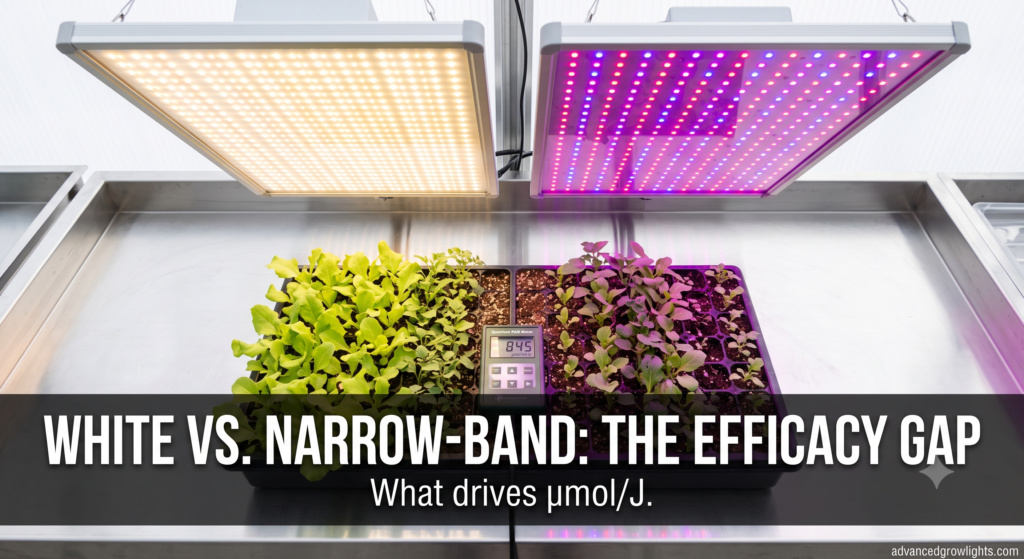
Every fixture buyer eventually stares at two spec sheets with the same PPF output and different watt draws. One fixture bathes the canopy in white light. The other glows the flat magenta of red and blue diodes with almost nothing in between. A sales rep will tell you the white one grows better plants. A forum thread will tell you the magenta one saves money. Both are half right, and DesignLights Consortium’s newest efficacy floor turned the gap between them into a line item you can’t wave away.
DLC raised the horticultural photosynthetic photon efficacy (PPE) minimum to 2.5 µmol/J under Horticultural Technical Requirements V4.0, an 8.7% jump over the V3.0 floor. Fixtures that didn’t clear it lost their Qualified Products List listing on January 5, 2026, and with it, eligibility for the utility rebates that fund a large share of commercial fixture purchases. That threshold doesn’t care whether a fixture is broad-spectrum white or narrow-band red and blue. It cares about one number. And that number is not evenly distributed across spectrum types.
The Debate Every Buyer Eventually Has
Two camps dominate cultivation forums and trade show floors in 2026. One argues for broad-spectrum white, usually a 3000K to 5000K base blended with supplemental deep red, on the grounds that it mimics daylight and reads better to the human eye running the room. The other argues for narrow-band red and blue, the classic “blurple” recipe, on the grounds that it wastes fewer electrons getting photons onto the leaf. Neither side is lying. They’re optimizing for different variables, and the DLC’s 2.5 µmol/J floor made it harder to ignore which variable your business needs most.
Where the Efficacy Gap Comes From
Paul Kusuma, P. Morgan Pattison, and Bruce Bugbee measured this directly in a 2020 Horticulture Research paper that remains the reference point for LED efficacy claims across the industry. At the individual diode level, tested at matched current density and junction temperature, the numbers separate cleanly by color.
| LED type | Photon efficacy (µmol/J) |
|---|---|
| Warm white (2700K, phosphor-converted) | 2.6 |
| Cool white (6500K, phosphor-converted) | 2.9 |
| Blue (450nm) | 3.5 |
| Red (660nm) | 4.5 |
| Far-red (730nm) | 4.7 |
Source: Kusuma, Pattison & Bugbee, “From physics to fixtures to food: current and potential LED efficacy,” Horticulture Research (2020).
The Phosphor Tax
Every white LED starts life as a blue diode. A phosphor coating absorbs a portion of that blue light and re-emits it at longer, lower-energy wavelengths to fill out the visible spectrum a human eye reads as “white.” That conversion loses energy at every step. Kusuma’s team put a number on it: blue diodes convert electricity to photons at roughly 93% of their theoretical maximum efficiency, red diodes at 81%, and phosphor-converted white at 76%. The gap isn’t a manufacturing shortfall one supplier will eventually engineer away. It’s a physical cost of making white light out of blue diodes, and it applies to every phosphor-converted fixture on the market.
What Fixtures Deliver in Practice
Diode-level numbers don’t survive contact with a real fixture. Driver losses, thermal droop, and optical coverings all take a further cut. Kusuma’s 2020 benchmarking put the best white-plus-red fixtures of that era at 2.59 to 2.78 µmol/J and the best blue-plus-red fixtures at 2.55 to 3.0 µmol/J, against theoretical ceilings of 3.4 and 4.1 µmol/J respectively. Six years of LED package improvements have closed part of that gap since. Commercial fixtures verified in AGL’s directory today, including the Gavita RS 2400e (750W V2 revision) at 3.2 µmol/J and the Fluence SPYDR 3 at 3.0 µmol/J, now sit close to or above the numbers Kusuma’s team called near-ceiling for white-plus-red architecture in 2020. Progress happened. Physics didn’t move.
Spectrum Also Changes What You Grow, Not Only What You Pay
Efficacy isn’t the whole story, and treating it as the whole story is its own mistake. Frank Westmoreland, Paul Kusuma, and Bruce Bugbee tested this directly in cannabis, publishing in PLOS ONE in 2021. They ran fixtures across a range of blue photon fractions and measured flower yield and cannabinoid concentration. Dropping blue fraction from 20% to 4% raised flower yield by 12.3%, a linear relationship of roughly 0.77% more yield per 1% less blue (p = 0.04). Cannabinoid concentration didn’t move. CBD held between 7.6% and 11.8% and THC between 0.3% and 0.5% across every treatment, with a consistent 25:1 ratio regardless of spectrum.
Growers chasing a specific spectrum recipe tend to skip the part that matters most. The same paper found that a white-plus-red fixture running 10% blue, at 2.51 µmol/J efficacy, produced 27% more flower per dollar of electricity than legacy HPS, despite yielding only 4.6% less per unit area than the lowest-blue treatment in the study. Westmoreland’s team concluded that fixture efficacy drove cost-effective production more than fine-tuning the exact blue fraction. Spectrum composition shifts yield at the margins. Efficacy determines whether that yield turns a profit.
That finding sits alongside the broader spectrum-marketing skepticism AGL has covered before in UV and Far-Red Supplemental Lighting: What the Science Actually Says vs. What Brands Want You to Believe. The pattern repeats. A spectral tweak produces a measurable, real, and usually modest effect. Marketing copy describes it as transformative.
DLC V4.0 Now Recognizes Tunable and Multi-Channel Fixtures
Hort V4.0 didn’t stop at the PPE floor. It added clarified testing language for spectrally tunable products, addressing fixtures with independently controlled channels that don’t run a single fixed spectrum. That’s a formal acknowledgment that the white-versus-narrow-band choice increasingly has a third answer: run both, at different ratios, on a schedule.
ThinkGrow’s commercial fixtures use a dual-channel architecture with separate white and far-red control, letting an operator shift the spectral ratio between vegetative and flowering stages without swapping hardware. California Lightworks builds programmable multi-channel controllers around the same idea, simulating a spectral arc across a photoperiod rather than holding one ratio for the life of the crop. The tradeoff is upfront cost and a controller to configure and maintain, against the flexibility to run an efficacy-favoring recipe in veg and a red-weighted recipe in flower without buying two different fixtures. For a single-crop, single-stage room, that flexibility is overhead. For an operation running multiple crops or a rolling harvest across zones, it starts to justify itself.
The Math: Same Photon Output, Different Bill
Take two fixtures matched at 1,700 µmol/s PPF output, a class both broad-spectrum and narrow-leaning commercial fixtures compete in today. Fixture A runs 2.6 µmol/J, typical of a broad white-plus-red design. Fixture B runs 3.0 µmol/J, typical of today’s higher-efficacy commercial fixtures. Fixture A draws 653.8W to hit that PPF target. Fixture B draws 566.7W. That’s an 87.1W gap, or 13.3% less power for identical photon delivery.
Run both 12 hours a day for 350 days a year, accounting for routine downtime, and Fixture A burns 366.2 more kilowatt-hours annually than Fixture B. At an illustrative commercial rate of $0.14/kWh, that’s roughly $51 per fixture per year. Scale that to a 20-fixture flower room and the gap runs about $1,025 a year, or roughly $7,200 across a fixture’s typical service life. That number says nothing about which fixture grows a better plant. It says everything about which fixture costs less to run at identical output, a distinction covered in more depth for the current electricity rate environment in Grow Light Efficacy Just Got More Expensive to Ignore, and for fixture longevity assumptions in Grow Light Lifespan: What LM-80 Testing Proves.
Where Real Commercial Fixtures Land
| Fixture | PPE (µmol/J) | Spectrum architecture |
|---|---|---|
| Gavita RS 2400e (750W) | 3.2 | Broad white-plus-red |
| Fluence SPYDR 3 | 3.0 | Broad white-plus-red |
| Lumatek ZEUS 600W PRO | 2.85 | Broad white-plus-red |
| DLC Hort V4.0 minimum | 2.5 | Any qualifying architecture |
Notice what’s missing from that table: a pure narrow-band blue-plus-red fixture from a major commercial brand. Most manufacturers building for the DLC-rebate commercial market have converged on broad white-plus-red, betting that clearing the 2.5 µmol/J floor with room to spare matters more to buyers than chasing the theoretical 4.1 µmol/J ceiling of a blue-plus-red design most growers find visually harsh to work under for a full shift. AGL profiles the full manufacturer landscape, including how each brand positions its spectrum architecture, in Best LED Grow Light Manufacturers in 2026.
How to Verify a Manufacturer’s PPE Claim
A spec sheet number and a DLC-tested number are not automatically the same thing. Manufacturers self-report PPE during the DLC application process, but the figure that lands on the Qualified Products List reflects a specific test protocol, IES LM-79 photometric testing at defined electrical and thermal conditions, run by an accredited lab. A marketing PDF can round up, cherry-pick a best-case sample, or quote a diode-level number instead of a fixture-level one. None of that shows up unless you check.
DesignLights Consortium publishes the Horticultural QPL as a searchable database at designlights.org, and every listed fixture carries its tested PPE, PPF, input wattage, and spectral distribution alongside the manufacturer’s model number. Before treating any spec sheet claim as fact, search the fixture by model number on the QPL directly. If it isn’t listed, the fixture either hasn’t been submitted for testing or didn’t clear the current threshold, and either case is worth a direct question to the sales rep rather than an assumption in either direction. AGL walks through the certification process itself, including what gets tested and how delisting works, in DLC Horticultural Lighting Certification Explained.
The same caution applies to spectrum diagrams. A published spectral power distribution chart shows relative intensity by wavelength, not absolute photon count, and two charts that look nearly identical on a marketing page can represent meaningfully different blue or far-red photon fractions once you convert to actual µmol/m²/s at each wavelength band. If a manufacturer won’t provide the underlying spectral data behind a chart, treat the chart as illustration rather than evidence.
A Practical Way to Decide
- Confirm the fixture clears the DLC V4.0 floor of 2.5 µmol/J before comparing anything else. Below that line, it isn’t rebate-eligible in most utility territories regardless of spectrum.
- If your electricity cost per canopy dominates the P&L, higher µmol/J beats a specific spectrum ratio almost every time, per Westmoreland’s efficacy-over-spectrum finding.
- If your market pays a premium tied to a morphology or yield trait sensitive to blue fraction, weigh that against the modest, well-documented yield shift Westmoreland measured, not a spectrum diagram in a sales deck.
- If you run more than one crop stage or crop type under one roof, price a tunable fixture’s control-system overhead against buying separate fixed-spectrum hardware for each stage.
- Check PPFD, DLI, and PPE together before comparing any two fixtures. The fundamentals are laid out in PPFD, DLI, and Efficacy Explained.
The spectrum debate will keep running on forums because it’s an interesting argument about plant biology. The efficacy floor DLC enforced isn’t an argument. It’s a number on a spec sheet, and in 2026 it’s the number that decides whether a fixture qualifies for the rebate that offsets a third or more of its purchase price. Compare verified specs across every brand in the AGL directory before you commit to either camp.
Is full-spectrum white always less efficient than narrow-band red/blue grow lights?
At the diode level, yes. Phosphor-converted white LEDs convert electricity to usable photons at roughly 76% of theoretical maximum efficiency, against 81% for red diodes and 93% for blue diodes, per Kusuma, Pattison & Bugbee (2020). At the fixture level the gap narrows because driver and thermal losses affect every architecture, and current commercial white-plus-red fixtures like the 750W Gavita RS 2400e V2 now clear 3.2 µmol/J (the earlier 800W RS 2400e ran 3.0 µmol/J).
Does spectrum composition affect cannabinoid or nutrient content?
In the one controlled study to test it directly, no. Westmoreland, Kusuma & Bugbee (2021) found blue photon fraction changed cannabis flower yield but had no statistically significant effect on THC or CBD concentration across a 4% to 20% blue range.
What’s the minimum efficacy required to qualify for DLC Horticultural V4.0 rebates?
2.5 µmol/J, an 8.7% increase over the V3.0 threshold. Products that did not meet it were delisted from the DLC Qualified Products List on January 5, 2026.
Why do phosphor-converted white LEDs lose efficacy?
A white LED starts as a blue diode. Its phosphor coating absorbs part of that blue light and re-emits it at longer wavelengths to fill out a spectrum the human eye reads as white. That conversion step, a Stokes shift, discards energy at every photon it processes.
Are tunable, multi-channel spectrum fixtures worth the added cost?
It depends on how many crop stages or crop types run under one roof. A single-crop, single-stage room gets little benefit from tunability. An operation cycling multiple crops or stages can offset the higher upfront and control-system cost with one fixture doing the job of two fixed-spectrum designs.
How much does blue photon fraction affect yield?
Westmoreland’s 2021 study measured roughly a 0.77% flower yield increase for every 1% reduction in blue photon fraction, a modest but statistically significant linear relationship (p = 0.04).
Does a higher PPE number always mean a worse-looking or lower-quality light for the room?
Not necessarily. Manufacturers have closed much of the gap since 2020 by improving diode-level efficiency inside broad white-plus-red architectures, not only by stripping spectrum down to bare red and blue.
Should a small or hobbyist grower care about efficacy the way a commercial operation does?
Less so. Electricity cost differences that add up to thousands of dollars a year across a 20-fixture commercial room are a rounding error across one or two fixtures. Spectrum quality and coverage uniformity matter more at that scale.