BLOG POST
Longer Photoperiods, Lower Intensity: What New Lettuce Research Means for CEA Lighting Design
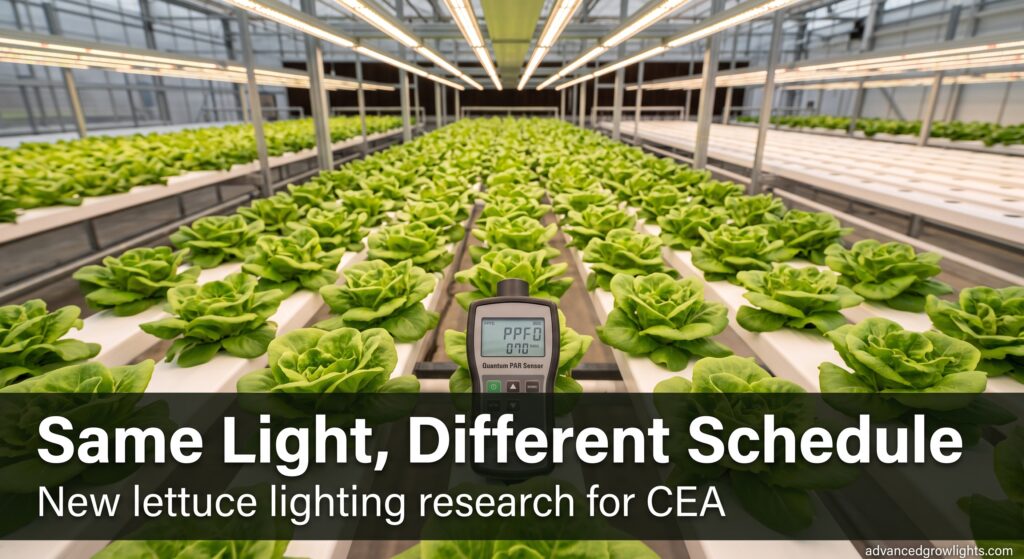
A lettuce crop under 22 hours of dim light can outgrow the same crop under 16 hours of bright light, even when both receive the same total dose of photons each day. Wageningen University published that finding in February 2026, and it challenges a design assumption most CEA lighting plans still lean on: that daily light integral is the only number worth optimizing. Schedule matters too. For growers sizing fixture counts and dimming strategies right now, the gap between “same DLI” and “same result” is worth real money.
Three peer-reviewed studies published between 2019 and 2026 give commercial lettuce growers a clearer picture of what photoperiod length does to yield, energy use, and fixture requirements when the daily light integral stays fixed. None of them agree on a single “best” schedule. They agree on one thing: photoperiod is a design variable in its own right, not a rounding error on top of DLI.
CEA capital budgets face more scrutiny than they did even two years ago, and fixture count is one of the largest line items on any lighting quote. A design lever that trades hardware for a schedule change, at no cost to yield, deserves a look before the next purchase order goes out.
The Wageningen Study: Continuous Light at Equal DLI
Diego Núñez Ocaña and a team at Wageningen University compared two lighting schedules on ‘Danstar’ and ‘Jagger’ lettuce cultivars in climate chambers, holding daily light integral fixed at 16.9 mol per square meter per day. One group grew under an 18-hour photoperiod. The other group grew under continuous light, 24 hours on, at a lower intensity scaled to hold the same daily dose. Temperature held at 23°C, relative humidity at 81%, CO2 enrichment at 815 ppm.
The continuous-light plants won on every growth metric the team tracked. Fresh mass rose 15% across both cultivars, with ‘Jagger’ gaining 23% and ‘Danstar’ a more modest 6%. Dry mass climbed 18% overall. ‘Jagger’ also intercepted 10% more cumulative light under continuous exposure. ‘Danstar’ showed no change in interception at all, a reminder that genetics set the ceiling on how much a schedule change can do.
Energy told a stranger story. Núñez Ocaña’s team found total energy use stayed about the same between the two schedules. A longer photoperiod at lower intensity should cost the same as a shorter one at high intensity if the DLI target holds constant, and the data backed that up. The power bill stayed flat. Light-use efficiency did not: dry-mass-based LUE improved 11% under continuous light, fresh-mass-based LUE improved 7%. Leaf chemistry shifted too. Sucrose dropped 15% under continuous light while starch rose 12% to 49%, depending on cultivar. Glucose and fructose held steady.
A Second Study Points the Same Direction, With a Caveat
Wen Li and a team at China Agricultural University and the Chinese Academy of Agricultural Sciences ran a related but different trial in 2025. They tested four light/dark cycles on two lettuce cultivars, ‘Frillice’ and ‘Crunchy’, at a fixed intensity of 250 µmol per square meter per second: 16 hours light and 8 dark, 12 and 6, 8 and 4, and 4 and 2.
For ‘Frillice’, 12 hours of light beat the 16-hour control. Fresh weight rose 29.4%, dry weight rose 25.8%, and growth rate rose 25%. Light energy use efficiency and electric energy use efficiency each improved 26.6%. ‘Crunchy’ told a different story: the 16-hour schedule stayed the better option for that cultivar, and the 12-hour schedule produced no measurable gain. Push either cultivar further, to 8 hours or 4 hours of light, and biomass dropped 10.1% to 34.5% against the 16-hour baseline.
Two takeaways sit inside Li’s data. A genotype-dependent sweet spot exists, and finding it takes bench testing, not a spec sheet default. The schedule that lifts ‘Frillice’ fails ‘Crunchy’, grown under the same fixtures in the same room.
Where the Research Draws a Line
Extended photoperiod and continuous light aren’t a free pass across every crop, or even across every intensity. A 2019 study from the Chinese Academy of Agricultural Sciences, led by Lingyan Zha, tested lettuce under 12 days of continuous light at three intensities: 100, 200, and 300 µmol per square meter per second. No visible leaf injury appeared at any of the three levels. But at the two higher intensities, reversible photoinhibition showed up on day six, and reactive oxygen species climbed as light level rose. Zha’s team traced the stress to excess daily light integral, not to the missing dark period itself.
That distinction carries weight for other crops on the same range. Tomato, potato, and onion show leaf chlorosis and photosynthetic damage under continuous light in ways lettuce, tested so far, doesn’t. Treat lettuce’s tolerance as crop-specific rather than a general rule for the whole house. It won’t carry over to your tomato benches without its own trial.
The Fixture Math: Same DLI, Different Peak PPFD
The payoff shows up in the numbers. Take a commercial lettuce operation targeting a daily light integral of 17 mol per square meter per day, a common commercial benchmark.
At a 16-hour photoperiod, required PPFD works out to 17,000,000 µmol divided by 57,600 seconds, about 295 µmol per square meter per second. Stretch the photoperiod to 22 hours and the same math gives about 215 µmol per square meter per second, a 27% cut in peak intensity for the exact same daily dose. That’s not a rounding error. A fixture rated to deliver 295 µmol at canopy height needs more diodes, more driver current, and more heat rejection than one rated for 215 µmol. Spread across a few thousand square feet of production, that gap shows up as fewer fixtures, a lower equipment bill, or the option to space fixtures wider and cover the same canopy with less hardware.
None of this shows up as a smaller utility bill on its own. As Núñez Ocaña’s team found, total daily energy draw stayed about the same across schedules, because the total photon count never changed. The savings live in capital cost and thermal load, not kilowatt-hours.
| Photoperiod | Required PPFD | Peak Intensity vs. 16h | Practical Implication |
|---|---|---|---|
| 16 hours (control) | ~295 µmol/m²/s | Baseline | Standard fixture sizing |
| 18 hours | ~262 µmol/m²/s | 11% lower | Modest cut in diode count |
| 22 hours | ~215 µmol/m²/s | 27% lower | Meaningful cut in fixture load |
| 24 hours (continuous) | ~197 µmol/m²/s | 33% lower | Needs cultivar-specific validation first |
DLI held at 17 mol/m²/day throughout. PPFD figures rounded to the nearest whole number.
What This Means for Fixture Selection
None of this works without real dimming control. A fixture locked to one output level can’t shift from a 16-hour high-intensity schedule to a 22-hour low-intensity one without a hardware swap. Growers running this strategy need fixtures with 0-10V, PWM, or RS-485 dimming, paired with a controller that holds a stable low output for extended stretches instead of stepping between a handful of preset levels.
This is where DLC-qualified horticultural fixtures earn their premium. Products on the DLC Horticultural Qualified Products List go through PPE and dimming-linearity testing that off-list fixtures skip, and that testing matters more, not less, when a fixture runs at 65% of rated output for 22 hours instead of full output for 16. For background on how PPE, DLI, and efficacy tie together, see AGL’s PPFD, DLI, and efficacy breakdown.
Manufacturers active in both cannabis and leafy-greens segments, Fluence and P.L. Light Systems among them, already build dimmable fixtures for this kind of schedule tuning. The spec that matters isn’t peak PPF output. It’s dimming range and stability at the low end, since a 22-hour schedule spends most of its runtime there.
Retrofit facilities face a harder call than new builds. A room already running fixed-output fixtures at a 16-hour schedule can’t test a 22-hour, lower-intensity alternative without either swapping hardware or adding a dimmer module upstream of the driver, and not every fixture accepts one. Before committing to a schedule trial, confirm the installed base can hit the lower PPFD target without flickering, driver strain, or a dead band at the bottom of the dimming curve. New builds carry no such constraint and can spec for schedule flexibility from the start.
Spectrum Was Held Constant, and That’s a Limitation
Every study cited here used a fixed spectrum: white LED combined with red diodes in the China Agricultural University trial, standard full-spectrum LED in the Wageningen chambers. None of them varied red-to-blue ratio or far-red content alongside photoperiod. AGL has covered the spectrum side of this question on its own; see UV and far-red supplemental lighting: science vs. marketing. Until a photoperiod-by-spectrum trial runs on lettuce, treat the findings here as independent of spectrum choice, not proof that spectrum doesn’t matter.
Should You Change Your Lighting Schedule Tomorrow?
Not without a trial bench first. The cultivar split between ‘Frillice’ and ‘Crunchy’ in Li’s data, and between ‘Jagger’ and ‘Danstar’ in Núñez Ocaña’s, means a schedule change that helps one variety can flatline another grown in the same room. Run a side-by-side comparison on your own cultivar before committing a whole facility to a new photoperiod. Track fresh weight, dry weight, and tipburn incidence for one full crop cycle at minimum, since related photoperiod research has linked longer exposure to higher tipburn rates even when overall biomass improved.
If the trial holds up, the fixture-sizing math above applies to your next equipment order, not to your operating schedule alone. A dimmable, DLC-qualified fixture bought today can run either the 16-hour or the 22-hour version of your crop. A fixed-output fixture bought today runs one, forever.
Frequently Asked Questions
Does extending photoperiod always increase lettuce yield?
No. China Agricultural University’s 2025 trial found a 12-hour schedule beat 16 hours for ‘Frillice’ lettuce but produced no gain at all for ‘Crunchy’, grown under the same conditions. Test your own cultivar before changing a production schedule.
Can I run continuous light (24 hours) on lettuce without hurting the crop?
Wageningen’s 2026 study found no leaf injury under continuous light at a DLI of 16.9 mol/m²/day. A 2019 CAAS study found no injury up to 300 µmol/m²/s continuous either, though reversible photoinhibition appeared at the higher intensities on day six. Lettuce tolerates continuous light better than tomato, potato, or onion, but a research trial showing no injury is not the same as a guarantee at commercial scale for every cultivar and facility.
Does a longer photoperiod at lower intensity cut my electricity cost?
Not on its own. Núñez Ocaña’s team at Wageningen found total energy use stayed about the same between an 18-hour and a 24-hour schedule at equal DLI. The gain shows up as a lower peak PPFD requirement, meaning fewer fixtures or less driver capacity, not a smaller utility bill.
How much lower can peak PPFD go if I extend the photoperiod?
At a fixed DLI of 17 mol/m²/day, stretching from a 16-hour to a 22-hour photoperiod cuts required PPFD from about 295 to about 215 µmol/m²/s, a 27% reduction. The relationship scales in proportion to photoperiod length: double the hours, halve the intensity, for the same daily dose.
What fixture features does a schedule like this require?
Real dimming, 0-10V, PWM, or RS-485, with a stable low end. A fixture that only steps between a handful of preset levels won’t hold the precise low PPFD an extended photoperiod calls for, and cheap dimmable drivers can flicker or drift at low output.
Does light spectrum change these results?
Unclear. Every study cited here held spectrum fixed while varying photoperiod. No published trial has tested photoperiod and spectrum together on lettuce, so treat these findings as independent of red-to-blue ratio or far-red content until that research exists.
Do these findings carry over to microgreens or other leafy crops?
Not without their own trial. All three studies used lettuce. Crops with documented continuous-light sensitivity, tomato, potato, and onion among them, respond differently, and a microgreen’s much shorter production cycle changes the DLI math on its own terms.
What’s the biggest risk in extending photoperiod without testing first?
Tipburn and cultivar mismatch. Related photoperiod research has linked longer light exposure to higher tipburn rates in some lettuce varieties even as overall biomass improved, and the cultivar-dependent results in the studies above mean a schedule that helps one variety can hurt another growing in the same room.
Browse DLC-qualified, dimmable fixtures built for schedule-tuned lettuce and leafy-green production in the AGL grow light directory.