BLOG POST
Postharvest LED Treatments: What the Research Says About Replacing Fungicides
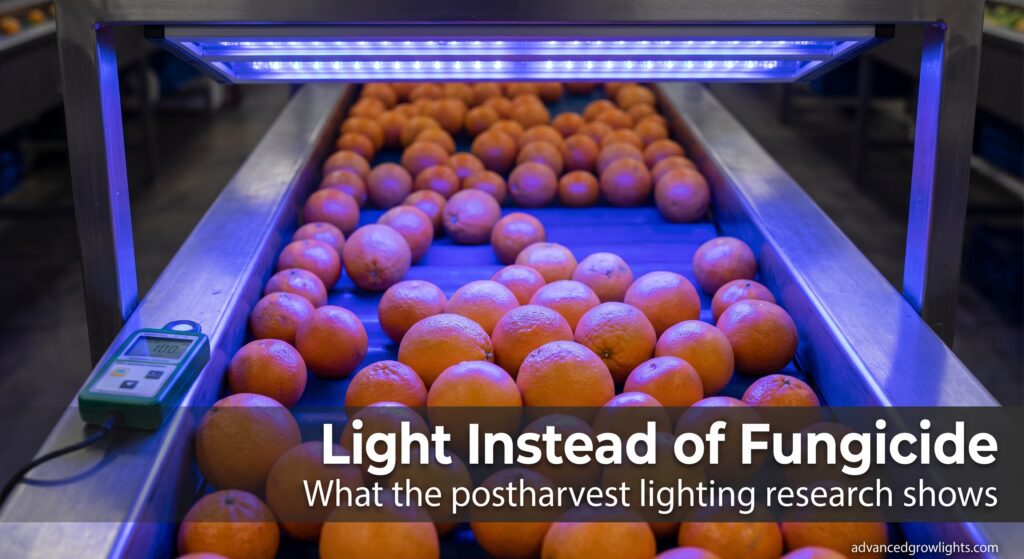
A 2025 review in the journal Foods pulled together five years of postharvest lighting studies and found blue LED light cutting citrus green mold severity by roughly two-thirds in controlled trials. A separate trial on dragon fruit cited in the same review dropped decay incidence from 86% to 15% after a two-hour blue light exposure. Neither result involves a fungicide. Both come from flipping on a light.
Growers packing fruit, herbs, and leafy greens for retail have limited room left to maneuver on fungicide use. Residue tolerances keep tightening at the buyer level, and consumers increasingly read “treated with” on a label as a mark against the product. Postharvest light treatment sidesteps that problem entirely: it uses the plant’s own biology, triggered by specific wavelengths, to fight off the same fungal pathogens a chemical spray would target. The research is young, uneven across crops, and far from settled. But the mechanism is real, published, and worth understanding before your next packing-line retrofit.
This Isn’t Germicidal UV-C
AGL covered germicidal UV-C and its use against powdery mildew in active grow rooms. That’s a different tool solving a different problem. Germicidal UV-C sits at 254 nm, well outside the range plants or fungi use for anything but damage. It works by shredding microbial DNA directly, the same principle behind UV disinfection in water treatment and hospital rooms.
Postharvest light treatment runs on visible and near-visible wavelengths: violet at 405 nm, blue between 450 and 470 nm, green around 520 to 530 nm, red at 660 nm, and UV-A near 370 nm. Plants evolved photoreceptors, cryptochromes, phototropins, and phytochromes, to read these wavelengths as information. Shine the right one on a piece of fruit after harvest, and you’re not killing the fungus directly. You’re telling the fruit’s own tissue to defend itself.
How a Photon Turns Into a Defense Response
The chain runs from photoreceptor to hormone to gene to enzyme. Blue and violet light absorbed by cryptochromes shifts hormone metabolism inside the fruit, primarily jasmonic acid and salicylic acid. A 2024 study on citrus, published in Scientia Horticulturae, traced this directly: LED blue light altered abscisic acid, salicylic acid, indole-3-acetic acid, and jasmonate levels in treated fruit, with jasmonic acid doing most of the work in triggering the protective response against fungal infection.
Those hormone shifts switch on genes. The Foods review documents upregulation of phenylalanine ammonia-lyase (PAL), peroxidases (POD), and chitinases, the same enzyme family a plant deploys when it detects a real infection. Anthocyanin-pathway genes (CHS, F3H, DFR, ANS, UFGT) and the MYB1 transcription factor activate alongside them, which is why treated fruit often comes out more pigmented as a side effect. Ripening genes (NCED1, NCED2, NOR, RIN) get suppressed in the same window, delaying senescence. One light exposure, several downstream effects, most of them favorable to shelf life.
What the Trials Show, Crop by Crop
Results vary sharply by crop, wavelength, dose, and pathogen. None of this generalizes cleanly, which is the honest caveat behind every number in the table below. Each result comes from a specific published trial, not a universal rule.
| Crop | Treatment | Reported Result | Target Pathogen / Effect |
|---|---|---|---|
| Citrus (Valencia orange, tangerine) | Blue, 450 nm, ~60 µmol·m⁻²·s⁻¹ | 67–70% reduction in rot severity | Penicillium digitatum (green mold) |
| Dragon fruit | Blue, 450 nm, low intensity, 2-hour exposure | Decay incidence dropped from 86% to 15% | General postharvest decay |
| Litchi | Violet/blue/green combination | Pathogen load cut by roughly 2 log CFU/g (~99%) | Mixed surface pathogens |
| Avocado | Red, 660 nm vs. blue | Anthracnose incidence: 25% (red) vs. 50% (blue) vs. higher in untreated controls | Colletotrichum (anthracnose) |
| Strawberry | Red, 660 nm | Reduced disease progression (AUDPC) at 36 hours post-inoculation | Botrytis cinerea (gray mold) |
| Strawberry | Blue/green combination, ~50 µmol·m⁻²·s⁻¹ | High inhibition of pathogen growth | Colletotrichum acutatum |
Two patterns hold across the table. Blue and violet wavelengths dominate the disease-suppression results. And every one of these numbers comes from a lab-scale or small commercial trial, not a validated packing-line protocol. A grower adapting this for a real facility is extrapolating, not following a settled standard.
The Quality Bonus Nobody’s Marketing Yet
Disease suppression isn’t the only effect. The same wavelength exposures that trigger defense pathways also push secondary metabolite production up. Violet light at 405 nm increased phenolics, anthocyanins, and vitamin C in strawberry trials cited in the Foods review. Blue light at 470 nm produced a roughly 30% increase in vitamin C and total phenols in citrus. Blueberries accumulated more anthocyanin, ascorbic acid, and glutathione under multiple blue and violet treatments.
Blue light carries a second effect worth noting for anyone managing cold-chain timing: it delays ripening by inhibiting ethylene biosynthesis. Combined with the antifungal effect, that’s two separate reasons shelf life extends under the right treatment, not one. A February 2026 review in AgriEngineering frames this as the core opportunity in postharvest lighting: growth-stage and postharvest-stage light strategies are converging into a single toolkit, rather than staying separate disciplines the way they’ve historically been treated.
Working Through a Treatment Dose
Postharvest light dosing uses the same PPFD-times-time math AGL covered in PPFD, DLI, and Efficacy Explained, adapted to a shorter, more intense window than a normal photoperiod.
Take the citrus protocol from the table: 450 nm blue light at 60 µmol·m⁻²·s⁻¹, held for 48 hours continuously. Multiply PPFD by exposure time in seconds, then divide by 1,000,000 to convert micromoles to moles, the same conversion used for daily light integral:
60 µmol·m⁻²·s⁻¹ × 172,800 seconds (48 hours) ÷ 1,000,000 = 10.4 mol·m⁻² total dose.
For scale, that’s close to one full day’s DLI for a leafy green crop growing under typical CEA lighting, delivered instead as a continuous 48-hour treatment at lower intensity. A packing facility running this on a rolling basis needs to budget it as its own load: fixtures, run time, and cooling, separate from any cultivation lighting already on the utility bill. It’s a small addition next to a cultivation room’s power draw, but it’s not free, and owning cultivation fixtures doesn’t cover it. The equipment, spectrum and intensity both, is different enough to require its own line item.
Why Your Grow Light Probably Isn’t a Postharvest Fixture
Nearly every fixture in AGL’s manufacturer directory is built and DLC-tested for cultivation: full-canopy PPFD, broad spectra, high total output. Postharvest treatment wants something different: narrow-band output at a single wavelength, delivered at low-to-moderate intensity across a packing line or cold room, not a canopy. A 750-watt fixture tuned for a flowering room isn’t the right tool for a produce-grading conveyor, even though both run on LEDs and both get called “grow lights” informally.
Commercial postharvest lighting is a smaller, less mature market than cultivation lighting, and AGL doesn’t yet have verified fixture specs to recommend for this specific application. Growers exploring it today are more likely to be working with horticultural research equipment or custom LED arrays than off-the-shelf commercial fixtures. That will likely change as the research matures, but it hasn’t yet.
The gap looks similar to where UV-C sat five years ago: published research ahead of commercial hardware, with early movers building custom setups until manufacturers caught up. UV-C fixtures for horticultural pest control are now a standard catalog item across multiple brands. Narrow-band postharvest fixtures aren’t there, not because the science doesn’t support them, but because the packing and cold-storage market hasn’t demanded them at volume yet.
Where the Science Runs Thin
Every number above needs an asterisk. Dose-response curves shift by cultivar within the same crop species, so a protocol validated on one citrus variety may not transfer to another. Most trials run in controlled lab chambers on small fruit batches, not on pallets moving through a real cold chain. Excess exposure carries its own risk: several of the review papers note that pushing intensity or duration too far triggers oxidative stress and hormonal disruption, undoing the benefit the treatment was meant to produce.
Reproducibility is the other open question. A protocol built around a specific cultivar, growing region, and ripeness stage at harvest may perform differently on the same species grown somewhere else. None of the reviewed trials controlled for that variable at the scale a commercial buyer would need before committing capital to new fixtures.
None of this makes the research wrong. It makes it early. Treat every percentage in this piece as evidence that the mechanism works, not as a plug-and-play spec for your facility.
Frequently Asked Questions
Is postharvest light treatment the same as UV-C sanitation?
No. UV-C at 254 nm kills pathogens directly by damaging their DNA. Postharvest light treatment uses visible and near-UV wavelengths that the plant’s own photoreceptors detect, triggering an internal defense response rather than acting as a disinfectant.
Which wavelength works best?
There’s no single answer. Blue (450–470 nm) and violet (405 nm) show the strongest disease-suppression results across the published trials, but the best wavelength depends on the crop and the target pathogen. Red light performed better than blue in the avocado anthracnose trial, for example.
Can this fully replace fungicide treatment?
Not based on current evidence. Every published trial ran as a standalone lab or small-scale test. No published study has validated light treatment as a full commercial replacement for fungicide at packing-line scale.
Does this work on cannabis or does it only apply to food crops?
Nearly all the published research covers food crops, particularly citrus, berries, and tropical fruit. Cannabis curing and drying are typically done in darkness to preserve terpenes and trichomes, so applying postharvest light treatment to cannabis would need its own dedicated research before anyone could recommend it.
How much does light treatment cost compared to fungicide application?
None of the sources reviewed here published a cost comparison. The electrical load is modest, as the worked example above shows, but fixture cost, facility retrofit, and labor haven’t been documented in the available research.
Does postharvest light treatment affect flavor or nutrition?
In several trials, yes, and positively. Vitamin C, phenolic compounds, and anthocyanins increased under blue and violet treatment in multiple crops. The reviewed studies frame these as side effects of the same defense pathway, not guaranteed outcomes across every crop or protocol.
What equipment do I need to test this on my own crop?
A narrow-band LED source at your target wavelength, a PAR meter capable of reading that wavelength accurately, and a controlled space to hold treated versus untreated batches for comparison. This is closer to a research setup than an off-the-shelf commercial install right now.
Is this the same thing as far-red or UV supplemental lighting used during cultivation?
No, though the underlying photoreceptor science overlaps. AGL’s breakdown of UV and far-red supplemental lighting covers wavelength effects during active growth. Postharvest treatment applies similar photoreceptor principles after harvest, on fruit that’s no longer photosynthesizing for yield.
Postharvest lighting won’t replace a packing line’s fungicide budget this year. But the mechanism is documented, the effect sizes in these trials are large enough to take seriously, and the equipment gap is the kind that commercial manufacturers close once demand shows up. Track new fixtures built for this application in AGL’s grow light directory as the category develops.
Is postharvest light treatment the same as UV-C sanitation?
No. UV-C at 254 nm kills pathogens directly by damaging their DNA. Postharvest light treatment uses visible and near-UV wavelengths that the plant’s own photoreceptors detect, triggering an internal defense response rather than acting as a disinfectant.
Which wavelength works best?
There’s no single answer. Blue (450–470 nm) and violet (405 nm) show the strongest disease-suppression results across the published trials, but the best wavelength depends on the crop and the target pathogen. Red light performed better than blue in the avocado anthracnose trial, for example.
Can this fully replace fungicide treatment?
Not based on current evidence. Every published trial ran as a standalone lab or small-scale test. No published study has validated light treatment as a full commercial replacement for fungicide at packing-line scale.
Does this work on cannabis or does it only apply to food crops?
Nearly all the published research covers food crops, particularly citrus, berries, and tropical fruit. Cannabis curing and drying are typically done in darkness to preserve terpenes and trichomes, so applying postharvest light treatment to cannabis would need its own dedicated research before anyone could recommend it.
How much does light treatment cost compared to fungicide application?
None of the sources reviewed here published a cost comparison. The electrical load is modest, as the worked example above shows, but fixture cost, facility retrofit, and labor haven’t been documented in the available research.
Does postharvest light treatment affect flavor or nutrition?
In several trials, yes, and positively. Vitamin C, phenolic compounds, and anthocyanins increased under blue and violet treatment in multiple crops. The reviewed studies frame these as side effects of the same defense pathway, not guaranteed outcomes across every crop or protocol.
What equipment do I need to test this on my own crop?
A narrow-band LED source at your target wavelength, a PAR meter capable of reading that wavelength accurately, and a controlled space to hold treated versus untreated batches for comparison. This is closer to a research setup than an off-the-shelf commercial install right now.
Is this the same thing as far-red or UV supplemental lighting used during cultivation?
No, though the underlying photoreceptor science overlaps. AGL’s breakdown of UV and far-red supplemental lighting covers wavelength effects during active growth. Postharvest treatment applies similar photoreceptor principles after harvest, on fruit that’s no longer photosynthesizing for yield.