
BLOG POST
Your CO2 Setpoint Decides Whether a High-Intensity Grow Light Pays Off
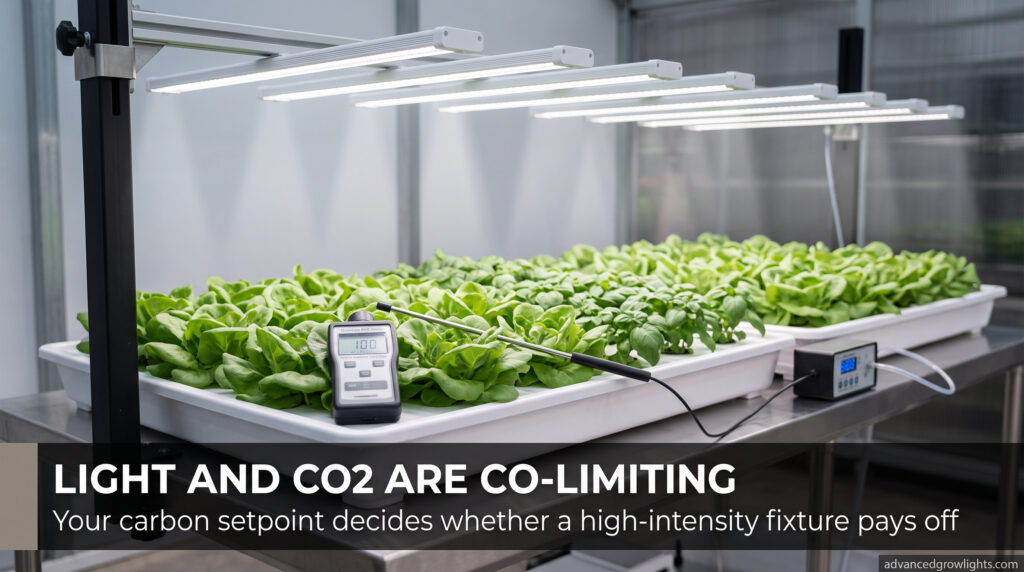
You can line up two fixtures on PPF, efficacy, and price and still make the wrong call. The number that settles whether the higher-output fixture earns its cost is not printed on either spec sheet. It is your CO2 setpoint, and behind it, your electricity rate.
Light and CO2 feed photosynthesis together. Raise one without the other and the extra input does less work than the datasheet implies. That shows up on the power bill every month, and in a capital budget that bought more PPF than the room converts at a good rate of return.
Researchers settled the physiology decades ago. What follows is how it maps onto a fixture purchase, where the effect is strong, and where a popular version of the rule breaks down. Spectrum claims get the attention, and we have sorted that science from the marketing elsewhere. Intensity is where the CO2 interaction bites.
How light and CO2 share the limit
Photosynthesis runs on two inputs that trade off against each other. Light supplies the energy. CO2 supplies the carbon that energy fixes into sugar. Starve either one and the other cannot do its share.
Plot net photosynthesis for a single leaf against light intensity and the curve rises fast at first, then bends over. Past a point, each added photon buys less carbon fixation than the one before it. That point is the light saturation point. Erik Runkle at Michigan State University lays out the mechanism in Greenhouse Product News: enriching the air with CO2 lets a leaf use light it could not use before, so the intensity at which its response curve flattens moves higher. The two inputs are multiplicative. CO2 does more at high light, and light does more at high CO2. If PPFD, DLI, and efficacy are not yet second nature, start with our primer on the three numbers that matter.
Why the curve bends
The enzyme that fixes carbon, RuBisCO, also reacts with oxygen. That side reaction, photorespiration, burns energy and releases CO2 the leaf had captured. The lower the CO2 around the leaf, the more often RuBisCO grabs oxygen instead of carbon. So a leaf at ambient CO2 loses a slice of every bright moment to photorespiration, and past its saturation point the extra light feeds that loss as much as it feeds growth. Enrichment tips the ratio back toward carboxylation, which is the biochemical reason a leaf’s usable light level rises with CO2.
The leaf is not the canopy
A single exposed leaf saturates well before a stand of plants does. Upper leaves shade lower ones, so a canopy keeps converting added light after its top leaves have flattened out. This gap between leaf-level and canopy-level response is where the popular version of the CO2 rule goes wrong, and it is the reason the two worked examples below land in different places.
Where the saturation point sits, by crop
The saturation point is not one number. It moves with species, temperature, whether you are measuring a leaf or a canopy, and the CO2 level in the room. The figures below come from controlled studies.
| Crop and scale | CO2 | Light response | Source |
|---|---|---|---|
| Cannabis, single leaf, 30°C | Ambient, ~350 ppm | Net photosynthesis peaks near 1,500 PPFD; drops by 2,000 | Chandra et al. 2008 |
| Cannabis, single leaf | ~750 ppm vs ~350 ppm | Net photosynthesis about +50% at the same light; WUE about +110% | Chandra et al. 2008 |
| Cannabis, whole canopy, indoor | Ambient, no enrichment | Dry flower yield rose in proportion to light all the way to 1,800 PPFD | Rodriguez-Morrison et al. 2021 |
| Tomato, canopy, closed greenhouse | 400 vs 1,000 ppm | +51% net photosynthesis at 1,000 ppm across 303 to 653 PPFD; a 10% light cut offset by ~100 ppm more CO2 | Dannehl et al. 2021 |
| Lettuce, whole plant | 400 to 1,600 ppm | Fresh weight best at 300 PPFD; dry weight similar at 300 and 600; authors recommend 300 PPFD with 1,200 ppm | Esmaili et al. 2020 |
Read the cannabis rows together. A single leaf tops out near 1,500 PPFD at ambient CO2, but a whole flowering canopy kept paying back light to 1,800 PPFD with no CO2 added, because the shaded leaves used what the top leaves could not. CO2 still helps the leaf, and it changes the economics, but it does not switch a wasteful fixture into a useful one the way it would for a single leaf.
Two worked examples
Greenhouse tomato: the co-limitation is clean
A winter greenhouse runs supplemental LED to fill a daily light gap. Dannehl and colleagues at Humboldt-Universität zu Berlin measured tomato canopies across 303 to 653 PPFD and 400 to 1,000 ppm CO2. Raising CO2 from 400 to 1,000 ppm lifted net photosynthesis 51% at the same light, and a 10% cut in light was covered by about 100 ppm more CO2.
So a grower short on winter light has two levers, and they substitute for each other. Run the fixtures harder, or hold CO2 higher. When electricity is the expensive input and the greenhouse already burns gas for heat, the CO2 lever often buys more growth per dollar. The fixture you size for should match the light you will run once CO2 is doing its share, not a worst-case all-light plan. Buy the smaller fixture, commit to the CO2, and the capital and the running cost both come down. Our supplemental lighting economics breakdown works through the fixture-hours math for fruiting crops.
Indoor cannabis: leaf and canopy disagree
Take a 4 ft by 4 ft flowering table, 16 square feet, about 1.5 square meters. Put an 800 W fixture rated at 3.0 µmol/J over it, in the class of the Gavita RS 2400e listed in the AGL directory. At full output that fixture puts out about 2,400 µmol/s of PPF. Spread across 1.5 square meters, the canopy sees about 1,600 PPFD.
A single cannabis leaf at ambient CO2 and 30°C reaches its photosynthetic maximum near 1,500 PPFD, so the exposed top leaves are at their leaf-level ceiling. The canopy is not the leaf. Rodriguez-Morrison, Llewellyn and Zheng at the University of Guelph grew cannabis from 120 to 1,800 PPFD with no CO2 supplementation and found dry flower yield rose in proportion to light the whole way up. The photons at 1,600 PPFD are not wasted. Lower leaves use them.
The case for holding back at ambient CO2 is about cost, not waste. Yield rose in step with light in that study, which means the energy bill and the canopy heat also rose in step, and the price per gram did not. The marginal 40% of an 800 W fixture is about 320 W. Twelve hours a day, thirty days, at 12 cents per kWh, that slice runs about $14 a month per fixture, plus the cooling it adds. Across a 40-light room that is around $550 a month buying a proportional, not a bonus, yield gain. Add CO2 to 1,000 to 1,200 ppm and the same photons produce more, which is the point at which a high-output fixture starts to look like the right buy rather than an expensive one.
The DLI angle
Daily light integral is the total photon dose the canopy gets over 24 hours, and two rooms can hit the same DLI in different ways. One runs 1,600 PPFD for 12 hours. The other runs 1,000 PPFD for close to 19 hours, which suits day-neutral crops. The second room keeps its leaves nearer their efficient range for more of the photoperiod and draws less peak power, so it often converts the same dose at lower connected load and lower demand charges. That points a grower of long-day crops toward a fixture sized for a moderate PPFD over a wide footprint rather than a high peak over a tight one.
What this means when you spec a fixture
The buying decision follows from your CO2 plan and your power rate.
Enrich to 1,000 ppm or higher and hold it there, and high-intensity fixtures earn their price. Design for 1,500 to 1,800 PPFD in cannabis flower, size the fixture to hit that at 80 to 90% drive, and keep headroom at the top. Compare candidates in our manufacturer overview.
Run ambient CO2 and the math changes, though not the way the leaf-level rule suggests. A dense canopy still uses light past 1,500 PPFD, so you are not forced down to a low number. You are choosing how much energy cost and heat to take on for a yield gain that scales in proportion rather than pulling ahead. Many ambient-CO2 cannabis rooms settle at 1,000 to 1,300 PPFD for that reason. For leafy greens and most greenhouse crops, where leaf and canopy saturation sit closer together, the ceiling is lower and firmer. In every case the efficacy figure matters more than raw output, because you will run the fixture at part power for much of its life.
Dimming is not optional
Any fixture you buy for an enriched room should dim, and the controller should track a CO2 sensor or a schedule. CO2 injection fails. Generators cut out, tanks run dry, controllers drift. When CO2 falls to ambient and the lights stay at an enriched-room setpoint, the leaves are now past their efficient range, the room is running hot, and the bill climbs for a shrinking return until someone notices. A fixture that steps down with the CO2 protects the crop and the bill.
The CO2 side of the ledger
CO2 enrichment is not free, and it does not always pay.
A generator covering about 4,800 square feet runs $1,000 to $2,500 plus install, per Oklahoma State University Extension. Burning propane or natural gas for CO2 adds heat and water vapor that the HVAC then has to pull back out. Liquid CO2 skips the heat but costs more per pound and needs a tank and a vaporizer.
Enrichment pays when light is already plentiful and the leaves are hitting a carbon limit. It pays less in a dim room, because a carbon-limited plant needs the light first. It pays less in a leaky greenhouse that cannot hold the setpoint. The response also flattens: going from 400 to 700 ppm buys far more photosynthesis than going from 900 to 1,200. Runkle puts the practical ceiling near 1,000 ppm for most crops, with the steepest gains in the first few hundred ppm above ambient.
How to find your own ceiling
You do not need a lab. Three checks get you close.
Read the photometric file. The manufacturer’s PPFD map at your mounting height tells you what the canopy sees at full and reduced output. Match that against the intensity your crop and your CO2 plan justify, then decide whether you are buying capacity you will use or capacity you will dim away.
Watch the crop and the meter together. Track yield or growth rate against the energy the room draws, week over week. When a step up in intensity stops moving yield, or moves it less than the extra kilowatt-hours cost, you have found the point where more light stops paying. On light-sensitive genetics, bleaching or bronzing on the top leaves marks the same line sooner.
Log CO2 across the photoperiod. A sealed room with no injection can fall to 250 to 350 ppm within an hour of lights-on as the canopy draws it down. If that is your room, the leaves are carbon-limited for most of the day and a brighter fixture returns even less. Sort out the CO2 first, then revisit the light. Growers running long photoperiods at modest intensity should also read our take on trading intensity for hours.
The HPS-to-LED retrofit trap
A double-ended 1,000 W HPS lamp puts about 1,800 to 2,100 µmol/s of PPF into the room when it is fresh, less as it ages. Growers replacing it reach for an LED fixture that matches or beats that photon output, on the logic that more is safer.
An 800 W LED at 3.0 µmol/J produces about 2,400 µmol/s. That is a one-to-one replacement for the HPS photon output, with a little to spare, and it cuts wall draw by about 20%. It does not lower the light reaching the canopy. If your goal is a lower bill at the same PPFD, the 800 W class does that. If your canopy was already getting more light than its economics justified under HPS at ambient CO2, matching the photon count locks that in. Stepping down to a 600 to 650 W LED class, near 1,800 to 1,950 µmol/s, is the move that brings delivered PPFD down while still covering the low end of the old HPS output.
The retrofit is the moment to decide which one you want. Measure the PPFD your HPS layout produced at the canopy, settle whether CO2 is part of the new plan, and pick the LED class from there.
Match the fixture to the room
Before you buy the highest-output fixture on the shortlist, price out the CO2 program and the power draw that would make its top band worth running. If enrichment is not in the plan and your rate is high, a lower-output fixture with strong efficacy grows a similar crop for less capital and less power. The AGL directory lists verified PPF, efficacy, and photometric data for commercial fixtures so you can match output to your CO2 strategy before you spend. Browse it at advancedgrowlights.com/directory.
Does more PPFD always mean more yield?
Up to a point, and the point is higher than most rules of thumb suggest. Leaf photosynthesis saturates first, but whole-canopy yield keeps responding because shaded leaves use the extra light. Indoor cannabis yield rose in proportion to light all the way to 1,800 PPFD in a University of Guelph study with no CO2 added. The real ceiling is set by energy cost, canopy heat, and leaf stress as much as by a hard biological limit.
What is the light saturation point at ambient CO2?
It depends on whether you mean a leaf or a canopy. A single cannabis leaf at 30 degrees C and ambient CO2 reaches its photosynthetic maximum near 1,500 PPFD (Chandra et al. 2008). A dense canopy keeps converting light well past that because lower leaves stay light-limited. Leafy greens and most greenhouse crops saturate lower, closer to 300 to 700 PPFD at the whole-plant level.
If I add CO2, how much more light can my plants use?
CO2 raises the leaf-level saturation point and lifts photosynthesis at any given intensity. Chandra et al. measured about a 50 percent gain in cannabis leaf photosynthesis going from roughly 350 to 750 ppm. Dannehl et al. found tomato net photosynthesis rose 51 percent from 400 to 1,000 ppm across a 300 to 650 PPFD range. In practice, enriched cannabis rooms design for 1,500 to 1,800 PPFD in flower and get a better return on those photons than an ambient room would.
Is CO2 enrichment worth it for a small grow?
Often not. Generators and controllers start around $1,000 to $2,500 before install, the gas adds heat your cooling then removes, and a room that leaks cannot hold the setpoint. Enrichment pays when light is already high and the leaves are hitting a carbon limit. In a dim or unsealed space, spend on light and sealing first.
My sealed room still loses CO2 after lights-on. Why?
An active canopy pulls CO2 out of sealed air fast, sometimes below 300 ppm within an hour. With no injection or fresh-air exchange, the leaves spend most of the photoperiod carbon-limited. Day-long monitoring shows the drawdown, and the fix is injection or ventilation, not a brighter fixture.
Do I still need dimmable fixtures if I run steady CO2?
Yes. CO2 systems fail, and when they do a fixture locked at an enriched setpoint drives the leaves past their efficient range for a shrinking return until someone steps in. Dimming tied to a CO2 sensor or schedule protects the crop during an outage and lets you tune intensity by growth stage.
How does temperature fit in?
Leaf temperature sets the rate of the enzyme reactions that fix carbon. Chandra’s cannabis data put the photosynthetic optimum near 25 to 30 degrees C. Colder leaves use less light and less CO2. Light, CO2, and leaf temperature all have to line up for a high-output fixture to pay off.
Does any of this apply to leafy greens and vertical farms?
Yes, and the ceiling is lower and firmer than in cannabis because leaf and canopy saturation sit closer together. Esmaili et al. found lettuce fresh weight best at 300 PPFD, with dry weight similar at 300 and 600, and recommended 300 PPFD with 1,200 ppm CO2. Vertical farms running 200 to 400 PPFD are seldom light-limited at the top of the canopy, so CO2 and airflow often return more than a lighting upgrade.