BLOG POST
ASHRAE, California, and DLC Just Converged on the Same Grow Light Efficacy Floor
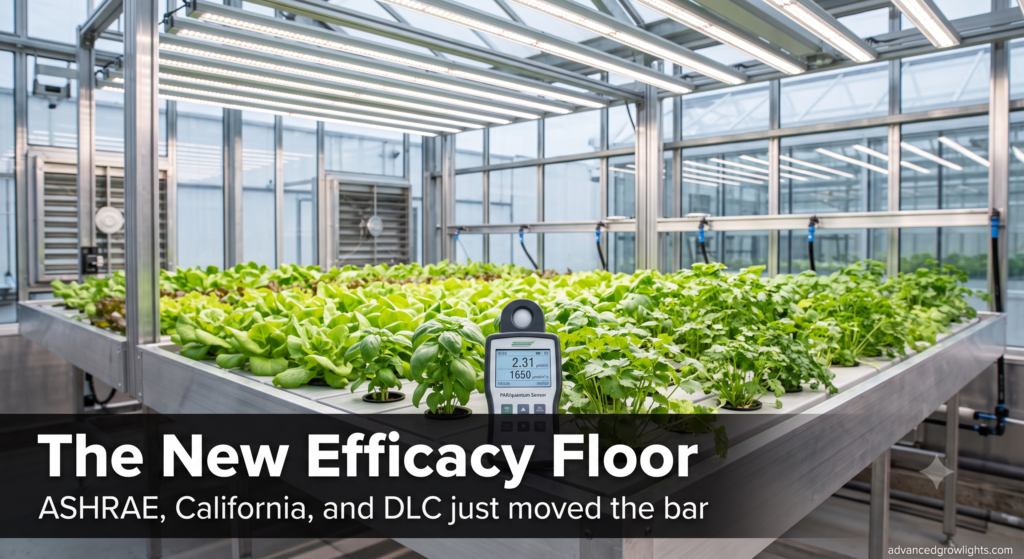
ASHRAE approved a new efficacy floor for horticultural lighting in July 2025. California’s 2025 Energy Code raised its own floor to take effect January 1, 2026. The DesignLights Consortium delisted its Version 3.0 horticultural products on January 5, 2026, replacing them with a stricter Version 4.0. Three standards bodies, three separate rulemaking processes, and all three landed within a few tenths of a µmol/J of each other inside a single twelve-month window.
That convergence isn’t a coincidence. DesignLights Consortium’s Version 4.0 work informed ASHRAE’s new luminaire definition, and California’s update tracked similar cost-effectiveness math. If you’re specifying commercial fixtures this year, the headline percentages (31%, 47%, 8.7%, depending on which body you ask) matter less than a simpler question: who this reaches, and when.
The Changes, Side by Side
Here’s how the three requirements stack up against each other, sourced from the standards documents themselves rather than manufacturer summaries.
| Standard | New PPE Floor | Applies To | Trigger | Effective |
|---|---|---|---|---|
| ASHRAE 90.1 Addendum bz | 2.5 µmol/J (integrated luminaires); 1.7–1.9 µmol/J unchanged for removable-lamp luminaires | Greenhouses and indoor grow spaces | 40 kW+ connected horticultural load | Approved July 31, 2025; folded into 90.1-2025, pending state adoption |
| California Title 24 (2025 Energy Code) | 2.3 µmol/J | Indoor controlled environment horticulture facilities | 40 kW+ connected horticultural load | January 1, 2026, for new permits |
| DLC Horticultural V4.0 | 2.5 µmol/J | Any luminaire seeking DLC Qualified Products List listing | No load threshold, applies per product | New applications since April 18, 2025; V3.0 delisted January 5, 2026 |
Read our full breakdown of Title 24’s grow light provisions for the California-specific detail. This piece focuses on the ASHRAE addition, since it’s the one most growers outside California haven’t clocked yet.
Greenhouses take the bigger jump
Notice the two percentages aren’t equal. Indoor grow spaces move from 1.9 to 2.5 µmol/J, a 31% increase. Greenhouses move from 1.7 to 2.5 µmol/J, a 47% increase, once a facility crosses the 40 kW threshold with integrated luminaires. ASHRAE’s earlier standard treated greenhouse supplemental lighting as a smaller add-on to sunlight, so it started from a lower bar. Addendum bz erases that gap and holds both space types to the same number. Greenhouse operators still running older HPS or first-generation LED supplemental fixtures have the furthest distance to close.
The Luminaire Redefinition Buried in the Fine Print
ASHRAE’s Addendum bz does more than raise a number. It redefines what gets measured. The old standard rated “light source PPE,” a bare LED or lamp figure that ignored how much of that light the fixture’s optics and housing delivered to the canopy. The new standard rates “luminaire PPE,” which accounts for the whole fixture: optical losses, thermal derating, everything between the diode and the plant.
ASHRAE built this definition on the ANSI/ASABE S640-2017 metric, the same one the American Society of Agricultural and Biological Engineers developed for horticultural lighting testing, and aligned it with DLC’s luminaire-based approach in Hort V4.0. That alignment matters more than the number itself. Under the old rule, a manufacturer could publish an efficacy figure straight from a diode’s datasheet, before accounting for how much light a cheap housing wastes as heat. Under the new definition, that gap shows up in the published spec.
For background on how PPE, PPF, and PPFD relate to each other, see our explainer on the three numbers that matter most.
Crossing the 40 kW Line
Both ASHRAE and California trigger their stricter floor at facilities running 40 kW or more of connected horticultural lighting load. Below that line, ASHRAE’s exception language keeps the older 1.7 µmol/J minimum in place.
Forty kilowatts sounds substantial until you count fixtures. Commercial LED bars in the 600 to 800 watt range are standard for flowering rooms running sole-source lighting. At 650 watts per fixture, 40 kW of connected load works out to 62 fixtures. At 800 watts per fixture, it’s 50. A single flowering room in the 3,000 to 6,000 square foot range, depending on spacing and target PPFD, can cross that threshold on its own. The exemption protects hobbyist and micro-commercial setups. It doesn’t protect a mid-size single-room cultivation facility, and that’s the kind of operation most prone to assume a national energy code change targets someone bigger.
The Floor Sits Behind the Market
ASHRAE’s own foreword to Addendum bz makes an unusual admission for a regulatory document: even at 2.5 µmol/J, the new requirement lands “near the bottom (22nd percentile) of lighting efficacies in the DesignLights Consortium’s database of horticultural LED lighting products.” Most DLC-listed fixtures on the market today already clear the new “stricter” code floor by a wide margin.
That’s by design, not oversight. ASHRAE 90.1 requirements have to pass a cost-effectiveness scalar threshold before they get adopted, meaning the standard targets a payback that works across the full population of regulated facilities, not the leading edge of what a fixture can do. A grower buying to the code minimum, rather than to what DLC’s qualified products list offers today, leaves both efficiency and rebate dollars unclaimed. Our manufacturer overview covers where current fixtures land on the efficacy curve.
Model Code Versus Enforced Code
ASHRAE 90.1 is a model code. It becomes enforceable when a state or local jurisdiction adopts it into its own building code, and that adoption runs on a separate, often slow, timeline. As of mid-2025, multiple states were still enforcing energy codes equivalent to ASHRAE 90.1-2016 or 90.1-2019, several code cycles behind. New York adopted requirements equivalent to 90.1-2022 in July 2025. Rhode Island’s updated code, based on the 2024 IECC, became effective in December 2025. Addendum bz targets 90.1-2022 and gets folded into 90.1-2025, a standard most states haven’t adopted yet.
California doesn’t wait on ASHRAE’s cycle. Title 24 runs its own rulemaking process, and its 2.3 µmol/J requirement is already in force for new permits as of this year. If you’re building or retrofitting in California, the higher bar applies now. If you’re anywhere else, check what edition of the energy code your jurisdiction enforces today before assuming Addendum bz reaches your next build.
How adoption works in practice
A state doesn’t flip a switch when ASHRAE publishes a new edition. Most states run their own legislative or agency rulemaking process to decide whether to adopt a new model code edition, hold public comment periods, and set a phase-in date for new construction versus renovations. Some states write ASHRAE 90.1 into law by reference and update it on a regular schedule. Others build their code around the International Energy Conservation Code, which tracks a similar but not identical cycle, and lag ASHRAE by a version or two. A handful of states and cities write their own energy codes from scratch and borrow provisions from both. Before you assume a new requirement applies, find out which body writes your local energy code, not just which national model it borrows from.
Checks to Run Before Your Next Fixture Order
Ask whether a published PPE figure is luminaire-level or diode-level
A spec sheet that cites only a chip or lamp efficacy number, without a fixture-level test report, isn’t giving you the figure the new codes use. Ask the manufacturer whether their published number was tested per ANSI/ASABE S640-2017 at the luminaire level, not the diode level.
Confirm current DLC QPL status yourself
V3.0 listings are being removed from the qualified products list. A fixture marketed as “DLC listed” on a product page from a year ago may no longer carry a current listing. Check the QPL search tool at designlights.org rather than trusting the marketing copy.
Rebate eligibility runs through DLC, not ASHRAE or Title 24
Most utility rebate programs anchor eligibility to DLC’s Horticultural QPL, not to the ASHRAE or Title 24 thresholds themselves. Clearing the code minimum doesn’t guarantee rebate eligibility if the specific product isn’t on the current list.
Under 40 kW doesn’t mean under scrutiny
The exemption removes the stricter code requirement. It doesn’t change the underlying economics. A fixture running near the old 1.7 µmol/J floor still costs more to operate over its lifetime than one running near 3.0 µmol/J, exemption or not.
Browse the AGL directory for verified specs across current commercial fixtures.
Luminaire PPE vs. PPF: what’s the difference?
Luminaire PPE measures photosynthetic photon flux emitted by the entire fixture, per ANSI/ASABE S640-2017, divided by electrical input power. PPF alone measures total photon output without accounting for power draw. A fixture can post a high PPF number and still lose on efficacy if it needs more electrical power than a competing product to hit the same output.
Does ASHRAE 90.1 Addendum bz apply to my facility right now?
Depends on where you build. California’s own 2.3 µmol/J Title 24 requirement is in force for new permits as of 2026. Outside California, Addendum bz becomes enforceable after your state or local jurisdiction adopts the 90.1-2025 edition into its own building code, and most jurisdictions haven’t reached that point yet.
ASHRAE versus California’s Title 24: how the numbers compare
Title 24 sets a lower floor, 2.3 µmol/J versus ASHRAE’s 2.5, but reaches indoor facilities today because California runs its own rulemaking process independent of ASHRAE’s model code cycle. ASHRAE’s number is higher on paper, but enforcement waits on individual states to adopt the 90.1-2025 edition, a process that can take years.
Do I need a DLC-listed fixture to comply with ASHRAE 90.1?
Not by default. ASHRAE 90.1 and Title 24 set efficacy floors a fixture has to clear on paper, checked against a spec sheet or test report during plan review. DLC listing is a separate, voluntary program tied to utility rebate eligibility. A fixture can meet the code minimum without DLC listing, though most commercial-grade fixtures pursue it anyway to unlock rebates.
V3.0-listed fixtures: what happens to their DLC status?
V3.0 listings stayed active through October 31, 2025, and came off the Horticultural Qualified Products List on January 5, 2026. A fixture that carries just a V3.0 listing no longer qualifies for rebate programs that require current DLC status, even if the fixture itself hasn’t changed.
Does the 2.5 µmol/J requirement apply to fixtures with replaceable lamps?
No. The 2.5 µmol/J floor applies to integrated, nonserviceable luminaires. Fixtures built around removable or serviceable lamps stay at the older 1.7 µmol/J (greenhouse) or 1.9 µmol/J (indoor) minimum under both the ASHRAE and prior California requirements.
My facility runs less than 40 kW of horticultural lighting. Am I exempt?
From this specific code tier, yes. Facilities under 40 kW of connected horticultural lighting load fall under ASHRAE’s exception language and keep the older, lower PPE floor. The exemption doesn’t change the economics of running a less efficient fixture. It removes the code requirement to upgrade, not the cost of skipping the upgrade.
Your state’s current energy code edition: where to check
Start with your state energy office or building code authority; most publish which edition of the IECC or ASHRAE 90.1 is in force where you build. The Building Codes Assistance Project and the Northeast Energy Efficiency Partnerships both track state-by-state adoption status and update it as jurisdictions move to newer editions.