
BLOG POST
Forecast-Driven Grow Lighting: How Growers Are Beating Electricity Price Spikes
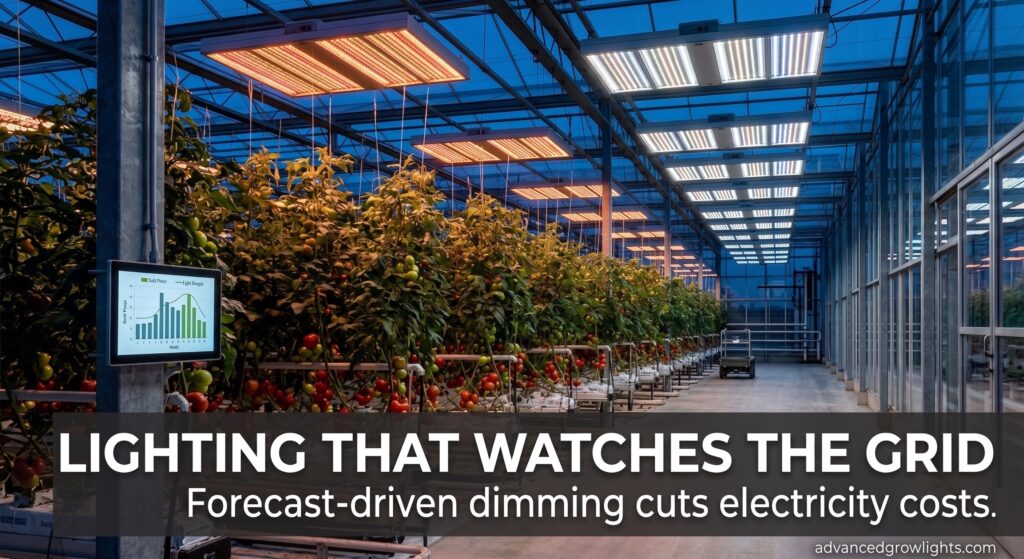
AI data centers are pulling power off the same grids that feed commercial greenhouses, and the resulting price swings are turning lighting from a fixed cost into a live variable. Growers who dim fixtures against tomorrow’s electricity forecast are already banking savings that show up on a utility bill, not a spec sheet. Here’s how the mechanism works, what it can and can’t do for yield, and what it takes to run in your own facility.
The Shift From Fixed Schedules to Price-Responsive Control
For a decade, greenhouse lighting ran on a clock. Turn on at sunset, hold a target PPFD through the dark hours, turn off at sunrise. Abhay Thosar, Chief Horticulture Specialist at Sollum Technologies, watched that model hold for most of his career as a grower before he moved into software. “Ten years ago, growers were not really looking at weather forecasts or electricity pricing when making lighting decisions,” he told HortiDaily in July. “Today they have access to weather forecasts, energy pricing and predictive models.”
Sollum is launching a new energy management module at Cultivate’26 in Columbus that folds day-ahead electricity pricing directly into the lighting schedule. The software adjusts output hour by hour against tomorrow’s forecast power costs, while a grower-set floor keeps light delivery inside agronomic bounds. Thalie St-Jacques, the company’s Software Development Team Lead, put the design goal plainly: “The best products are going to be the most accessible. It doesn’t have to be complicated for growers; it has to be complicated for us as the developers.”
The PPFD Floor That Protects Yield While Cutting Cost
The mechanism is simple to describe and harder to tune well. Growers set a minimum PPFD floor for each crop stage, and fixtures never dim below it regardless of price. Above that floor, the software trims output during the priciest hours of the day and shifts light delivery toward the cheapest ones, all while tracking toward the same daily light integral. St-Jacques described the added visibility this gives growers: they can preview tomorrow’s power consumption, sunlight, and greenhouse light integral a full day ahead, then adjust strategy before a price spike hits rather than after.
Our breakdown of PPFD, DLI, and efficacy covers the floor concept in more depth. The daily light integral is the number this whole strategy exists to protect.
Light Use Efficiency vs. Energy Use Efficiency
Thosar frames the tradeoff around two separate metrics. Light use efficiency measures how well a crop converts photons into yield, the number growers have optimized for since HPS gave way to LED. Energy use efficiency asks a different question: does the marginal photon delivered during a price spike still pay for itself? “Growers can compare both metrics and decide whether the expected crop response justifies the electricity cost,” he said. During periods of high electricity prices, holding maximum supplemental output may no longer clear that bar, even when the crop would technically respond to more light.
The Numbers: What Growers Are Saving
Sollum’s module launched this summer, so independent field results aren’t out yet. A separate deployment already has a year of data behind it. M. Nordström AB, a Finnish tomato and cucumber grower, has run Priva ECO for more than a year to shift supplemental lighting toward the cheapest hours on the day-ahead market. The result: energy cost savings of 8 to 15 percent depending on the season, and roughly 25 percent better energy efficiency compared with the grower’s prior fixed-schedule approach.
The mechanism at M. Nordström mirrors Sollum’s: software optimizes lighting timing within limits the grower sets, so the crop still receives its required light total. Two vendors, two greenhouses, the same core idea, and savings that land in a similar range. That consistency is what separates this from a single company’s pitch.
Take a one-acre greenhouse, about 4,047 square meters, running 150 W of supplemental lighting per square meter for 14 hours a night, a realistic density for a mid-size tomato operation. That works out to roughly 607 kW of total draw, or about 8,500 kWh a night. At a flat $0.12/kWh, that’s close to $1,020 a night in lighting electricity, or about $30,600 across a 30-night month. Apply the low end of the Nordstrom savings range, 8 percent, and the same month costs about $28,150, a difference of roughly $2,450. At the high end of 15 percent, the month drops to about $26,000, saving close to $4,600. Neither figure includes hardware or software cost, and results depend on how volatile the local rate structure is, but the range gives a grower a starting point before evaluating a vendor.
Electricity Prices Are Getting Harder to Predict
None of this matters if power prices hold steady. They aren’t. Commercial electricity demand in the US is on pace to outgrow residential demand for the first time on record, and AI-workload data centers are driving most of that growth. Industry trackers project US data center power demand climbing from 31 gigawatts in 2025 to 41 gigawatts in 2026 and 66 gigawatts by 2027. Goldman Sachs projects the AI buildout alone adds 6 percent to electricity costs between 2026 and 2027, with another 3 percent by 2028.
A grower on a flat-rate contract feels none of this day to day. A grower exposed to wholesale or time-of-use pricing feels every megawatt the data centers pull. That second group is who price-responsive lighting is built for, and their ranks are growing as utilities push more commercial accounts toward variable rates. For the mechanics of how efficacy factors into that math, see our piece on grow light efficacy and 2026 electricity costs.
Four-Channel Fixtures Make the Spectral Math Work
Price response gets more interesting once a fixture can shift spectrum, not only intensity. Blue light drives specific morphological responses at a fraction of a fixture’s total power draw, while red light converts to photosynthesis more efficiently than most other wavelengths used in horticulture. A four-channel fixture can lean on the cheaper-to-produce wavelength during a price spike and restore full spectrum once prices ease, something a fixed white-light fixture can’t do.
P.L. Light Systems, one of the manufacturers listed in our directory, sells the ParFX Ultra Max, the top tier of its ParFX Ultra line, in 2-, 3-, and 4-channel configurations built around this kind of recipe switching, rated above 5,000 µmol/s at its highest output setting. The fixture pairs with P.L.’s MeshIQ wireless control system, which talks to existing climate control computers over the Horti Lighting Protocol without a proprietary gateway or a subscription fee.
Thosar sees the barrier as perception more than economics at this point. “There is still a mindset around high-pressure sodium systems, and some growers believe four-channel dynamic lighting is prohibitively expensive,” he said. “In reality, fixture costs have become much more comparable.” Our manufacturer overview has current specs on the major commercial brands if you’re comparing options.
| Dimension | Fixed-Schedule Lighting | Price-Responsive Dynamic Lighting |
|---|---|---|
| Trigger for changes | Clock and photoperiod only | Day-ahead price forecast plus PPFD floor |
| Cost basis | Same rate every hour | Shifts consumption toward cheapest hours |
| Hardware needed | Any dimmable fixture | Dimmable fixture plus control software or platform |
| Documented savings | Baseline | 8-15% (Priva ECO, M. Nordström AB, 1-year field data) |
| Spectrum flexibility | Fixed unless multi-channel | Pairs well with 4-channel spectrum shifting |
| Utility program overlap | N/A | Compatible with separate demand response enrollment |
Price Response Is Not the Same as a Utility Demand Response Program
The two get confused because both respond to grid conditions, but they run on opposite mechanics. A utility demand response program pays a facility to curtail load during a small number of called events each year, often with a day-ahead or two-hour notice. The Los Angeles Department of Water and Power, for example, pays $10 per kW for day-ahead notice and $15 per kW for two-hour notice during its DR season. The facility gets a check, and in exchange it agrees to cut load exactly when the utility calls, whether or not that suits the crop.
Price-responsive lighting software runs every day, not a handful of times a year, and the grower keeps full control. It reads the day-ahead price curve and dims proactively toward the floor when prices are high, without ceding a curtailment decision to a third party. The two approaches aren’t exclusive. A facility can run price-responsive dimming as its daily default and still enroll flexible circuits in a formal DR program for the handful of peak events that pay well enough to justify a deeper cut.
DLC Controls Rebates Are Starting to Catch Up
DesignLights Consortium finalized Networked Lighting Controls V5.2 this year, extending NLC eligibility to horticultural control systems for the first time. That is a separate list from the Horticultural QPL that has covered horticultural fixtures since 2022, which already required baseline control compatibility; NLC is the distinct program utilities use to rebate networked control systems specifically, and horticultural platforms were excluded from it until this year. Utility rebate programs that already pay for networked controls in retail and office buildings can now apply the same incentive structure to a greenhouse control platform, provided the system and fixtures clear the listing bar. We covered the listing mechanics in our NLC v5.2 breakdown. The short version: a price-responsive control layer bought this year has a better shot at rebate eligibility than one bought two years ago.
Starting Without Betting the Whole Facility
Thosar’s advice to skeptical growers skips the pilot-program jargon. “Unless you try something in your own greenhouse, you won’t believe it,” he said. “You don’t have to convert an entire facility. Start with a smaller installation, build confidence, and then expand based on your own results.” A single zone on a four-channel fixture with a conservative PPFD floor gives a grower a full season of real cost data before committing capital across the whole range.
Two variables are worth locking down before that pilot: the utility’s actual rate structure (flat, time-of-use, or wholesale pass-through) and the PPFD floor the crop can tolerate at its most sensitive growth stage. Everything else in a vendor’s pitch is downstream of those two numbers.
Price-responsive control won’t fix a facility on a bad electricity contract, and it won’t replace a properly sized fixture count. It takes the daily light integral a grower already committed to and delivers it during the cheapest hours available, which is money left on the table for any operation exposed to variable rates. Browse verified specs on four-channel and standard fixtures in the AGL directory before scoping a pilot zone.
What is forecast-driven or price-responsive grow lighting?
It is control software that reads day-ahead or real-time electricity price data and adjusts supplemental lighting output against that forecast, while a grower-set minimum PPFD floor keeps light delivery inside agronomic limits.
Will dimming for cost savings hurt my yield?
Not if the PPFD floor is set correctly. The software only dims the light above that floor, and the crop still receives its target daily light integral because delivery shifts toward cheaper hours rather than getting cut.
Do I need a four-channel fixture to use price-responsive control?
No. Single-channel dimmable fixtures can run price-responsive intensity control today. A four-channel fixture adds the option to shift spectrum toward cheaper-to-produce wavelengths during a price spike, which is an extra lever rather than a requirement.
How much can a commercial grower actually save?
The one field-tested case study available, Finnish grower M. Nordstrom AB running Priva ECO for over a year, documents 8 to 15 percent energy cost savings depending on the season, and roughly 25 percent better energy efficiency versus its prior fixed-schedule approach. The comparable Sollum module launched in mid-2026, so independent results for that platform are not out yet.
Is this the same as a utility demand response program?
No. A utility DR program pays a facility to curtail load during a handful of called events a year, on a schedule the utility sets. Price-responsive lighting software runs every day against day-ahead price data and a PPFD floor the grower sets, and the two approaches can run alongside each other.
What electricity rate structure does this require?
The savings only materialize when a facility is exposed to time-of-use or wholesale, day-ahead pricing. A flat-rate contract that charges the same price every hour gives the software nothing to optimize against.
Does price-responsive control qualify for DLC rebates?
DesignLights Consortium finalized Networked Lighting Controls V5.2 in 2026, extending NLC eligibility to horticultural control systems for the first time. Eligibility depends on the specific system and fixtures clearing the listing requirements, so check the current DLC Horticultural and NLC Qualified Products Lists before assuming a rebate applies.
What is the difference between light use efficiency and energy use efficiency?
Light use efficiency measures how well a crop converts delivered photons into yield. Energy use efficiency asks whether the marginal photon delivered during an expensive pricing hour still pays for itself in crop response, a comparison that becomes relevant only once electricity cost varies hour to hour.